Proteinuria in Dogs: What Protein in Urine Means
Proteinuria in dogs means protein is showing up in the urine — and one positive test is not a diagnosis. Vets confirm it with repeat tests about two weeks apart and quantify it with a urine protein-to-creatinine (UPC) ratio, where dogs above 0.5 are classified as proteinuric (IRIS, 2026). Here's what causes protein to show up, from temporary factors to kidney disease, and what your vet checks next.
Proteinuria in dogs means protein is showing up in the urine — common on routine urinalysis, not a diagnosis by itself. Veterinary references define persistent proteinuria as positive results on about three occasions at least two weeks apart (IRIS, 2026; VCA), and vets quantify it with a urine protein-to-creatinine (UPC) ratio: a dog above 0.5 is classified as proteinuric (IRIS, 2026). Causes range from temporary to serious — and bleeding or inflammation in the urinary tract is a more common cause than kidney disease (VCA). What your dog's result means is your vet's call.

Protein in the urine is a question to investigate — not a diagnosis on its own.
Proteinuria in dogs: what protein in the urine means
Proteinuria is the medical term for protein in the urine; in dogs it works as a flag, not a verdict. The kidneys normally hold back large molecules like albumin; when protein shows up in a sample, the questions are where it came from and whether it stays (VCA; Merck, updated 2026).
Most vets spot it on routine screening, not because of symptoms — for older dogs, often part of a senior dog blood panel. The dipstick pad detects primarily albumin (Merck, 2026); a lab can measure protein more precisely, and your vet decides whether to recheck, quantify, or investigate.
Why one positive urine protein test isn't a diagnosis
A single positive reading isn't enough to act on: vets confirm persistence, then rule out harmless explanations.
- Persistence: positive results on about three occasions at least two weeks apart (IRIS, 2026; VCA); for substaging, IRIS calls for urine samples over at least two weeks.
- Temporary causes: stress, exercise, fever, excitement, and congestive heart failure can cause mild "functional" proteinuria (eClinPath); Merck adds seizures and extreme temperatures. A 20-minute treadmill session didn't affect albuminuria in one study (IRIS).
- Dipstick limits: the pad "only provides a subjective and not always accurate measurement of the degree of proteinuria" (eClinPath); alkaline urine and detergents such as chlorhexidine can cause false positives (eClinPath; IRIS). Home strips share these limits — see our at-home strips guide.
- Collection: cystocentesis (a bladder sample) is the cleanest method (eClinPath); free catches can carry bacteria and cells from the urinary or genital tract. Mild microscopic blood from cystocentesis rarely matters; visible blood can (eClinPath).
UPC: how vets quantify protein in dog urine
The urine protein-to-creatinine ratio (UPC) turns "some protein" into a trendable number: urine protein divided by urine creatinine, correcting for sample concentration (Merck, 2026; eClinPath). In dogs (IRIS, 2026):
- Below 0.2 — normal
- 0.2–0.5 — borderline proteinuric
- Above 0.5 — proteinuric
- Above 2 — strongly suggestive of glomerular disease; Merck calls it suggestive, not definitive (Merck, 2025)
Read with context: blood, white cells, and bacteria can push a UPC up, so vets read it with the urine sediment and often retest after treatment (eClinPath). New to lab reports? Our guide to dog blood test results covers the rest.
A UPC is priced by the hospital, not nationally — as of October 2026 we couldn't verify a generalizable U.S. price; ask for an itemized estimate.
What's leaking, and why: the four main categories
Vets sort canine proteinuria by where the protein enters the urine — before the kidney, inside it, or after (eClinPath; Merck):
- Pre-renal (overload): small proteins flood past healthy filters — hemoglobin (red cells destroyed in blood vessels), myoglobin (severe muscle injury), or Bence-Jones proteins (e.g., multiple myeloma) (eClinPath; IRIS).
- Glomerular: leaky filtering units; the most common glomerular diseases in dogs are immune complex glomerulonephritis, glomerulosclerosis, and amyloidosis — proteinuria, sometimes severe, is their hallmark (Merck, 2025).
- Tubular: damaged tubules reabsorb less filtered protein; usually milder (eClinPath).
- Post-renal: inflammation, infection, or bleeding in the urinary or reproductive tract adds protein after urine forms (eClinPath; Merck).
Protein in the urine and the IRIS kidney stages
In dogs with chronic kidney disease (CKD), proteinuria is part of the IRIS staging system. IRIS stages CKD 1–4 using blood creatinine and SDMA, measured at least twice in a hydrated, stable dog, then substages by blood pressure and urine protein (IRIS, 2026).
- Substaging takes patience: at least two urine samples over at least two weeks (IRIS, 2026).
- The magnitude counts: higher proteinuria is linked to faster progression; in one dog study, adverse-outcome risk rose roughly 1.5 times per 1-unit UP/C increase (IRIS, 2026).
The numbers behind the stage are decoded in our kidney values guide; the stages are explained in our cat kidney disease guide (same framework for dogs and cats).
What vets check next
Once proteinuria looks persistent, the workup finds the source and checks the body's response (Merck; VCA; IRIS). Your vet may:
- Repeat the urinalysis and UPC on an inactive sediment — one without inflammation or bleeding signs; our urinalysis guide shows what's read under the microscope.
- Run a urine culture and infection tests — urinary and systemic infections, including Lyme disease, can cause proteinuria (VCA).
- Measure blood pressure — hypertension is a common complication and part of IRIS substaging (Merck; IRIS).
- Check bloodwork, including albumin — severe protein loss can lower albumin; blood tests assess kidney function (Merck; VCA).
- Consider imaging — and in severe cases a biopsy — biopsy is considered for severe or progressive cases (VCA; Merck).
Which tests your dog needs, and in what order, is your vet's decision.
Symptoms & when to worry
Most dogs with early proteinuria feel completely normal — it's usually found on routine testing (Merck). Signs that appear usually reflect the underlying cause:
- Drinking and urinating more than usual (Merck)
- Lethargy, appetite loss, or weight loss — vague signs shared by many conditions (Merck)
- Blood in urine, straining, or accidents — often urinary inflammation or infection, a frequent cause of proteinuria (VCA; eClinPath)
- Swelling or fluid buildup — possible with severe, long-standing protein loss (Merck)
Book an exam if these signs persist — especially if a test already flagged protein. Sudden trouble breathing, collapse, or a rapidly swelling abdomen needs an emergency call. Only your vet can sort out what's going on.
Protein in dog urine: quick reference
Five things worth remembering:
- One positive test isn't a diagnosis — vets confirm persistence first: about three positives, two weeks apart (IRIS, 2026; VCA).
- In dogs, a UPC above 0.5 is classified as proteinuric; 0.2–0.5 is borderline (IRIS, 2026).
- The dipstick is a flag, not a measurement — collection, inflammation, and alkaline urine can skew it (eClinPath; IRIS).
- Causes range widely: leaky kidney filters, tubular damage, urinary-tract infection or bleeding — plus temporary factors (Merck; eClinPath).
- Next steps often include: a repeat urinalysis, UPC, urine culture, blood pressure, and bloodwork (Merck; VCA).
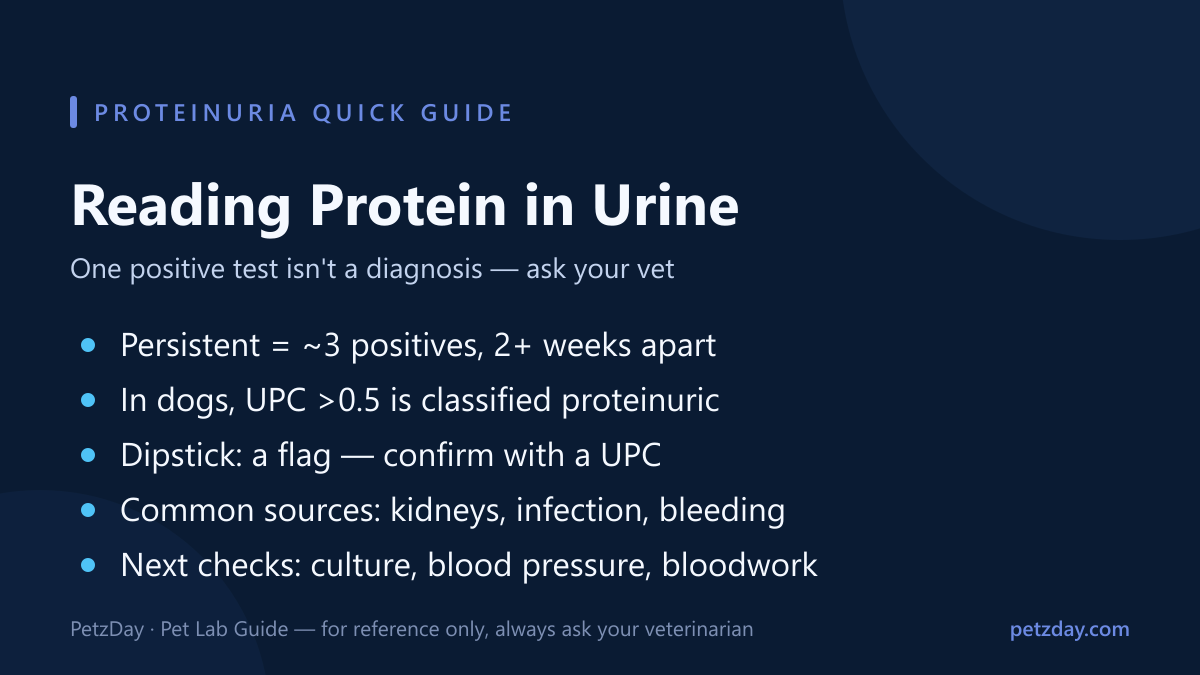
Protein in urine, on one card — confirm the details with your vet.
Proteinuria is often a long game: rechecks, UPCs to compare, observations only you record. PetzDay keeps results, dates, and notes in one shareable timeline — your side of the story, not a replacement for clinic records. Create a free PetzDay account or browse the full library.
FAQ
Does protein in dog urine always mean kidney disease?
No — bleeding or inflammation in the urinary system is a far more common cause than serious kidney disease (VCA), and temporary factors like fever or strenuous exercise can cause mild, short-lived proteinuria (Merck; eClinPath). When protein persists without inflammation or bleeding, kidney disease becomes more likely; your vet confirms with repeat tests and a UPC.
What does a high UPC mean in dogs?
In dogs, a UPC below 0.2 is normal, 0.2–0.5 is borderline proteinuric, and above 0.5 is proteinuric (IRIS, 2026). Above 2 is strongly suggestive of glomerular disease — damage to the kidney's filtering units (IRIS; Merck, 2025). Vets read it with the sediment, blood pressure, and bloodwork.
Should I worry about a trace of protein in my dog's urine?
Not automatically. Mild proteinuria in concentrated urine may not be a cause for concern, but protein in dilute urine should be investigated — it may signal developing kidney disease (VCA). The dipstick can't measure protein precisely, so vets confirm with a UPC and often a repeat sample.
References
- eClinPath (Cornell University) — Urinalysis: Chemical constituents — dipstick, categories, UPC
- eClinPath (Cornell University) — Urinalysis: Sample collection — sampling & contamination
- IRIS — Proteinuria — persistence & UPC thresholds
- IRIS — Staging of CKD — substaging & UPC table
- IRIS — Staging of CKD Guidelines (2026), PDF
- Merck Veterinary Manual — Urinalysis — pre-renal causes; protein pad (updated Aug 2026)
- Merck Veterinary Manual — Glomerular Disease in Dogs and Cats — hallmark signs; UPC >2 (reviewed Mar 2025)
- VCA Animal Hospitals — Urine Protein — causes; persistence
- VCA Animal Hospitals — Urinalysis — dilute urine; UPC follow-up
All web sources accessed October 2026.
Last reviewed: October 10, 2026. This article is for general education and does not replace an examination by your veterinarian. Follow your vet's guidance for all testing and treatment decisions.