Cat Kidney Disease: Early Signs, Stages & What to Track at Home
Cat kidney disease is common in senior cats, and early signs — more drinking, more urination, slow weight loss — are easy to miss. Here's what the IRIS stages mean and what's worth tracking at home.
Cat kidney disease — chronic kidney disease (CKD) — is one of the most common conditions in older cats: roughly a third of cats over age 10 and about 80% of cats over 15 are affected (Cornell Feline Health Center; VCA, updated 2026). Early signs are easy to miss — most cats just drink more, urinate more, and lose a little weight while still acting normal (Merck Veterinary Manual; Cornell). CKD is progressive, but found early it can be staged and managed to slow progression and protect quality of life (Cornell).
Cats hide kidney disease well — the earliest clues are usually in thirst, litter box habits, and weight.
Early signs of kidney disease in cats
Cat kidney disease early signs start with changes you can measure: extra drinking, extra urination, and gradual weight loss — often while your cat still acts completely fine (Merck; VCA, 2026). Cats hide illness well, and CKD is a prime example: early stages usually cause no obvious signs at all (Cornell). That is why habit-watching beats symptom-waiting — early kidney disease in cats is quiet by nature.
In plain terms, damaged kidneys can't concentrate urine well, so cats urinate more and drink more to compensate — and creatinine, the main waste product vets track, typically doesn't rise until roughly 75% of kidney function is lost (Cornell; Merck).
Early signs quick-check list — what you might notice, what it can mean:
- Drinking more than usual — bowls refill more often or the fountain runs dry; thirst is a direct response to reduced urine concentration (Cornell; VCA).
- Bigger or more litter clumps — increased urine volume is often the first measurable change, and can appear while your cat shows no other signs (Merck; VCA).
- Gradual weight loss, even with a normal appetite — often dismissed as "just aging" (VCA; Cornell).
- Variable or reduced appetite — skipping meals or getting picky; often subtle at first (VCA).
- Dull coat, less grooming, hiding more — subtle habit shifts are how many cats signal something is off (VCA; Cornell).
- Vomiting, bad breath, mouth ulcers, or a bony, weak appearance — more advanced signs; contact your vet promptly (VCA).
When to worry. If your cat goes 24 hours or more without eating, vomits repeatedly, or seems clearly weak or withdrawn, contact your vet right away. And if extra thirst, extra urine, and weight loss occur together, book a checkup before it becomes a crisis (Merck; Cornell).
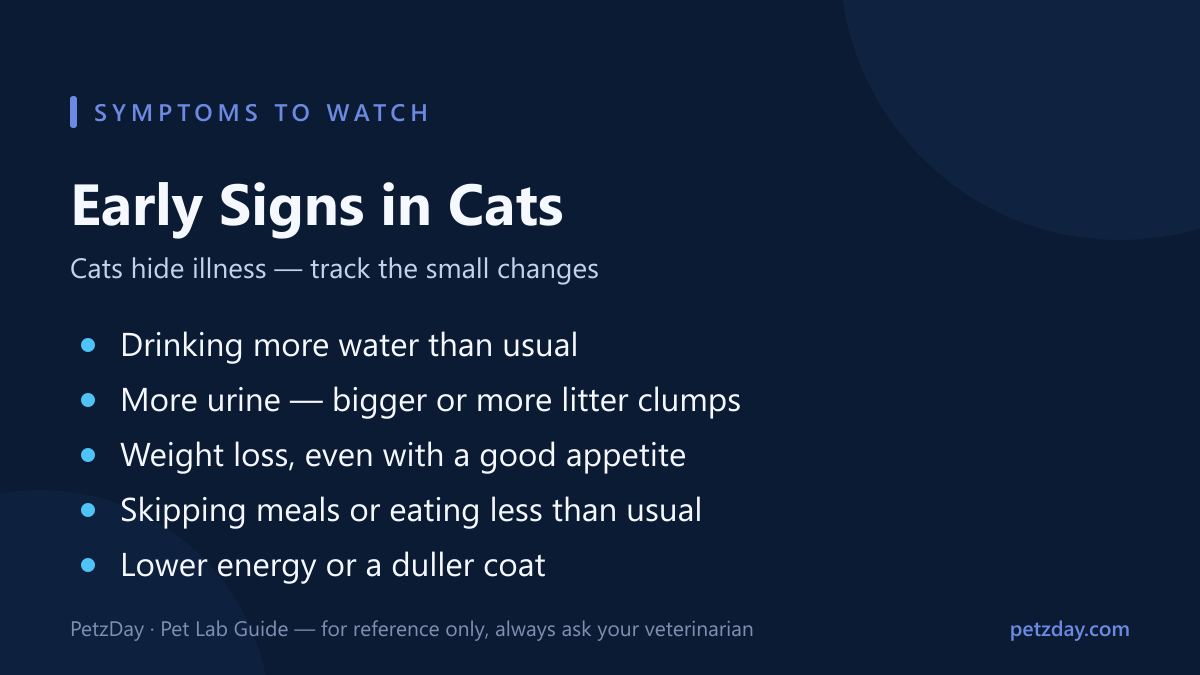
Keep this checklist handy — the pattern over weeks tells your vet more than a single day.
The IRIS stages of chronic kidney disease in cats, explained simply
Vets stage chronic kidney disease in cats from 1 to 4 with the IRIS system (International Renal Interest Society), combining blood and urine results with your cat's exam (IRIS, 2026; Cornell). Stage 2 kidney disease in cats — mild CKD — is the stage most owners first hear about, because stage 1 usually causes no signs (Cornell).
Staging isn't one-time: IRIS guidelines call for fasting creatinine and SDMA measured at least twice in a hydrated, stable patient, then substages for blood pressure and urine protein (IRIS, 2026).
The four stages, in plain English:
- Stage 1 — damage underway, values still normal. Changes are detectable by specific tests (dilute urine, abnormal imaging, a rising SDMA), but waste products aren't elevated and there are usually no signs (IRIS, 2026; Merck).
- Stage 2 — mild kidney disease. Waste products build up mildly; most cats still show no signs, though some start urinating more (IRIS, 2026; Merck).
- Stage 3 — moderate. Filtering slows further, and signs such as appetite loss, weight loss, or vomiting become more likely — severity varies (IRIS, 2026; VCA).
- Stage 4 — severe. Highest risk of systemic signs and complications; management is most intensive (IRIS, 2026).
- Substages count too: blood pressure and urine protein sit alongside the stage number — about 60% of cats with CKD develop high blood pressure, and both factors change management (Cornell; IRIS, 2026).
The numbers behind the stages — creatinine, SDMA, urine specific gravity — are decoded in our kidney values guide, and the urinalysis guide covers the urine side.
Why senior cat kidney disease is so common
Age is the biggest reason senior cats develop kidney problems: CKD becomes more common around age 5 to 6 and climbs steeply after 10 — sources estimate 30–40% of cats over 10 and roughly 80% of cats over 15 are affected (Merck; VCA; Cornell). Kidneys accumulate wear over a lifetime, and cats compensate so well that nothing shows until much function is gone (Cornell).
Two conditions make senior cat kidney disease trickier to spot:
- High blood pressure — about 60% of cats with CKD develop hypertension, which can further damage the kidneys; blood pressure checks are part of a proper workup (Cornell).
- Hyperthyroidism — treating it often "unmasks" hidden kidney disease, so kidney values get rechecked once thyroid levels normalize — see our guide to thyroid testing in cats — T4, free T4 and what results mean (VCA).
Most cases are caught by routine senior bloodwork (Merck; Cornell).
Diet & monitoring (vet-guided)
What your cat eats, drinks, and how often they are checked are your veterinarian's decisions — CKD management is individual and changes as the disease progresses (IRIS, 2026).
Vet-led care can involve diet adjustments, hydration support, monitoring of kidney values, blood pressure, and urine protein — and, when needed, medications. Whether a specific therapeutic diet is right for your cat is your vet's call, not an internet checklist (IRIS, 2026; VCA).
A few guardrails:
- Never switch foods or start supplements based on a blog or store label — ask your vet first (VCA).
- Keep fresh water in several spots; whether extra fluids are needed is your vet's call (Cornell).
- Ask which changes between visits should trigger a call.
What to track at home
Between vet visits you are your cat's data collector — trend lines beat single data points (IRIS, 2026). A few minutes a day gives your vet weeks of context:
- Water intake — roughly how much your cat drinks (bowl refills or fountain changes)
- Urine output — number and size of litter clumps; accidents outside the box
- Appetite — what was eaten, skipped, or refused, plus any vomiting
- Weight — weekly, on the same scale if you can
- Energy and behavior — hiding, grooming, play, social changes
- Medications — what was given, when, and any reaction
- Lab results and vet notes — dated, so trends are visible
Keep every result in one place
CKD is a long game — months and years of rechecks, bloodwork, and small course corrections. That history scatters: a discharge sheet here, a lab PDF there, a symptom story only you remember. Rechecks, new vets, and 2 a.m. emergencies go better with the whole record on one screen.
PetzDay is built to hold that history: log daily observations, tag every lab result by date, and pull up the trend when your vet asks. Create a free PetzDay account — it takes a few minutes — or browse our full library of plain-English guides.
FAQ
Can anemia be a sign of kidney disease in cats?
Yes. Healthy kidneys produce erythropoietin, a hormone that tells the bone marrow to make red blood cells — cats with CKD may produce less of it, leading to anemia, especially as the disease advances (Cornell; VCA). Anemia isn't specific to kidney disease, though: many conditions cause it, so your vet reads red blood cell results alongside the rest of the panel (eClinPath).
Why is my cat drinking more water than usual?
Increased thirst with increased urination is often the first sign owners notice of kidney disease in cats: damaged kidneys cannot concentrate urine, so the body drinks more to compensate (Cornell; VCA). Diabetes, hyperthyroidism, and other conditions cause the same pattern; blood work plus a urinalysis tells them apart (VCA).
Is stage 2 kidney disease in cats serious?
It's classified as mild, and many cats at stage 2 act completely normal — but "mild" doesn't mean "nothing to do." CKD is progressive, so stage 2 is when consistent monitoring gives your vet the clearest picture of how fast things are changing. Ask what your cat's stage means for their care (IRIS, 2026; Cornell).
References
- Cornell Feline Health Center — Chronic Kidney Disease — accessed October 2026
- IRIS — Staging of CKD (Modified 2026), PDF
- IRIS — CKD Treatment Recommendations for Cats (2026), PDF
- Merck Veterinary Manual — Kidney Disease and Kidney Failure in Cats
- VCA Animal Hospitals — Chronic Kidney Disease in Cats — updated May 2026
- VCA Animal Hospitals — Hyperthyroidism in Cats
- eClinPath (Cornell University) — Kidney
- eClinPath (Cornell University) — Anemia
Last reviewed: October 9, 2026. This article is for general education and does not replace an examination by your veterinarian.