At-Home Urine Test Strips for Dogs & Cats: What They Can and Can't Tell You
At-home urine test strips for dogs and cats are screening tools, not diagnostic tests — and the infection pads (leukocyte esterase, nitrite) plus the specific-gravity pad are considered not valid in animals. We compare CheckUp, VetStix 11SG and human Multistix 10 SG on parameters, per-strip cost, storage and limits (snapshot: October 2026).
At-home urine test strips for dogs and cats are screening tools, not diagnostic tests. In the listings we verified in October 2026 they cost about $0.30–$0.57 per strip, and the infection pads on every product below — leukocyte esterase and nitrite — are considered "not valid in animals" by the Merck Veterinary Manual. We compare three US options: CheckUp Pet Wellness (Coastline Global), VetStix 11SG (VetOne) and a human clinical strip, Siemens Multistix 10 SG — any monitoring plan is your vet's call.
How we put this together. Public information only: manufacturer specifications, public retail listings, and published veterinary references. We did not conduct hands-on testing. Snapshot: October 2026; specs and prices change — verify before buying.
This post contains affiliate links. If you buy through them, we may earn a commission at no extra cost to you.
Public specs, prices and limits; October 2026 snapshot.
What home urine strips can (and can't) tell you
Strips give a quick, semiquantitative read of a few urine chemistries; only some pads count in dogs and cats, and none diagnose anything.
- Usable in animals: pH, protein, glucose, ketones, bilirubin and blood (heme) — the pads Merck names; blood often flags urinary problems first (collection irritation can too). Protein is a flag, not a quantity: the dipstick read is "subjective and not always accurate," so your vet confirms with a UPC (eClinPath).
- Not valid in animals: leukocyte esterase and nitrite "should not be used" (Merck), and the SG pad is flagged the same way — vets measure urine specific gravity by refractometer (eClinPath). There's no at-home UTI or concentration verdict.
- Beyond strips: cells, casts and crystals need microscopy — our urinalysis guide shows what your vet sees; kidney numbers (BUN, creatinine, SDMA) need bloodwork — our kidney values guide ties them to urine concentration.
The three options at a glance
One pet-retail kit, one vet-lab strip, one human strip — verified October 2026 snapshot; check price and expiry before buying.
CheckUp Pet Wellness Urinalysis Testing Kit (Coastline Global)
- Parameters (10): urobilinogen, glucose, bilirubin, ketone, SG, blood, pH, protein, nitrite, leukocytes (50 strips)
- Cost: $14.99–$19.99 per 50 ≈ $0.30–$0.40 per strip (UPCO; The Natural Dog, Oct 2026; Chewy archived: $16.90)
- Packaging & shelf life: 110 days once opened (brand)
- Recording: visual read; no app found
- Where to buy: Chewy, Walmart marketplace, pet stores
VetStix 11SG Urinalysis Test Strips (VetOne)
- Parameters (11): occult blood, bilirubin, urobilinogen, ketones, protein, nitrite, glucose, pH, SG, leukocytes, ascorbic acid (100 strips)
- Cost: $36.99 per 100 ≈ $0.37 per strip (EntirelyPets, Oct 2026; out of stock when checked)
- Packaging & shelf life: 30-month listed shelf life; SG listed "reliably... to 1.07"
- Recording: visual read; no app found
- Where to buy: pet pharmacies (EntirelyPets verified); veterinary channels
Multistix 10 SG Reagent Strips (Siemens Healthineers — human example)
- Parameters (10): glucose, bilirubin, ketone, SG, blood, pH, protein, urobilinogen, nitrite, leukocyte esterase (Siemens); human, CLIA-waived — not for pets
- Cost: $35.95–$56.87 per 100 ≈ $0.36–$0.57 per strip (MedexSupply; USA Medical & Surgical, Oct 2026)
- Packaging & shelf life: moisture-sensitive — cap tightly, discard after expiry (Merck)
- Recording: visual; clinics can use CLINITEK readers (eye error 12.4% vs 2.9% — Siemens)
- Where to buy: medical suppliers (Siemens lists Cardinal Health, Fisher Scientific, Henry Schein, McKesson, Medline, VWR)
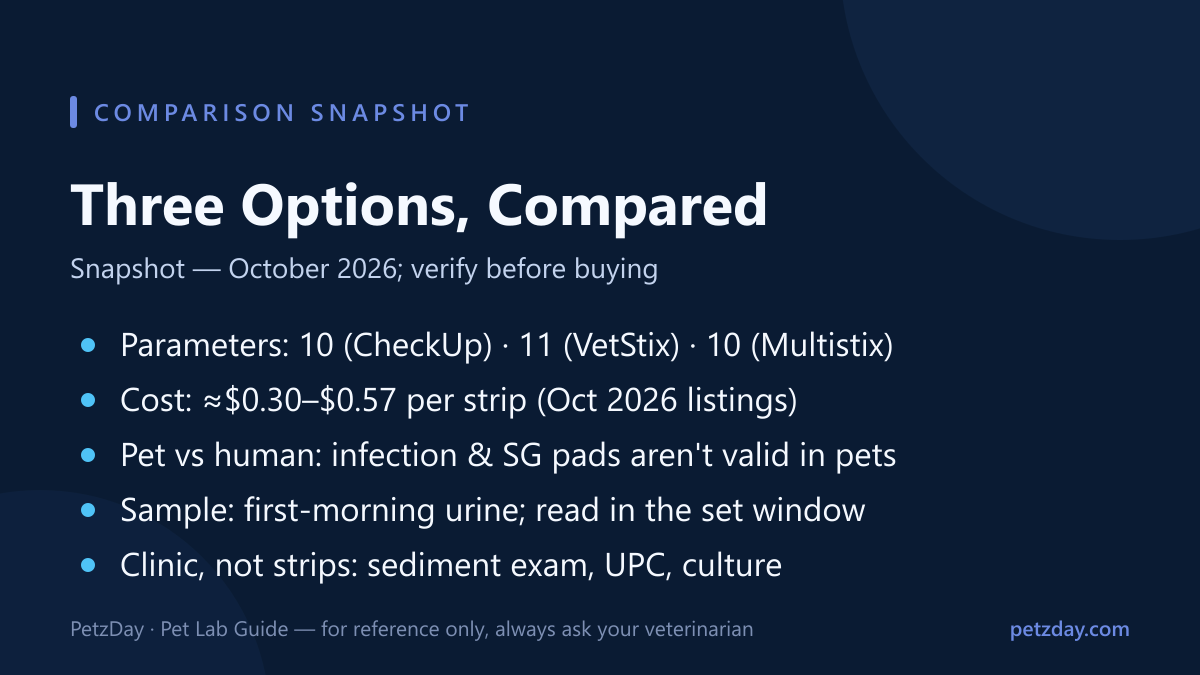
Parameters, cost, species differences, sampling and when to go to the clinic.
Pet-specific vs human strips: the real differences
All three carry the same blind spot: the infection and SG pads are the ones veterinary references say not to use in animals.
- Infection pads. Merck: leukocyte esterase and nitrite pads are "not valid in animals and should not be used." A negative doesn't rule a UTI out; a positive doesn't confirm one.
- Specific gravity. VetStix markets vet-grade SG ("reliably determined to values of 1.07"); we found no independent strip-SG validation in dogs or cats, and veterinary references measure USG by refractometer (eClinPath). Treat pad SG as a rough signal.
- Calibration. Human strips are validated for people (Multistix is CLIA-waived); pet products carry pet or lab positioning (CheckUp: CE-grade; VetStix: "veterinary practices and laboratories"). No public head-to-head trial in dogs/cats exists that we found — so no product is called "more accurate."
- Common ground. All read colors by eye; sample and technique drive quality as much as price.
How to test properly
Most home-strip errors are technique errors — ask your vet to walk you through a first test.
- Use first-morning urine (CheckUp guidance) and test fresh.
- Clean, dry container; avoid litter and cleaner residue. Sterile collection is a clinic procedure.
- Dip exactly per your label: CheckUp — 2 seconds, read at 60; VetStix — 1 second max, tap off excess.
- Read inside the timing window; pads keep darkening past it.
- Lab-bound samples: refrigerate up to 24 hours (Merck) — still test fresh at home.
- Log date, time and result. Patterns beat a single reading.
When strips aren't enough
A strip points your vet in a direction; confirmation happens in the clinic.
- Sediment exam: cells, casts, crystals and bacteria — the part of urinalysis a pad can't see.
- USG by refractometer: concentration questions, including kidney staging (eClinPath).
- UPC: follows up a protein flag accurately (eClinPath).
- Culture: the only way to confirm a bacterial UTI and pick an antibiotic.
- Bloodwork: kidney trends strips can't see.
Who should keep strips at home
With a vet-set plan, home strips suit a few households — and few others.
- Chronic kidney disease families. Cats especially are monitored with bloodwork and in-clinic USG; strips only if your vet wants a between-visit signal. What to track: our cat kidney guide.
- Diabetic pets. Urine glucose/ketones are secondary signals; insulin decisions stay with your vet.
- Urinary or stone history. A suspicious result is a call to the clinic, not a treatment decision.
- Poor fits. Anyone wanting a diagnosis, pets with an active problem, and households that won't log results.
PetzDay logs results with dates and context in one timeline (create a free account) — plainly, it stores what you enter, doesn't read strips, and isn't a vet-records replacement. Browse our library.
Limitations & what to check before buying
This is a public-information guide, not hands-on testing — and strips have failure modes that matter.
- Prices and stock change fast (the VetStix listing was out of stock).
- Strips expire and hate moisture: cap tightly with desiccant, discard expired strips (Merck). CheckUp: 110 days opened; VetStix: discard discolored pads.
- Eye-reading is subjective — Siemens data: 12.4% error by eye versus 2.9% on an instrument.
- No companion app was found for any product as of October 2026; recording is manual either way.
- No public head-to-head validation in dogs and cats exists for these three that we found — every reading is a question for your vet, not an answer.
FAQ
Are at-home urine test strips accurate?
They're screening tools; accuracy depends on the pad. In animals, leukocyte esterase, nitrite and SG pads are considered "not valid in animals and should not be used" (Merck Veterinary Manual, 2026), and reference labs measure USG with a refractometer (eClinPath). Visual color reading adds further error. Use strips for trends your vet can interpret.
Can I diagnose a UTI at home?
No. A UTI is confirmed with a properly collected sample, a urine sediment exam and often a culture — clinic work strips can't replicate; the infection pads aren't valid in dogs and cats (Merck; eClinPath). If your pet is straining, having accidents, or you see blood in the urine, call your vet instead of testing at home first.
How should I store test strips?
Keep the bottle tightly capped with the desiccant inside, and store cool and dry — strips are adversely affected by moisture and expire (Merck). Once opened, CheckUp's strips last 110 days per the brand; VetStix says to replace the cap immediately and discard discolored pads. Never use strips past the bottle date; ask your vet if unsure.
References
- eClinPath — Urinalysis: Chemical constituents — pad scope; leukocyte/urobilinogen pads not used
- eClinPath — Urinalysis: Concentrating ability — USG by refractometer
- Merck Veterinary Manual — Urinalysis — leukocyte esterase, nitrite and SG pads "not valid in animals"; storage advice (updated August 2026)
- Siemens Healthineers — Multistix 10 SG Reagent Strips — parameter list; reading-error data
- Siemens Healthineers — Multistix 10 SG purchase options — distributor list
- Coastline Global — CheckUp Strips (brand FAQ) — parameters, timing, 110-day shelf life
- UPCO Pet Supplies — CheckUp Pet Urine Testing Strips — $14.99 (Oct 2026)
- The Natural Dog — CheckUp Pet Urine Testing Strips — $19.99 (Oct 2026)
- Chewy — CheckUp listing (archived March 2026) — $16.90 archived
- EntirelyPets — VetOne VetStix 11SG, 100 count — $36.99; parameters; shelf life
- MedexSupply — Multistix 10 SG, 100/bx — $35.95 (Oct 2026)
- USA Medical & Surgical — Multistix 10 SG — $56.87 (Oct 2026)
Last reviewed: October 10, 2026. For general education only; not a replacement for an examination by your veterinarian. Follow your vet's protocol for all testing, dosing, and treatment decisions.