Reticulocytes and Anemia in Dogs: What High and Low Counts Mean
A reticulocyte count in dogs shows whether the bone marrow is responding to anemia. Merck (2026) cites a regenerative response as more than 60,000 reticulocytes/µL in dogs, though labs set their own cutoffs — and if counts stay low next to a low hematocrit, the anemia is likely non-regenerative, or the sample was taken less than 3–5 days after onset (Merck, 2026; eClinPath). Here's how vets read high and low counts, what causes each pattern, and when to call.
A reticulocyte count tells your vet whether a dog's bone marrow is fighting back against anemia. Reticulocytes are the newest red blood cells; when the count rises, the marrow is answering — in dogs, an absolute reticulocyte count above roughly 60,000/µL is classically called regenerative (Merck, 2026). If counts stay low next to a low hematocrit, the anemia is likely non-regenerative — or the sample was taken before the marrow could respond, which takes about 3–5 days (Merck, 2026; eClinPath).

Reticulocytes and anemia in dogs: what high and low counts mean.
Reticulocyte count in dogs: what reticulocytes are
Reticulocytes are immature red blood cells — the bone marrow's newest output — and counting them shows whether an anemia is regenerative (the marrow is responding) or non-regenerative (it isn't) (eClinPath).
Reticulocytes are red cells released before they finish maturing: they have no nucleus but still carry RNA from hemoglobin production, and the marrow releases them early when the body senses an oxygen shortage (eClinPath; VCA, 2023). On a stained smear, the youngest appear as larger, purple-tinged cells called polychromatophils — the "polychromasia" your vet may mention (eClinPath).
Species matter for reading the number. Dogs release two forms — aggregate reticulocytes (younger, more RNA) and punctate reticulocytes (older, small dots of RNA) — and both are included in a dog's reticulocyte count (eClinPath). Cats have both forms too, but aggregate cells mature into punctate within 12–24 hours, and punctate cells can persist for 7–21 days; so labs count only aggregate reticulocytes in cats — the cells that reflect the marrow's current response (eClinPath; Merck, 2026).
Labs report reticulocytes as a percentage; vets convert that into an absolute count or a corrected reticulocyte percentage — the percentage times (your dog's hematocrit ÷ 45%). An anemia in dogs is generally considered regenerative when the corrected value tops 1% (eClinPath; Merck, 2026). The HCT, HGB, and RBC lines it's read beside are covered in our complete blood count guide.
High reticulocytes in dogs: the regenerative response
A high reticulocyte count means the bone marrow is producing new red cells — and in an anemic dog that points to two broad causes: blood loss or red-cell destruction (hemolysis) (eClinPath; Merck, 2026).
How high is "high" depends on the lab. Merck (2026) cites more than 60,000 reticulocytes/µL in dogs as regenerative; Cornell's diagnostic lab grades the response against the severity of the anemia — under about 92,000/µL is inadequate at that lab, rising through mild, moderate, and marked past 300,000/µL (eClinPath). That's why the count is always read against how anemic the dog is — never as a stand-alone pass/fail.
Blood loss can be obvious — trauma or surgery — or hidden: intestinal ulcers, parasites, or a bleeding tumor in the spleen or gut (Merck, 2026; eClinPath). Hemolysis is the other regenerative bucket. In dogs, the classic example is immune-mediated hemolytic anemia (IMHA): antibodies coat red cells and the spleen removes them early. Roughly three-quarters of dog cases are considered primary; the rest are triggered by infections, blood parasites such as Babesia, drugs, or cancer (VCA, 2023; eClinPath).
Occasionally a high count shows up without anemia — an "erythropoietic drive" from heart or lung disease, or reduced oxygen sensing in the kidney. In one large study, about 4% of non-anemic dogs had a reticulocytosis (eClinPath).
The 3–5 day rule: why early counts can look flat
Bone marrow needs about 3–5 days after anemia begins to release enough reticulocytes to show up in blood, so an acute bleed or a hemolytic crisis can look non-regenerative on the first sample (Merck, 2026; eClinPath).
Merck's anemia overview calls it the 3–5 day response; Cornell's pages add that an anemic dog without a reticulocytosis either has a non-regenerative anemia or was sampled within the first 2–3 days (eClinPath). Practical takeaway: one "normal" count early on does not prove the marrow is failing — vets often repeat the CBC a few days later before drawing conclusions.
Low reticulocytes in dogs: non-regenerative anemia
Low — or inappropriately normal — reticulocytes alongside anemia mean the bone marrow is not making enough new red cells: a production problem, once timing and sample quality are accounted for (eClinPath; Merck, 2026).
A study of 456 dogs with anemia (excluding acute blood loss) found inflammatory disease and cancer-associated anemia to be the most common causes — both typically non-regenerative (eClinPath). The usual suspects:
- Kidney disease. Damaged kidneys don't produce enough erythropoietin to sustain red-cell production, and kidney inflammation locks iron away; when anemia appears it is usually mild to moderate — and not every patient develops it (eClinPath). Our kidney values guide covers SDMA, creatinine, and urine specific gravity; the feline side is in our cat kidney disease guide.
- Inflammation. Chronic inflammation raises hepcidin, a hormone that blocks iron absorption and locks iron inside cells — a "functional iron deficiency" that slows red-cell production even when iron stores look normal (eClinPath).
- Iron deficiency. Iron-deficient red cells come out small and pale; in adult dogs the most common cause is chronic blood loss, usually from the gastrointestinal tract — bleeding ulcers or tumors, or parasites — and sometimes from clotting problems that let small bleeds continue (eClinPath). Our platelet and clotting tests guide covers that workup.
- Bone-marrow disease and drugs. Damage to the marrow — immune-mediated, aplastic, or from cancer — and some medications, including chemotherapy agents and estrogen, suppress red-cell production (eClinPath; Merck, 2026).
Because the count alone rarely names the cause, vets pair it with a blood-smear review, iron and kidney values, infection testing, and sometimes a bone-marrow sample — your vet decides which apply (VCA, 2023; eClinPath).
Symptoms & when to worry
Anemia causes signs of oxygen shortage regardless of the reticulocyte count — and pale gums are the classic sign to check (VCA, 2023).
- Pale gums — from pink toward pale pink or white; the most common, most visible sign (VCA, 2023)
- Low stamina — listlessness, tiring easily, or collapsing with exertion (VCA, 2023)
- Breathing changes — labored or faster breathing, faster heart rate (VCA, 2023; Merck, 2026)
- Appetite and weight — eating less, losing weight (VCA, 2023)
- Visible blood loss — nosebleeds, or blood in stool, urine, or vomit (VCA, 2023)
- Yellow tint (icterus) — yellowish gums or eyes, which can accompany hemolysis (Merck, 2026)
When to worry: very pale or white gums, weakness or collapse, or trouble breathing — contact your vet or an emergency hospital promptly; with acute blood loss, a dog can deteriorate quickly (Merck, 2026; VCA, 2023). If anemia shows up on routine bloodwork while your dog acts normal, a workup is still needed — your vet decides how soon.
Reticulocytes and anemia in dogs: quick reference
- What it measures — reticulocytes are the newest red cells; the count shows if the marrow is responding (eClinPath)
- High = responding — in dogs, above about 60,000/µL is the classic regenerative cutoff; labs set their own (Merck, 2026)
- Low with anemia = not responding — non-regenerative, or sampled within the 3–5 day window (Merck, 2026; eClinPath)
- Two regenerative causes — blood loss or hemolysis; IMHA is the classic canine hemolytic disease (eClinPath; VCA, 2023)
- Species note — dog counts include aggregate and punctate reticulocytes; cats count aggregate only (eClinPath)
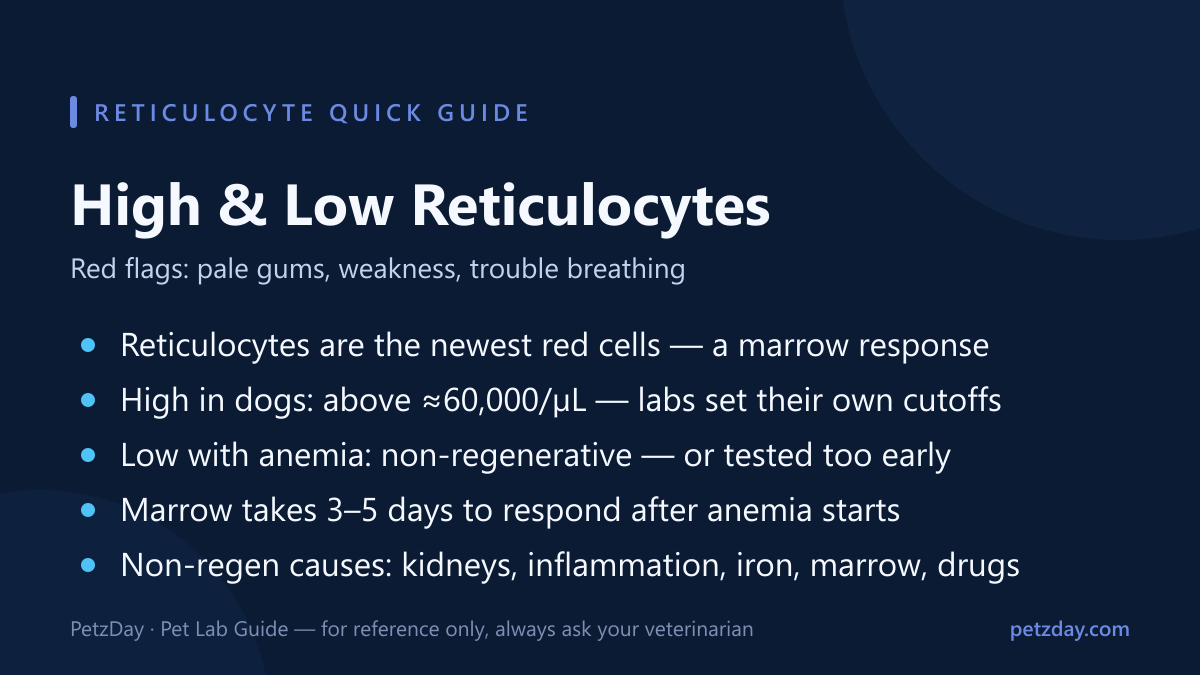
Reticulocytes and anemia in dogs, on one card — ask your vet about any abnormal result.
What to watch at home (and how to keep records)
Treatment decisions belong to your vet — the cause and severity drive what happens next (Merck, 2026). At home, the useful jobs are observation and record-keeping: track gum color, energy, appetite, and any bleeding — and keep results in one place so rechecks form a trend, not isolated numbers. That's what PetzDay is for — store each CBC, date, and note in one timeline your next vet can see (free account here). New to lab reports? Our guide to dog blood test results explained covers the rest. Costs vary by hospital, so ask for an itemized estimate at the recheck.
FAQ
What does a low retic hgb mean in dogs?
A low retic hgb — reticulocyte hemoglobin — means the hemoglobin content of the newest red cells is low, pointing to iron-deficient erythropoiesis: the marrow's young cells aren't being loaded with enough iron (eClinPath). It can accompany true iron deficiency, inflammation, or intense red-cell production — and studies disagree on how well it separates them; analyzers report it under names such as CHr or reticulocyte hemoglobin equivalent. Interpreting the result, and any follow-up testing, is your vet's job (eClinPath).
What does it mean if my dog has low reticulocytes?
Low reticulocytes with a low hematocrit usually mean the bone marrow isn't responding — a non-regenerative anemia — or that the sample came before the 3–5 day response window (Merck, 2026). Common reasons include kidney disease, inflammation, iron deficiency, marrow disease, and certain drugs (eClinPath). Your vet will narrow it down with the rest of the CBC and targeted tests.
How long does it take for reticulocytes to increase in dogs?
About 3–5 days from the onset of anemia — that's how long the bone marrow needs to ramp up and release enough new cells to be visible (Merck, 2026; eClinPath). That's why an acutely anemic dog can have a normal-looking count at first — and why vets often repeat the CBC. Recheck timing depends on how sick your dog is — follow your vet's schedule.
Is a high reticulocyte count in dogs something to worry about?
A high count is usually good news at the marrow level — the response is working — but it also points to blood loss or red-cell destruction as the anemia's cause, so a workup is still needed (eClinPath; Merck, 2026). A high count without anemia is uncommon and can reflect an erythropoietic drive, such as heart, lung, or kidney disease (eClinPath). Ask your vet what the number means in your dog's case.
References
- eClinPath (Cornell University) — Reticulocyte % — aggregate vs. punctate reticulocytes, species differences, how counts are done
- eClinPath (Cornell University) — Absolute Reticulocyte Count — counting method, Cornell's grading cutoffs, corrected reticulocyte percentage
- eClinPath (Cornell University) — Regeneration — the 3–5 day response window, formulas, dog vs. cat counts
- eClinPath (Cornell University) — Causes of Anemia — IMHA, iron deficiency, inflammation, chronic kidney disease mechanisms
- eClinPath (Cornell University) — Cause of Anemia Summary — chronic GI blood loss as the top cause of iron deficiency in adult animals; drugs that suppress erythropoiesis
- eClinPath (Cornell University) — Reticulocyte Indices — reticulocyte hemoglobin (CHr / retic hgb equivalents) and iron deficiency
- Merck Veterinary Manual — Overview of Anemia in Animals — regenerative thresholds, the 3–5 day rule (updated March 2026)
- VCA Animal Hospitals — Anemia in Dogs — clinical signs, PCV, what reticulocytes mean (updated October 2023)
- VCA Animal Hospitals — Autoimmune Hemolytic Anemia in Dogs — IMHA mechanism, primary vs. secondary cases (updated September 2023)
All web sources accessed October 2026.
Last reviewed: October 10, 2026. This article is for general education and does not replace an examination by your veterinarian. Follow your vet's guidance for all testing and treatment decisions.