Low Platelets in Dogs (Thrombocytopenia): Symptoms, Causes & What to Watch For
Thrombocytopenia in dogs — low platelets — means a platelet count below the lab's reference range, commonly cited in dogs as about 175,000–500,000 platelets per microliter (VCA, 2025). Many dogs have no signs at all, and spontaneous bleeding usually doesn't appear until counts fall below roughly 30,000/µL (Merck, 2026). Here's what causes it, how vets tell a real drop from a sample artifact, and what the workup looks like.
Thrombocytopenia in dogs — a low platelet count — is usually found on routine bloodwork, not because a dog looks sick: as many as 5% of dogs admitted to veterinary hospitals have one (VCA, 2025), and visible bleeding typically doesn't appear until counts fall below roughly 30,000 platelets per microliter (Merck, 2026). The number matters — what's behind it matters more.

Thrombocytopenia in dogs: what a low platelet count means, and what to watch for.
Thrombocytopenia in dogs: what low platelets mean
Thrombocytopenia — one of the most common bleeding disorders in veterinary medicine — means a platelet count below the lab's reference range: a finding, not a diagnosis on its own (Merck, 2025). Platelets plug small breaks in blood vessels; with too few, small-vessel and surface bleeding becomes possible (eClinPath).
Ranges vary by lab: VCA cites about 175,000–500,000 platelets per microliter for dogs, while Cornell's eClinPath puts normal dogs and cats at close to or above 200,000/µL (VCA, 2025; eClinPath). Below roughly 30,000/mcL, spontaneous bleeding becomes typical — though some dogs still show none (Merck, 2026).
A low count often turns up on routine bloodwork — for older dogs, sometimes on a senior dog blood panel — so the number is a start, not an answer. How platelets are counted, and what tests such as PT and APTT check, lives in our platelets and clotting guide.
Symptoms & when to worry
Most dogs with mildly low platelets feel normal — visible symptoms usually mean the count has dropped far enough for small leaks of blood (eClinPath; VCA, 2025):
- Petechiae — pinpoint red spots on the gums or skin; gum petechiae are a classic sign of immune-mediated thrombocytopenia (Merck, 2026)
- Bruising (ecchymoses) — purple patches, sometimes with no known injury
- Nosebleeds (epistaxis) that start without an obvious cause
- Blood in urine — or blood in the stool, including black, tarry stool (melena)
- Vague signs — lethargy, poor appetite, or fever from the underlying problem; with heavier bleeding, pale gums, faster breathing, and weakness (VCA, 2025)
When to worry. A nosebleed that won't stop, sudden widespread bruising, blood in urine or stool, or pale gums with weakness mean calling your vet promptly. Spontaneous bleeding usually appears under 30,000/µL (Merck, 2026), but a severely low count deserves attention even if your dog seems fine.
Is the low count real? Platelet clumping and false alarms
Before hunting for a disease, vets check whether the number is real: platelet clumps decrease the count obtained by any method, so a reported number is technically a minimum — and in badly clumped samples it can be invalid (eClinPath).
- Collection is usually the culprit. Difficult sticks, small veins, and slow flow make platelets clump — worse as a sample sits — and analyzers can report falsely low counts, especially in cats (eClinPath; Merck, 2025).
- The blood smear is the referee. Vets check it before trusting the number — and re-draw when needed (eClinPath; Merck, 2025). Rarely, the anticoagulant EDTA itself triggers clumping; a citrate tube gives an accurate count (eClinPath).
- Some low counts are normal for that dog. Hereditary macrothrombocytopenia keeps counts low (often 50,000–100,000/µL) in roughly 30–50% of Cavalier King Charles Spaniels; it's benign, needs no intervention, but vets may genetic-test to tell it from disease (Merck, 2026).
What causes low platelets in dogs
Vets sort thrombocytopenia by mechanism — and the mechanism determines which tests come next (eClinPath; Merck, 2026).
- Reduced production. Drugs, toxins, or marrow disorders — aplasia, fibrosis, cancer — slow platelet production; other cell lines often drop too (Merck, 2026).
- Increased destruction — immune-mediated (IMTP/ITP). Antibodies coat platelets, and the spleen removes them; middle-aged female dogs and Cocker Spaniels are overrepresented. It can be primary (no trigger found) or secondary to infections — especially vector-borne — drugs, cancer, or inflammation (Merck, 2026; VCA).
- Consumption and loss. Massive bleeding or DIC consumes platelets; severe blood loss lowers the count too (Merck, 2026; VCA, 2025).
- Sequestration. An enlarged spleen can hold a large share of the platelet supply out of circulation (Merck, 2026; eClinPath).
- Infection. Tick-borne diseases are a well-known trigger: Rocky Mountain spotted fever, Anaplasma, and Ehrlichia species cause mild to severe thrombocytopenia in dogs (Merck, 2026); VCA adds babesiosis, hemotropic mycoplasmosis, Lyme disease, and more (VCA).
- Medications and toxins. Some drugs and toxins — zinc, xylitol, snake venom — can be involved (VCA, 2025).
How vets investigate low platelets
The workup answers two questions — is the count real, and why did it drop (VCA, 2025; eClinPath; Merck, 2026):
- Repeat the CBC and read the smear. Vets confirm the number, check for clumps, and read red and white cells for clues (eClinPath; VCA, 2025). New to CBCs? Our guide to reading a complete blood count walks through each line.
- Screen for infections — tick-borne panels, guided by region and exposure (VCA; Merck, 2026).
- Check the rest of the clotting system to see whether low platelets are the whole story (eClinPath).
- Look deeper if needed — X-rays and ultrasound can reveal cancer, an enlarged spleen, or hidden bleeding; selected cases get a bone-marrow sample (VCA, 2025).
Which tests, and in what order, is your vet's call. Pricing is set by the hospital, not a national list — ask for an itemized estimate; our dog blood test cost guide explains what drives the total. New to lab reports? Our guide to dog blood test results covers the rest of the page.
What to watch at home
Medication and treatment decisions belong to your vet — the cause and the count determine whether (and what) treatment is needed. At home, the practical jobs are protection and observation:
- Ease up on roughness. Injury can cause bleeding below about 50,000/µL, and dogs with immune-mediated thrombocytopenia are kept at rest to avoid triggering bleeds (Merck, 2026). Ask your vet what to pause.
- Watch for the signs above — new bruises, gum color, stool color (black and tarry warrants a call), nosebleeds, blood in urine, energy level.
- Log what you see and every result. Rechecks, dates, and observations turn isolated numbers into a trend your vet can use. PetzDay keeps your dog's results in a shareable timeline — it complements clinic records, it doesn't replace them. Create a free account or browse the full library.
Diet changes or supplements? Ask your vet first — with low platelets, the priority is the cause.
Low platelets in dogs: quick reference
Five things worth remembering:
- Normal is a range — about 175,000–500,000 platelets/µL in dogs; labs vary (VCA, 2025)
- Bleeding risk starts low — spontaneous bleeding typically under ≈30,000/µL; injury bleeds under ≈50,000/µL (Merck, 2026)
- False lows are common — clumping can mask the real count; a smear keeps it honest (eClinPath; Merck, 2025)
- Causes by mechanism — immune destruction, tick-borne infection, marrow disease, DIC, spleen, blood loss (Merck, 2026; VCA, 2025)
- Red flag — sudden bruising or active bleeding: call your vet promptly, whatever the number (VCA, 2025)
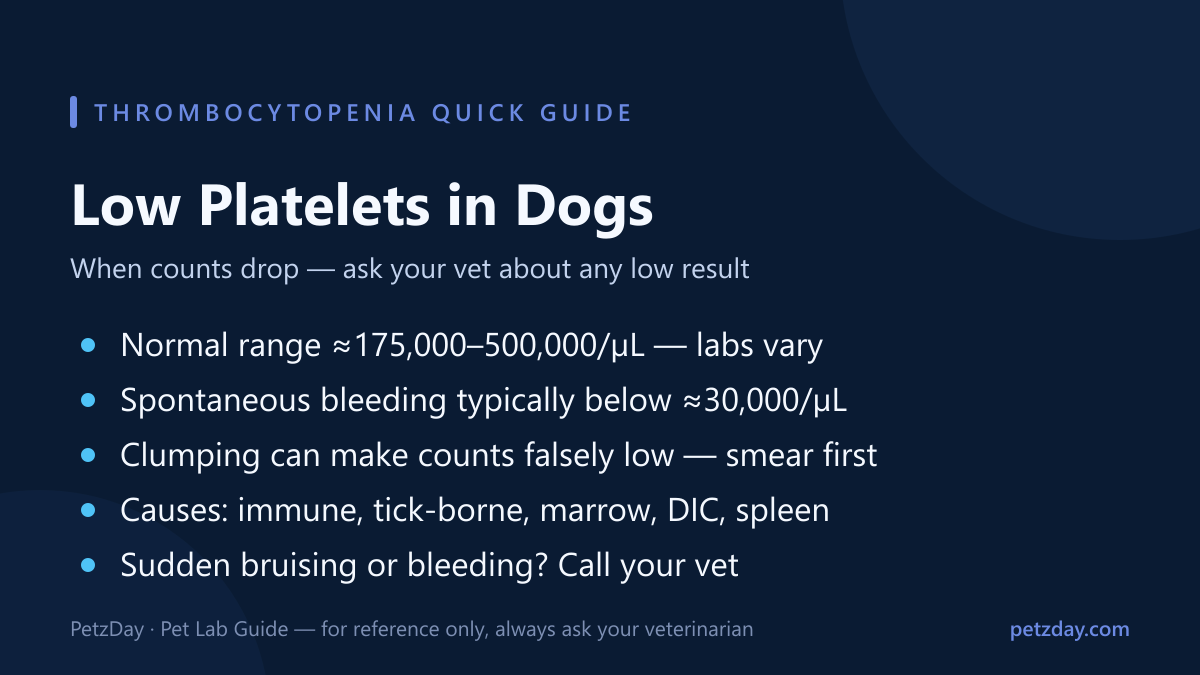
Low platelets in dogs, on one card — confirm the details with your vet.
FAQ
How low is too low for platelets in dogs?
Spontaneous bleeding is uncommon until counts fall below roughly 30,000/µL; under 20,000–30,000/µL is considered likely to bleed (Merck, 2026; VCA, 2025). Injury or surgery can cause bleeding below about 50,000/µL (Merck, 2026). Some dogs stay symptom-free — so your vet weighs count, cause, and signs.
Can low platelets in dogs be a false alarm?
Yes — clumped platelets commonly cause artificially low counts, so vets check the smear before trusting a result and may re-draw (eClinPath; Merck, 2025). Some dogs have a benign inherited form — hereditary macrothrombocytopenia, common in Cavalier King Charles Spaniels — that never causes bleeding (Merck, 2026).
Should I worry about low platelets in my dog?
It depends on how low the count is, whether it's real, and why — so talk to your vet. Call promptly for sudden bruising, bleeding gums, blood in urine or stool, a nosebleed that won't stop, or pale gums with weakness (VCA, 2025; eClinPath). Mild, isolated lows often need follow-up, not panic.
References
- eClinPath (Cornell University) — Platelet count — clumping, smear checks
- eClinPath (Cornell University) — Platelet number — bleeding signs, mechanisms, EDTA pseudothrombocytopenia
- eClinPath (Cornell University) — Clinical signs — petechiae, ecchymoses, mucosal bleeding
- Merck Veterinary Manual — Platelets in Animals — clumping, false lows (May 2025)
- Merck Veterinary Manual — Platelet Disorders in Animals — thresholds, ITP, tick-borne causes (March 2026)
- VCA Animal Hospitals — Thrombocytopenia in Dogs — causes, signs, ranges (October 2025)
- VCA Animal Hospitals — Immune-Mediated Thrombocytopenia in Dogs and Cats — ITP details, screening
- VCA Animal Hospitals — Ehrlichiosis in Dogs — low platelet counts in infected dogs
All web sources accessed October 2026.
Last reviewed: October 10, 2026. This article is for general education and does not replace an examination by your veterinarian. Follow your vet's guidance for all testing and treatment decisions.