How Much Does Blood Work Cost for Cats & Dogs?
Typical cat blood test cost in the US, what dog urinalysis adds, and the factors that move blood work prices — so you can compare quotes without paying for tests you don't need.
Routine blood work for a cat or dog in the United States — a complete blood count (CBC) plus a chemistry panel — typically falls between $130 and $300 at a general practice clinic, with quick in-house screens starting lower and emergency or specialty hospitals charging more. A dog urinalysis usually adds roughly $40 to $100 when it is billed separately. The number that matters is the one on your clinic's itemized estimate — "blood work" is not one fixed product.
This guide explains typical cat blood test cost ranges, what a dog urinalysis adds, and the factors that move the price. We do not compare local clinics here — near-you and cheapest searches are best settled by calling practices in your area — and no figure replaces a written quote from your veterinarian.

Cat and dog blood work: what it costs and what changes the price.
What does a cat blood test cost?
At a general practice in the US, a cat's routine blood work — a CBC plus a chemistry panel — typically costs between $130 and $300, and the final total depends on which tests the clinic bundles.
- Quick in-house screen (a handful of values): roughly $45–$90 — a fast look at a few key numbers, not a full panel.
- CBC alone: roughly $60–$120 — tallies red cells, white cells, and platelets.
- Chemistry panel alone: roughly $80–$200 — organ values and electrolytes.
- CBC + chemistry panel — routine blood work: roughly $130–$300 — the most common pairing for annual and pre-anesthetic checks.
- Add-on tests (thyroid T4, SDMA, pancreatic lipase): often an extra $30–$150 each.
- Emergency or specialty hospital: frequently 1.5–3× the same panel.
These are typical 2026 U.S. ranges, not a national price list. Every clinic sets its own fees, and "blood panel" can describe very different bundles. A cat blood test cost estimate is built from the same parts as a dog's; for the dog-specific numbers and what each value means, see our guides to dog blood test cost and reading a CBC in dogs and cats.
What does a dog urinalysis cost?
A dog urinalysis typically runs roughly $40 to $100 on its own at a general practice, and a urine culture — when needed — adds more.
- Urinalysis alone (dipstick plus sediment exam): roughly $40–$100.
- With urine culture and sensitivity: often an additional $150–$250 — a lab test that grows and identifies bacteria when infection is suspected.
- In-house versus reference lab: an in-house urinalysis gives a quick read on concentration, pH, protein, and cells; a sent-out lab may report more detail, and pricing differs.
Vets frequently order a urinalysis alongside blood work because kidney function shows up in both: blood chemistry values such as BUN, creatinine, and SDMA describe one side, while urine concentration and protein describe the other. Our guide to urinalysis results explains each finding, and our kidney values guide covers the blood side.
What changes the price of blood work for cats and dogs
Most of the gap between two quotes comes down to three things: where the test is run, how many values are included, and which clinic you visit.
- Clinic type. General practice is usually the least expensive; emergency and specialty hospitals run wider test menus around the clock and price higher.
- In-house analyzer versus reference laboratory. In-house machines return common panels quickly; sent-out tests add lab fees but offer broader menus and sometimes more precise assays. Ask which one your quote covers.
- Panel size and add-ons. A 10-value screen is not the same product as a 25-value panel. Each add-on raises the total.
- Where you live. Regions with higher operating costs price higher. We avoid local price comparisons here because they go stale quickly — call two or three clinics near you for real numbers.
- Species and temperament. Cats and nervous dogs sometimes need extra handling or light sedation for a blood draw, which can add a line item.
- Why the test is run. A pre-anesthetic screen is often bundled into a procedure quote, while a diagnostic workup for a sick pet involves more tests — and sometimes urgency, which carries a premium.
- Age-based panels. For older dogs, vets often order a wider senior dog blood panel — that guide explains what is included and why its cost differs from routine blood work.
How to compare quotes without cutting the wrong corner
The useful comparison is the total visit price for the same list of tests — not a single line item that sounds cheap.
- Ask for an itemized estimate before the visit: which tests, in-house or sent out, and what the total includes.
- Ask which tests change decisions now and which can wait for a recheck. Vets are used to triaging this question.
- Ask about bundles. Pre-anesthetic panels and annual wellness packages sometimes discount the same tests.
- Run the math on insurance and wellness plans, using your own pet's age and risk profile against typical annual testing.
- Do not skip monitoring tests your vet needs. Some medications are only safe with periodic blood checks — that recheck is not the place to save.
When blood work can't wait
Some situations are emergencies, and comparing prices is the wrong trade — get care started, then ask about estimates and payment plans.
Call your vet or the nearest emergency hospital right away if your cat or dog:
- collapses or is difficult to rouse
- has pale gums or bleeding that will not stop
- is having trouble breathing
- may have eaten something toxic
- cannot urinate or is straining without producing urine
- is vomiting repeatedly with severe lethargy
- has a seizure or severe pain
Blood work cost quick reference
If you only remember five numbers, these cover the common ranges — your clinic's itemized estimate is still the number that counts.
- CBC alone: roughly $60–$120
- Chemistry panel alone: roughly $80–$200
- CBC + chemistry: roughly $130–$300
- Dog urinalysis: roughly $40–$100
- Emergency or specialty: often 1.5–3× more
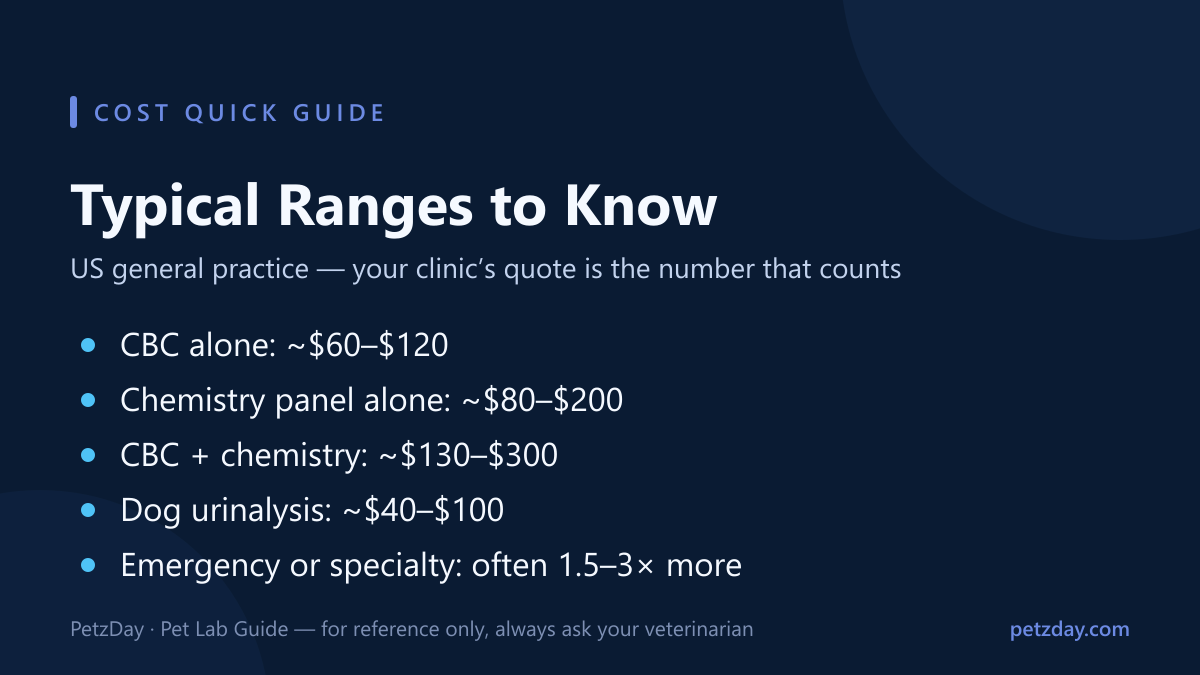
Five numbers to remember — your clinic's itemized estimate is the number that counts.
Keep every result and every receipt in one place
Blood work only becomes more valuable when you can compare it over time — and that starts with keeping each report where you can find it.
Lab results end up scattered across portals, printouts, and email attachments, and the moment you need them — a new vet, a second opinion, a 2 a.m. emergency — is the moment you cannot find them. Storing each panel plus the invoice in one place turns isolated numbers into trends, and trends are what vets actually use.
PetzDay keeps your pet's blood work, medications, and visit notes together — scan a report, tag the values that were flagged, and pull up the history at your next appointment. You can also browse our plain-English lab guides in the full library.
FAQ
How much does a cat blood test cost?
For a routine CBC plus chemistry panel, most cat owners in the US can expect roughly $130–$300 at a general practice, with add-ons priced separately. A quick in-house screen can run lower. These are typical 2026 ranges, not a set price — ask for an itemized estimate before the visit.
Does a dog urinalysis cost extra?
Usually yes, if it is billed separately. A dog urinalysis typically adds roughly $40–$100, and a urine culture adds more when infection is suspected. Sometimes a wellness package bundles urinalysis with blood work at a discount. Ask whether the quote you are comparing includes it or bills it as a separate line.
Why is blood work cheaper at some clinics?
Because the underlying product is not the same. One clinic may run a smaller panel in-house, while another sends a larger panel to a reference laboratory and adds a facility fee. Region and overhead matter too. Compare the total visit price for the same list of values, not a single line item.
Does pet insurance cover blood work?
It depends on the plan. Accident-and-illness policies often cover diagnostic blood work tied to a covered condition, subject to your deductible and reimbursement percentage, and many exclude routine wellness testing unless you add a wellness rider. Keep every invoice and lab report — you usually pay first and get reimbursed later.
How often does a healthy cat or dog need blood work?
There is no universal schedule. Many vets start annual panels around middle age — roughly 7 years for many dogs and cats — and test more often for seniors or pets on long-term medication. Your vet sets the interval based on age, breed, and health; your job is to keep the results findable when the next visit comes.
References
- Cornell eClinPath — Urinalysis
- Cornell eClinPath — Chemistry
- VCA Animal Hospitals — Know Your Pet
- Merck Veterinary Manual — Cat Owners
Last reviewed: October 20, 2026. This article is for general education and does not replace an examination by your veterinarian.