Dog Joint Health: Genes, Climate & Nutrition — Why Arthritis Starts Early
Joint disease in dogs is not only a disease of old age. Breed genetics set a floor, growth rate and body weight move it, and the surfaces a dog lives on change the load. Here is what the veterinary evidence supports — including where the popular 'cold and damp' and 'slippery floors' claims fall short.
Most owners assume arthritis arrives with grey muzzles — a wear-and-tear tax on a long life. The radiographs say otherwise. In one study of dogs aged eight months to four years, nearly 40% already had radiographic osteoarthritis, and only two were receiving any pain management (Enomoto et al., 2024). Joint disease is often established long before the first obvious limp, and the factors shaping it start in the first year: the genes a puppy inherits, how fast it grows, how much weight it carries as an adult, and the surfaces it lives on.
This guide maps those factors against veterinary orthopedic research and registry epidemiology. Where the evidence is thin — and two of the most repeated claims in this space are — we say so.
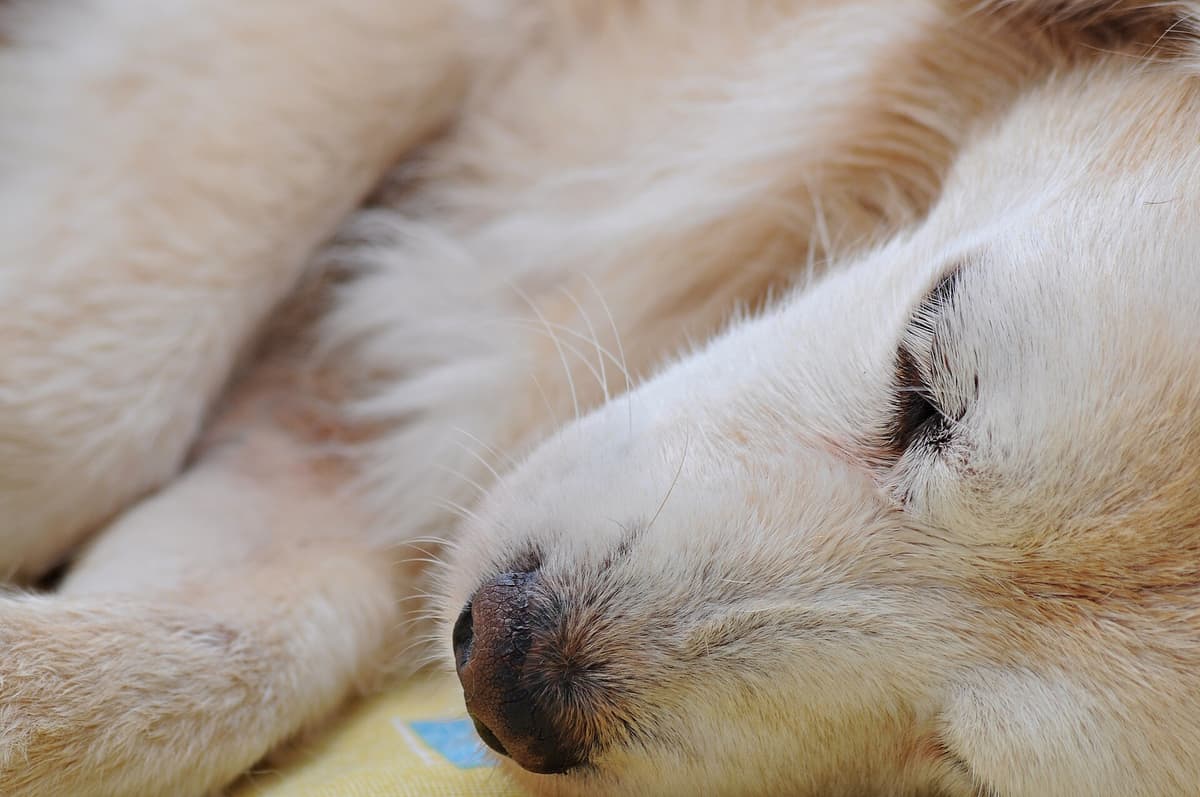
An older dog at rest. Photo: CristinaPessini / Wikimedia Commons (CC BY-SA 2.0).
Dog joint health begins with genetics you cannot change
Breed is the largest single predictor of which joint disease a dog develops. That is not fatalism — it is triage: knowing your dog's likely failure mode tells you what to screen for and where to spend money early.
Large and giant breeds: hip and elbow dysplasia
Hip dysplasia is a mismatch between the femoral head and the socket it sits in. It is inherited as a complex polygenic trait with low-to-moderate heritability — 0.35 for hip score and 0.19 for elbow score in UK Labrador Retrievers (Woolliams et al., 2011), with a second UK study putting hip heritability at 0.34 (Wood et al., 2002). Low heritability is exactly why screening both parents has never eliminated it, and why growth-phase nutrition matters so much.
Registry numbers show how unevenly risk is distributed. Across 921,046 dogs in the Orthopedic Foundation for Animals (OFA) registry, hip dysplasia prevalence was 15.56%, from 77.7% in Bulldogs to 0% in Italian Greyhounds; German Shepherds sat at 16.3%, Golden Retrievers 14.9%, Labrador Retrievers 9.2% (Loder et al., 2017). Read those as a ranking signal, not population risk: OFA entries are voluntary, and that paper found Bulldog prevalence swinging from 4.4% to 68.9% depending on the database queried.
Elbow dysplasia follows the same pattern. OFA calls it inherited and polygenic, with three developmental lesions — fragmented coronoid process, osteochondrosis of the medial humeral condyle, and ununited anconeal process — graded I to III on a flexed mediolateral view, with no "normal" grade and certification only at two years. If you are buying a large-breed puppy, ask for both parents' hip and elbow results by name, and understand that clear parents lower risk rather than remove it.
The physics underneath is unforgiving. A 35 kg dog jumping off a bed lands with a load well above its body weight through two small joints, and a shallow socket turns that load into shear. Body condition matters more in large breeds than small ones.
Small breeds: luxating patella
Patellar luxation is the small-dog counterpart and is also inherited: OFA states it should be considered an inherited disease, with limb deformities present at birth, and one case series found 82% of 124 cases to be congenital (Hayes et al., 1994). Vets grade it I to IV — from a kneecap that can be pushed out by hand and pops back on its own, up to one that is permanently out of place and irreducible — and roughly half of affected dogs have both knees involved (VCA Hospitals).
The epidemiology is unusually clear. In 210,824 UK dogs, prevalence was 1.30%, with odds ratios against crossbreeds of 6.5 for Pomeranians, 5.9 for Chihuahuas, 5.5 for Yorkshire Terriers and 5.4 for French Bulldogs (O'Neill et al., 2016). Medial luxation dominates in small breeds — 98% of cases in one series — while lateral luxation is more common in large and giant breeds. One correction worth making, because it is repeated everywhere: Poodles are frequently listed as high-risk, but were not among the high-risk breeds in that UK dataset.
Long-backed breeds: IVDD is a nerve problem, not arthritis
Dachshunds, Beagles, Pekingese, Shih Tzus and Lhasa Apsos are chondrodystrophic: their discs degenerate within months of birth and can herniate at one to two years of age, versus after five years in large breeds (Merck Veterinary Manual). That distinction matters, because intervertebral disc disease is not a joint disease. It compresses the spinal cord and produces neurologic signs — wobbliness, paw knuckling, paralysis, incontinence — not the cartilage-loss lameness of arthritis.
Hansen type I is an acute extrusion in younger dogs, roughly three to six years; type II is a chronic protrusion in older, often larger dogs (VCA Hospitals). Signs recur in 30–40% of cases, and roughly one in ten dogs managed surgically goes on to have a further episode (Aikawa et al., 2012). A long-backed dog dragging a hind foot needs an emergency room, not a supplement.
Climate, floors and terrain: what the evidence actually supports
This is where most joint content stops being honest. Weather and flooring are plausible and widely repeated, and in the published veterinary literature largely unproven.
Cold and damp weather
The mechanism sounds reasonable: synovial fluid is a non-Newtonian lubricant, and viscosity generally rises as temperature falls. But when researchers measured fluid from dogs' stifles — healthy, cruciate-deficient and post-surgical — viscosity was "practically temperature independent" between 25 °C and 38 °C, the range that matters inside a joint (Goudoulas et al., 2010). A meta-analysis of 11 case-crossover studies covering 15,315 participants found no association between humidity, air temperature, air pressure or precipitation and knee, hip or low-back pain in people (Ferreira et al., 2024). No dog-specific study of weather and osteoarthritis pain exists.
So are owners who report winter stiffness wrong? Not exactly. Cold reliably changes behaviour: shorter walks, more time on hard floors, fewer miles. A dog that moves less gets stiffer, and a stiff dog is easier to notice. Treat winter as an activity problem — coat on, shorter and more frequent walks, warm-up sniffing before any burst of running.
Hard pavement and slick indoor floors
There is a defensible physics case for pavement. Concrete does not deflect; the paw pad and limb absorb what the surface will not, and a trotting dog repeats that impact thousands of times a day.
The slick-floor claim is where the evidence runs out. A widely shared assertion holds that dogs slipping on hardwood is a major cause of cranial cruciate ligament rupture — but no published study links household flooring to cruciate disease, and the largest risk-factor study in the area, covering 1,243,681 dogs, examined breed, sex and age, not housing (Witsberger et al., 2008). That makes slippery floors a fall hazard rather than a proven ligament-destroying one, which is still reason to put runners along the hallway your dog sprints down.
Joint risk factors, graded by evidence
- Strong evidence: breed genetics (hip dysplasia, elbow dysplasia, patellar luxation); caloric intake during growth; adult body weight; age
- Moderate evidence: previous joint injury or surgery; high-impact repetitive activity in an overweight dog
- Plausible, unproven: hard paving adding cumulative impact load
- Popular but unsupported: weather causing arthritis pain; household flooring causing cruciate rupture
Life stages: the windows where you can change the outcome
Puppy: growth rate is the lever
If a breeder says dysplasia is "just genetics," point them at the Labrador colony study. Forty-eight puppies were fed either freely or 25% restricted to two years of age. Hip dysplasia by OFA criteria appeared in 7 of 24 restricted puppies versus 16 of 24 fed freely (Kealy et al., 1992). At five years the restricted group had less frequent and less severe hip osteoarthritis (Kealy et al., 1997), and by end of life they had a longer median lifespan (Kealy et al., 2002).
Practical translation: feed a large-breed puppy to a body condition score of 4–5/9 rather than to the top of the bag's chart, and choose a large-breed growth formula. Free-feeding a rapidly growing retriever is one of the few genuinely preventable exposures here.
Adult: body weight is the biggest lever you own
Adipose tissue is not inert storage; it releases inflammatory mediators, and every extra kilogram rides through every step. In 14 obese dogs, sixteen weeks of weight loss averaging 6.1% of body weight reduced lameness scores, and at 8.85% loss the improvement showed on force-plate gait analysis (Marshall et al., 2010). An earlier study of nine dogs losing 11–18% of body weight found significant reductions in hind-limb lameness (Impellizeri et al., 2000).
In practice that means measuring food, cutting treats before meals, and using the calorie calculator to get a starting number for your dog's weight and activity, then adjusting against the scale every two weeks.
Senior: measure pain instead of guessing
Osteoarthritis affects at least 20% of dogs over one year and around 80% of dogs over eight (VCA Hospitals), yet senior dogs are the group most likely to be under-treated, because slowing down gets read as "just ageing."
Vets now have validated owner-completed instruments: the Canine Brief Pain Inventory, which detected carprofen response against placebo in a 70-dog trial (Brown et al., 2008), and the Liverpool Osteoarthritis in Dogs questionnaire, where about −4 points is a clinically meaningful change (Alves et al., 2023). You do not need either to start. Write down four observations weekly — ease of rising from lying down, willingness on stairs, hesitation before jumping, and comfortable walk distance. That trend is more useful to your vet than "he seems slower."
Before assuming arthritis, rule out the mimics. A senior dog that is slow, cold-seeking and gaining weight may have hypothyroidism rather than joint disease; our guide to hypothyroidism in dogs covers the testing. Baseline bloodwork is also worth having on file before long-term medication — the senior dog blood panel guide explains what is checked and why liver and kidney values matter for drug safety.
Joint supplements: what the science supports
Glucosamine vs chondroitin vs green-lipped mussel
Start with the uncomfortable summary. A systematic review of 22 papers on nutraceuticals for canine osteoarthritis found the strength of evidence "low for all nutraceuticals except omega-3 fatty acid in dogs" (Vandeweerd et al., 2012). Tufts' clinical nutrition team puts it more gently: glucosamine/chondroitin products, if of good quality, "may have modest benefits in some animals."
That does not make supplements useless. It makes them adjuncts with a low ceiling — and it makes the omega-3 fraction, not the glucosamine number on the label, the part most worth paying for.
Glucosamine and chondroitin are the market default, usually paired. Trial results are inconsistent and quality control is a documented problem in this category, which is why the effect is framed as "may help some animals" rather than a predictable response.
Green-lipped mussel (Perna canaliculus) is the more interesting option for large breeds. In a six-week trial, 31 dogs fed a diet containing 0.3% mussel powder improved significantly on total arthritis score, joint pain and swelling — though not on crepitus or range of motion (Bui and Bierer, 2003). A separate eight-week study of 45 dogs found it beat placebo on three of six measures but was less effective than carprofen (Hielm-Björkman et al., 2009). The proposed mechanism is anti-inflammatory rather than structural: lipid extracts inhibit COX-1 and COX-2 in vitro (McPhee et al., 2007). Both trials are small — the effect is real enough to pursue and too small to replace analgesia.
Omega-3 (EPA/DHA) has the best evidence in dogs. A randomized, double-blind trial across 18 clinics and 127 dogs found that a diet with 31-fold more omega-3 and a 34-fold lower n-6:n-3 ratio improved owner-rated ability to rise and play at six weeks, and walking at 12 and 24 weeks (Roush et al., 2010). Dosing is the hard part: therapeutic levels usually exceed what a "skin and coat" capsule provides, so ask your vet for a target EPA+DHA dose.
What no supplement does: there is no trial evidence that any supplement prevents hip or elbow dysplasia. The only preventive intervention with trial support in growing large-breed dogs is controlled feeding.
Where pain medication fits
A common framing — "painkillers are harsh, so supplements are the safer daily option" — puts the risk in the wrong place. A systematic review of 64 studies found high strength of evidence for carprofen, firocoxib and meloxicam in canine osteoarthritis, while adverse effects such as vomiting, diarrhoea and anorexia appeared in 55% of those studies (Monteiro-Steagall et al., 2013). That is not a reason to avoid NSAIDs. It is a reason to use them properly: a baseline blood panel, owner vigilance for gut signs, and scheduled rechecks rather than an open-ended repeat prescription — which is what the 2022 AAHA pain management guidelines call for.
The honest comparison is not "drugs versus natural." It is risk-managed analgesia for a painful, progressive disease versus a supplement with a low efficacy ceiling.
How to choose, and what to ignore
- Look for a stated per-capsule dose — glucosamine, chondroitin, EPA and DHA in milligrams. "Proprietary blend" without numbers is a red flag.
- Prefer products that list omega-3 content separately from total fish oil.
- Run a 6–8 week trial, then decide with your vet. If gait, willingness to move or night-time restlessness do not change, stop paying for it.
- Do not stack supplements with NSAIDs without telling your vet. Several ingredients act on the same pathways.
If you are comparing products, judge the label before you buy: total actives in milligrams (glucosamine, chondroitin, EPA and DHA), a named omega-3 source, and no proprietary blend hiding the doses. A product without those numbers is not worth a trial.
Symptoms & when to worry
Osteoarthritis is slow and its early signs are subtle. Owners usually notice one of these before a vet does — and we break each one down, with what it looks like at home, in the seven early signs of arthritis in dogs.
- Difficulty rising after rest, or stiffness that "warms out" in the first few minutes
- Hesitation or refusal on stairs, or a bunny-hop gait going up
- Lagging behind on walks that used to be easy, or reluctance to jump into the car
- Licking at a single joint, or irritability when it is handled
- Restlessness at night
Some presentations need a vet this week, not next month: sudden inability to bear weight, a hot swollen joint, a dragging hind limb or knuckling paw (think IVDD), fever with lameness, or reluctance to move with vomiting. Those are not osteoarthritis patterns and should not be managed with a supplement. Your vet's exam plus radiographs will stage the problem; bloodwork establishes a baseline before any long-term drug. Our complete guide to dog blood test results explains what those panels measure.
What to track between visits
Joint disease is judged on trends, and trends need notes. Track the four things that change first: time to rise, stairs, walk distance, night-time restlessness. Add body weight on the same scale at the same time of day every two weeks, plus every medication and the response — the gap between doses is often the first sign a drug is wearing off.
PetzDay is built for that: one place for weight, medication, symptoms and lab results, so the pattern is visible instead of remembered. Keep a free history at petzday.com/register, and browse other condition guides in the article library.
FAQ
At what age should I start worrying about my dog's joints?
Watch from the first year, because that is when growth rate and body condition shape hip and elbow development. Start regular screening conversations around five to six years for large breeds and seven to eight for small breeds — earlier for any breed on the high-risk lists above.
Do dog joint supplements actually work?
Modestly, at best, and the evidence varies by ingredient. Systematic review rates evidence as low for every nutraceutical except omega-3 fatty acids. Green-lipped mussel has small positive trials; omega-3 has the best data. None replace weight control, analgesia when needed, or a diagnosis.
Is it true that cold, damp weather makes arthritis worse?
Owners report it, and it may reflect real changes in activity, but there is no canine evidence and human weather-pain studies have failed to show an association. Treat winter as an activity-management problem rather than a reason to increase medication.
Can I prevent hip dysplasia?
You cannot guarantee it, because inheritance is polygenic and only partly heritable. You can lower the odds: parents with recorded hip and elbow scores, a lean large-breed puppy, and a lean adult body weight.
References
- Loder et al. 2017 — Demographics of canine hip dysplasia in the OFA registry
- Woolliams et al. 2011 — Heritability of hip and elbow score in UK Labrador Retrievers
- Wood et al. 2002 — Heritability and epidemiology of hip-dysplasia score in UK Labradors
- OFA — Elbow dysplasia screening grades and inheritance
- VCA Hospitals — Hip dysplasia in dogs
- VCA Hospitals — Luxating patella in dogs (grades I–IV)
- Hayes et al. 1994 — Frequency and distribution of medial and lateral patellar luxation
- O'Neill et al. 2016 — Epidemiology of patellar luxation in UK primary-care practices
- Merck Veterinary Manual — Disorders of the spinal column and cord in dogs (IVDD)
- VCA Hospitals — Intervertebral disc disease in dogs
- Aikawa et al. 2012 — Recurrence after surgery for thoracolumbar disc extrusion
- Goudoulas et al. 2010 — Rheology of canine synovial fluid: healthy, pathological and post-surgery
- Ferreira et al. 2024 — Weather as a risk factor for musculoskeletal pain: systematic review and meta-analysis
- Witsberger et al. 2008 — Prevalence of and risk factors for hip dysplasia and cruciate ligament deficiency
- Kealy et al. 1992 — Limited food consumption and hip dysplasia in growing Labrador Retrievers
- Kealy et al. 1997 — Five-year follow-up: diet restriction and hip osteoarthritis
- Kealy et al. 2002 — Diet restriction and lifespan in dogs
- Marshall et al. 2010 — Weight loss and lameness in obese dogs with osteoarthritis
- Impellizeri et al. 2000 — Weight reduction and lameness in dogs with hip osteoarthritis
- Enomoto et al. 2024 — Radiographic osteoarthritis prevalence in young dogs
- VCA Hospitals — Arthritis in dogs (prevalence and owner-visible signs)
- Brown et al. 2008 — Canine Brief Pain Inventory detects treatment response
- Alves et al. 2023 — Minimal clinically-important differences for LOAD and COI
- Vandeweerd et al. 2012 — Systematic review of nutraceuticals for canine osteoarthritis
- Bui & Bierer 2003 — Green-lipped mussel in dogs with arthritis
- Hielm-Björkman et al. 2009 — Green-lipped mussel vs carprofen vs placebo
- McPhee et al. 2007 — Green-lipped mussel lipid extract inhibits COX-1 and COX-2
- Roush et al. 2010 — Omega-3 fatty acids and osteoarthritis in dogs
- Monteiro-Steagall et al. 2013 — Systematic review of NSAID-induced adverse effects in dogs
- AAHA — 2022 Pain Management Guidelines for Dogs and Cats
- Tufts Petfoodology — Dietary supplements for pets: harmful or helpful?
All web sources accessed November 2026. Product details reflect the manufacturer's public page at that date and may change.
Last reviewed: November 9, 2026. This article is for general education and does not replace an examination by your veterinarian. Follow your vet's guidance for all testing, medication, and treatment decisions.