Hypothyroidism in Dogs (Low Thyroid): Symptoms, Causes & What to Track
Hypothyroidism in dogs (low thyroid) is a treatable hormone shortage that causes weight gain, tiredness, and coat changes. Here's how vets confirm it and what to track between visits.
Hypothyroidism in dogs — often called low thyroid in dogs — is a shortage of thyroid hormone that slows the metabolism, and in more than 95% of cases the problem is in the thyroid gland itself (Merck Veterinary Manual, reviewed May 2024). It usually shows up in middle-aged dogs, roughly 4 to 10 years old, as weight gain without extra food, low energy, and a dull, thinning coat (Merck). The condition is treatable but not curable: most dogs are managed lifelong with daily oral thyroid hormone replacement and periodic rechecks (VCA Animal Hospitals).
A slow metabolism shows up gradually — weight gain, low energy, and coat changes — and is never diagnosed by symptoms alone.
Hypothyroidism in dogs (low thyroid): what it actually is
Hypothyroidism in dogs means the thyroid gland, located in the neck beside the windpipe, isn't producing enough thyroid hormone, so the whole body runs slow — and more than 95% of adult-onset cases are primary hypothyroidism, meaning destruction of the gland itself (Merck).
The two most common causes in dogs are both inside the thyroid gland (Merck; VCA):
- Lymphocytic thyroiditis — the most common cause. The immune system treats the thyroid as foreign and gradually attacks it; it is likely immune-mediated and genetics plays a role (VCA).
- Idiopathic thyroid atrophy — normal thyroid tissue is slowly replaced by fat tissue, for reasons that are still poorly understood (VCA; Merck).
Secondary hypothyroidism — where the problem sits higher up in the pituitary gland — is uncommon in dogs and usually tied to a pituitary tumor, often with other hormone losses (Merck). Hypothyroidism is rare in cats; in cats the common thyroid disease is hyperthyroidism, the opposite problem (Merck; VCA).
Low thyroid in dogs symptoms: what owners notice first
The signs of low thyroid in dogs build slowly and look a lot like normal aging — weight gain without extra food, low energy, and a dull, shedding coat — which is why vets test rather than guess (VCA; Merck).
What owners typically report:
- Weight gain without an increase in appetite — one of the most common early signs (VCA).
- Lethargy and exercise intolerance — sleeping more, tiring quickly, and a "slowing down" that's easy to write off as age (Merck).
- Cold intolerance — seeking warm spots or seeming cold when the house feels normal (VCA).
- Coat and skin changes — dryness, excessive shedding, slow regrowth after clipping, and symmetric hair thinning on the trunk, thighs, tail, or neck (Merck).
- Darkened skin (hyperpigmentation) — often over points of wear (Merck; VCA).
- Recurrent skin and ear infections — low thyroid makes the skin's defenses weaker (VCA).
- A "tragic" facial expression — thickened facial skin in some dogs (VCA).
- Nerve signs in some dogs — non-painful lameness, dragging feet, lack of coordination, or a head tilt (VCA).
When to worry. Hypothyroidism itself is rarely a same-day emergency — the signs creep in over weeks to months. But those same vague signs can belong to other, more urgent problems, so don't assume. Call your vet right away if your dog suddenly becomes weak, collapses, stops eating, or has trouble breathing; for slow, gradual changes, book a non-urgent visit and bring your notes on what you've observed and when it started.
How vets diagnose hypothyroidism in dogs
No single symptom proves hypothyroidism in dogs — vets diagnose it by matching the story and exam with thyroid blood tests, usually total T4, free T4, and TSH (Merck).
- Total T4 — a screening starting point. A low result raises suspicion but is not proof on its own.
- Free T4 by equilibrium dialysis — a more reliable measure when another illness is present, because total T4 can be dragged down by nonthyroidal disease (Merck).
- TSH — an elevated TSH supports primary hypothyroidism (Merck).
- Supporting lab clues — high blood cholesterol occurs in about 80% of dogs with hypothyroidism, and a mild nonregenerative anemia in about 40–50% (Merck).
A key caveat: hypothyroidism is one of the most overdiagnosed diseases in dogs, because many unrelated illnesses and some drugs lower thyroid hormone measurements in dogs with normal thyroids (Merck). For how each thyroid level is read, see our guide to thyroid testing in pets — T4, free T4, and TSH.
Diet & monitoring
There is no special diet that treats low thyroid in dogs — treatment is thyroid hormone replacement, and monitoring means scheduled rechecks and at-home tracking, not food changes (VCA; Merck).
Treatment is lifelong daily oral levothyroxine, a synthetic thyroid hormone, with the dose adjusted over time as your dog's tolerance changes (VCA). Thyroid levels are usually rechecked about every six months to keep the dose right — neither too low nor too high (VCA). Never start, stop, or change the dose on your own; ask your veterinarian.
What's worth tracking at home between visits:
- Weight — a slow upward drift or a drop after treatment starts
- Energy level and cold-seeking behavior
- Coat changes — shedding, thinning, regrowth
- Medication — dose and timing exactly as prescribed
- Recheck dates and every lab result, so the trend is visible
Those notes, plus each set of lab results, give your vet a trend to read at the next recheck — especially for dogs whose weight gain and low energy can be mistaken for plain aging, which is why senior dog blood panels often add a thyroid level.
Hypothyroidism in dogs quick reference
Five lines to remember before you talk to your vet:
- Most common cause — immune attack (lymphocytic thyroiditis) or gland atrophy, both inside the thyroid (Merck; VCA).
- Typical age — middle-aged dogs, roughly 4–10 years (Merck).
- Predisposed breeds — Golden Retriever, Doberman Pinscher, Irish Setter, Miniature Schnauzer, Dachshund, Cocker Spaniel, Airedale Terrier (Merck).
- Diagnosis — exam plus total T4, free T4, and TSH; a low T4 alone isn't proof (Merck).
- Treatment & monitoring — lifelong daily levothyroxine, with rechecks about every six months (VCA).
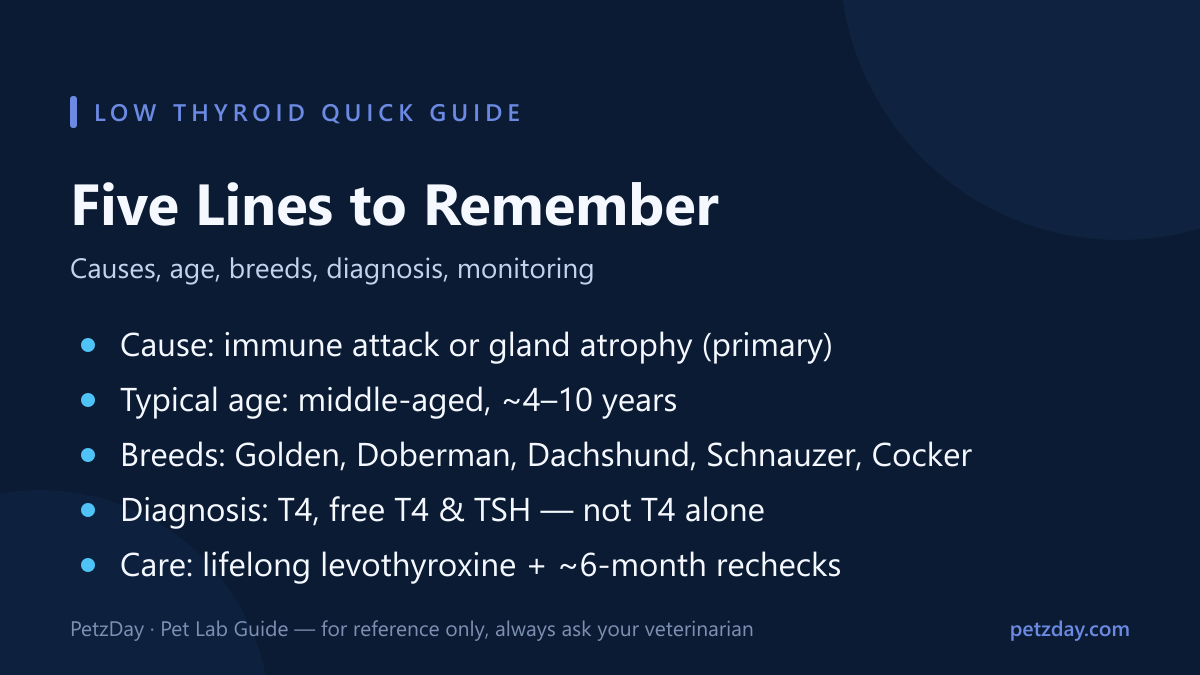
Copy these five lines into your vet notes — they're the facts your vet will ask about first.
FAQ
How much does a dog thyroid test cost?
At U.S. general practices, a thyroid (total T4) add-on commonly runs in the range of about $30–$150, depending on the clinic and whether it's part of a larger panel; specialty and emergency hospitals often charge more. Your clinic's written estimate is the number that matters — see our dog blood test cost guide for how panels are priced.
Is hypothyroidism in dogs painful?
Not directly. The disease itself slows the body down rather than causing acute pain, but the secondary effects — recurrent skin and ear infections, thickened skin — can be genuinely uncomfortable. If your dog seems painful, call your vet rather than assuming it's "just the thyroid."
Can hypothyroidism in dogs be cured?
No, but it is very manageable. It's treated lifelong with daily oral thyroid hormone replacement, and most dogs return to normal energy and a healthy coat once the dose is right (VCA). Periodic rechecks keep the dose adjusted as the body's tolerance changes over time (VCA).
Do cats get hypothyroidism too?
Rarely. The common thyroid disease in cats is hyperthyroidism — too much thyroid hormone — not too little (Merck; VCA). The tests sound similar, so it's worth knowing which direction the problem runs; our thyroid testing guide explains both.
Keep every thyroid level and symptom in one place
Low thyroid in dogs is a long game: a medication dose here, a recheck there, and a symptom story only you remember. A trend is what your vet reads at each recheck, so store each lab report, the dose as prescribed, and the signs you're seeing in one place. Create a free PetzDay account to keep it all together, or browse our full library of plain-English lab guides.
References
- Merck Veterinary Manual — Hypothyroidism in Animals — reviewed May 2024; updated May 2025
- VCA Animal Hospitals — Hypothyroidism in Dogs
- Tufts University, Cummings School of Veterinary Medicine — Hypothyroidism in Dogs (2016)
- American Kennel Club — Hypothyroidism in Dogs
Last reviewed: October 20, 2026. This article is for general education and does not replace an examination by your veterinarian.