Arthritis in Dogs: 7 Early Signs Most Owners Miss
Dog arthritis rarely starts with a limp. The first signs are behavioural — a slower rise, a skipped stair, a shorter walk — and they are easy to explain away as ageing. Here are the seven signs vets look for, what each one looks like at home, and what to do in the next two weeks.
Dog arthritis almost never announces itself with a limp. It starts with a dog who takes a second longer to stand up, who suddenly needs encouragement on the stairs, who stops jumping into the car without anyone deciding that he should. Because these changes arrive gradually, owners explain them away — "he's just getting older" — and the disease goes untreated for months.
That gap is measurable. In a study of dogs aged eight months to four years, nearly 40% already had osteoarthritis visible on radiographs, and only two of the affected dogs were receiving any pain management (Enomoto et al., 2024). Among dogs over eight, VCA Hospitals puts the figure at around 80%. The signs below are what vets actually ask about, and what is worth writing down before your next appointment.
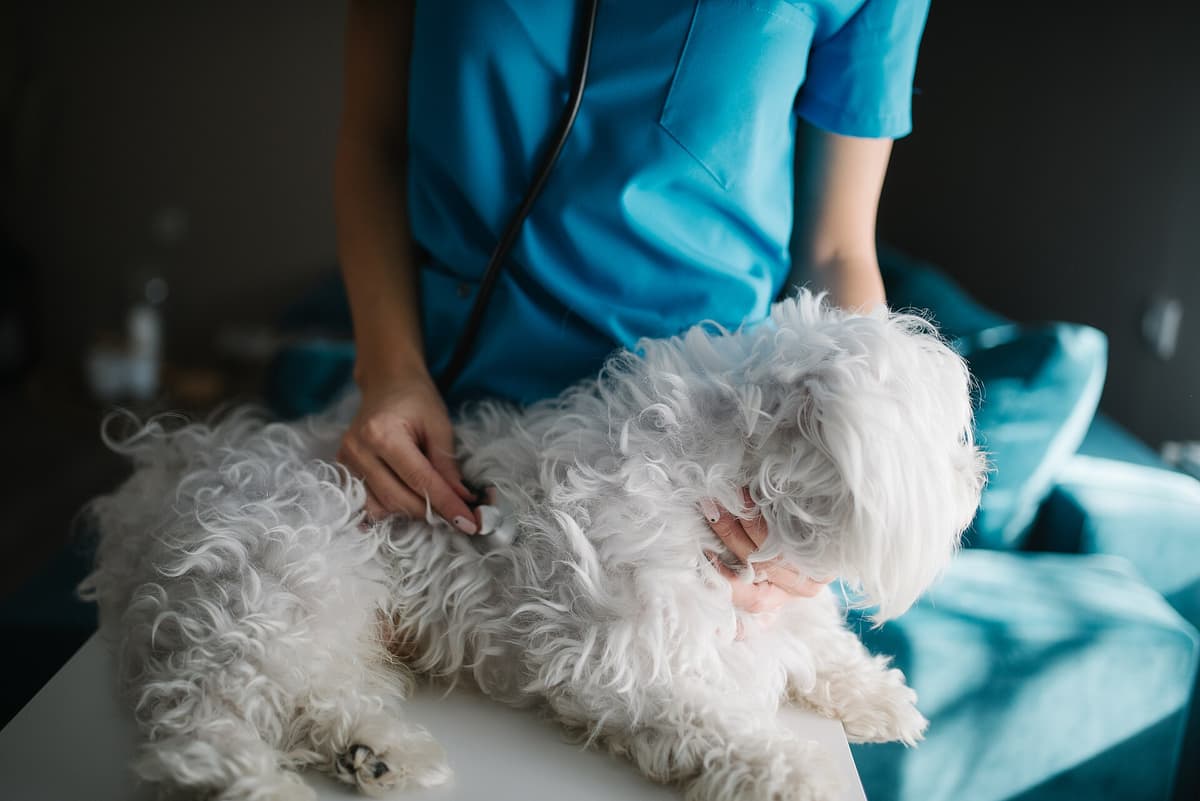
A routine exam. Photo: Nenad Stojkovic / Wikimedia Commons (CC BY 2.0).
The 7 early signs of arthritis in dogs
Osteoarthritis is a disease of the whole joint — cartilage loss, low-grade inflammation, and altered load through the limb. That combination produces a fairly consistent set of early behaviours, even though every dog is different. The pattern matters more than any single observation: one slow morning is noise, the same slow morning for three weeks is a signal.
1. Stiffness after rest that "warms out"
This is the classic sign, and the easiest to dismiss. A dog with early arthritis is stiff when first getting up from a nap or after a long car ride, then loosens up over the first few minutes of walking. Healthy dogs do the reverse — they stiffen as exercise goes on.
What to look for at home: time it. Count the seconds from the cue to stand to all four feet planted. Ten seconds is not a diagnosis, but a number that creeps from three to ten over a few months is exactly the kind of trend a vet can work with.
2. A new reluctance on stairs
Stairs ask a dog to load a flexed joint and push body weight uphill, which is why they are often the first place owners notice trouble. Early on, the dog still goes up but hesitates at the first step, or takes them one at a time, or waits to be carried. Going down is frequently harder than going up, because the forelimbs absorb the braking load.
Small dogs with patellar luxation may skip a step entirely rather than push through a flexed knee. The skip is more informative than the hesitation.
3. Shorter walks, and lagging behind
Dogs do not usually refuse a walk. They shorten it. The route that used to loop the park becomes the block; the block becomes the driveway. Owners read that as the owner's own schedule changing, or the weather.
If your walks have quietly contracted over three months, measure one route: same path, same time of day, and note where the dog first starts to lag. Distance to first lag is a decent home proxy for exercise tolerance, and it moves in a way you can see.
4. Hesitation before jumping
Jumping off a sofa, a bed, or into the boot of a car produces a load well above body weight through the front limbs. A dog with an uncomfortable elbow or shoulder does not always refuse — it pauses, circles, or waits for you to lift it. That pause is the sign.
Be careful here: lifting a 35 kg dog off the furniture for a year is not a solution, but neither is letting it keep launching. Ramps and steps exist for the transition period while the pain is being managed.

Reluctance to jump up or down from furniture is one of the earliest changes owners notice. Photo: Slyronit / Wikimedia Commons (CC BY-SA 4.0).
5. A change in gait — the head, the nails, the swing
Owners watch the face; vets watch the walk. Three early gait changes are worth knowing:
- Head bob. With a painful forelimb, the head drops as the good leg takes weight and lifts as the sore leg lands, so the dog appears to nod with every stride.
- Reduced stride length. The affected leg takes visibly shorter steps, and the dog may swing it outward to avoid flexing the joint.
- Nails scuffing or dragging. Less comfortable flexion means the paw clears the ground by less. Note this one carefully: dragging nails is also a neurologic sign, which is one of several reasons it should be examined rather than supplemented.
A phone video of your dog walking away from you and back, then trotting, is more useful to your vet than any description. Take it before the appointment, not during.
6. Licking one joint, or flinching when it is handled
Dogs with joint pain groom and lick the sore area, sometimes enough to stain the fur or create a lick granuloma. You may also notice a flinch when you dry a leg with a towel, trim nails, or lift the dog into a bath.
Alongside this, look for muscle loss. A dog that shifts weight off one hind limb uses that leg less, and the thigh on that side can look thinner after a few months. Muscle loss is a late-ish finding rather than an early one, but it is visible in the mirror in a way that subtle lameness is not.
7. Behaviour and sleep changes
Pain in dogs shows up as irritability more often than as crying. Watch for a dog that no longer wants to be brushed on one side, growls when another pet approaches its bed, gets restless or paces at night, or has started sleeping in a different position or room. Sleep disruption in particular tracks with pain severity, and owners tend to notice "he doesn't settle any more" long before "he's lame".
Signs by breed and age — when to look harder
The seven signs are the same across breeds, but the timeline is not:
- Large and giant breeds (Labrador, Golden Retriever, German Shepherd): hip and elbow dysplasia can produce radiographic change by two years of age. Start watching before middle age.
- Small breeds (Pomeranian, Chihuahua, Yorkshire Terrier, French Bulldog): patellar luxation is the common route to early arthritis; a skip in the gait is the sign.
- Long-backed breeds (Dachshund and other chondrodystrophic breeds): disc disease produces neurologic signs — wobbliness, knuckling, incontinence — which owners sometimes mistake for arthritis in the back legs.
If your dog is on any of those lists, or is simply past seven or eight, the annual exam is the wrong interval for joint questions. Bring the gait video and the four numbers below.
What looks like arthritis but is not
Slow, stiff, unwilling to move is a pattern with several causes, and only one of them is osteoarthritis:
- Hypothyroidism — a middle-aged or older dog that is sluggish, gaining weight, and seeking warmth. Our guide to hypothyroidism in dogs explains the testing.
- Cruciate ligament rupture — sudden onset, often with a toe-touching lameness and a click heard or felt at the knee; typically a surgical conversation, not a supplement one.
- Intervertebral disc disease — dragging a limb, knuckling the paw, or losing bladder control. This is an emergency.
- Bone pain and other diseases — a young large-breed dog with limb pain, or any dog with pain in one bone that does not respond to rest, needs imaging.
- Dental or abdominal pain — a dog with a painful mouth or abdomen also moves cautiously, eats differently, and sleeps poorly.
The point is not to frighten you into a workup for every slow morning. It is that "arthritis" is a diagnosis made by examination and imaging, not a feeling you confirm at home.
How vets confirm it — and what the visit actually checks
A standard joint workup is less mysterious than it sounds: watching the dog walk and trot, palpating each joint through its range of motion, checking for joint swelling and muscle bulk, then radiographs under sedation if the findings justify it. Radiographs show the bony changes of osteoarthritis but not pain itself, which is why vets increasingly pair them with owner-completed questionnaires — the Canine Brief Pain Inventory, which detected carprofen response against placebo in a 70-dog trial (Brown et al., 2008), or the Liverpool Osteoarthritis in Dogs scale.
Bloodwork commonly comes first. A baseline panel gives your vet the liver and kidney values needed to prescribe safely if long-term anti-inflammatory drugs are on the table; the senior dog blood panel guide explains what is included. Do not give human painkillers from the cupboard in the meantime — several common ones are toxic to dogs at ordinary human doses.
What to do in the next two weeks
- Weigh the dog on a clinic scale or a home scale you trust, and write it down. Weight is the one lever that changes the load on every joint immediately.
- Record four numbers for a week: seconds to rise, stairs (confident / hesitant / refuses), distance to first lag on a fixed route, and night-time restlessness.
- Take two videos: walking away, and trotting back, on a hard surface.
- Book the exam and bring all of it. Owners who arrive with three weeks of notes get a faster, more specific plan than owners who arrive with an impression.
If the dog is overweight, weight loss is not a cosmetic project: in obese dogs with osteoarthritis, sixteen weeks of weight loss averaging 6.1% of body weight reduced lameness scores, with further improvement on force-plate gait analysis at 8.85% loss (Marshall et al., 2010). The calorie calculator gives a starting number; adjust against the scale every two weeks.
For the full picture of what causes joint disease in the first place — breed genetics, growth rate, body weight and home surfaces — read dog joint health: genes, climate and nutrition. It also grades which of the popular claims actually have evidence behind them.
Symptoms & when to worry
Most of this article describes a slow disease you can plan around. These presentations do not wait for a routine appointment:
- Sudden inability to bear weight on a limb
- A joint that is hot, swollen and painful to touch, especially with fever
- A dragging hind limb, knuckled paw, or loss of bladder or bowel control (think disc disease)
- Crying out when lifted, or a dog that cannot settle in any position
- Lameness with vomiting, lethargy or lost appetite
- Pain in a single bone, or swelling that grows over weeks
What to track between visits
Arthritis is managed on trends. Keep one place for weight, medication, the four numbers above, and any lab results — the pattern between doses is often what tells your vet whether a drug is working or wearing off. PetzDay is free for that: start at petzday.com/register, and browse the rest of the condition guides in the article library.
FAQ
How early can arthritis be detected in dogs?
Radiographic changes can be present by two years of age in high-risk large breeds, and nearly 40% of dogs under four in one study had them even without a diagnosis. Detection is limited more by what owners report than by what imaging can see.
Is limping always the first sign?
No. Most owners notice stiffness after rest, hesitation on stairs, or a shortened walk before they notice a limp. Constant lameness is usually a later stage or a different problem, such as a cruciate rupture.
Can a young dog get arthritis?
Yes — developmental conditions like hip dysplasia, elbow dysplasia and patellar luxation cause secondary osteoarthritis at a young age. Age is a risk factor, not a requirement.
Do I need a vet visit if the signs are mild?
Yes, once, for a baseline. Mild signs are the best time to establish weight, bloodwork and a gait record, and to rule out the conditions that look like arthritis but are not.
References
- VCA Hospitals — Arthritis in dogs: signs and prevalence
- Enomoto et al. 2024 — Radiographic osteoarthritis prevalence in young dogs
- Brown et al. 2008 — Canine Brief Pain Inventory detects treatment response
- Alves et al. 2023 — Minimal clinically-important differences for LOAD and COI
- Marshall et al. 2010 — Weight loss and lameness in obese dogs with osteoarthritis
- VCA Hospitals — Luxating patella in dogs
- VCA Hospitals — Intervertebral disc disease in dogs
- Merck Veterinary Manual — Disorders of the spinal column and cord in dogs
- AAHA — 2022 Pain Management Guidelines for Dogs and Cats
- Monteiro-Steagall et al. 2013 — Systematic review of NSAID-induced adverse effects in dogs
All web sources accessed November 2026.
Last reviewed: November 9, 2026. This article is for general education and does not replace an examination by your veterinarian. Follow your vet's guidance for all testing, medication, and treatment decisions.