Anemia in Cats: Causes, Signs & What the Blood Work Shows
Anemia in cats means the red blood cell count, hemoglobin, or hematocrit has fallen below the range printed on the lab report — many laboratories call a cat anemic below a PCV of about 25% (Cornell Feline Health Center; VCA, 2023). The key branch point is whether the anemia is regenerative, because that separates blood loss and destruction from chronic kidney disease, retrovirus infection, and bone marrow disease.
Anemia in cats means a red blood cell mass below the reference range — hematocrit (HCT) or packed cell volume (PCV), hemoglobin, or red blood cell count — and many labs treat a cat as anemic below a PCV of about 25% (Cornell Feline Health Center; VCA, updated 2023). It is not a disease in itself: it results from blood loss, red cell destruction, or reduced production (VCA, 2023). The key branch point is whether the anemia is regenerative (Merck Veterinary Manual, 2026).

Pale gums plus lethargy is the pair that should trigger blood work the same day.
Anemia in cats: what the numbers mean
In one sentence: HCT/PCV, hemoglobin, and RBC count describe how much red cell mass is circulating, and the reticulocyte count shows whether the marrow is trying to replace it.
Hematocrit (HCT) and packed cell volume (PCV) are the percentage of blood volume taken up by red cells. Below roughly 25% is generally called anemic (Cornell Feline Health Center; VCA, 2023); PetzDay's reference range tool lists 30%–45%, which is why the printed range wins. HCT is calculated from MCV × RBC count, while PCV is measured after centrifugation, so the two can disagree (eClinPath).
Hemoglobin (HGB) is the oxygen-carrying protein inside red cells, and RBC is the red cell count. Dehydration can make all three look better than they are by concentrating the blood (eClinPath). See our complete blood count guide for the full report.
Regenerative versus non-regenerative. A regenerative anemia means the marrow is releasing reticulocytes; a non-regenerative anemia means it is not (Merck, 2026). The response takes 3–5 days, so a cat who bled yesterday can still look non-regenerative (Merck, 2026). Cats differ from dogs: only aggregate reticulocytes are counted, and above about 50,000/µL is regenerative (Merck, 2026); punctate reticulocytes persist up to 21 days and do not prove a current response (eClinPath).
Our guide to reticulocytes and anemia in dogs explains the canine 60,000/µL cutoff. Those are dog numbers — the feline threshold is lower, the cell type counted differs, and a dog-style reading will mislabel a cat's response.
Causes of anemia in cats
In one sentence: most feline anemia falls into three buckets — blood loss, red cell destruction, and reduced production — and chronic kidney disease is a leading cause of the reduced-production kind (Cornell Feline Health Center).
- Chronic kidney disease. The kidneys make erythropoietin, the hormone that signals red cell production; as kidney tissue is lost, that signal weakens, and 30%–65% of cats with advancing CKD develop anemia (Cornell Feline Health Center, 2021).
- FeLV and FIV. FeLV can suppress the marrow, cause anemia of chronic disease, or trigger immune-mediated destruction; FIV is also linked to marrow suppression (VCA, 2023; Cornell Feline Health Center).
- Blood loss. Fleas and ticks are a major cause, especially in kittens, and hookworms, intestinal ulcers, and bleeding tumors can leak slowly enough that you never see it (Cornell Feline Health Center; VCA, 2023). Black stool or a falling PCV with no visible wound deserves a search for internal loss.
- Immune-mediated hemolytic anemia (IMHA). The immune system tags the cat's own red cells; triggers include drugs, cancer, FeLV, and FIP, and some cases have no identified trigger (Cornell Feline Health Center). IMHA is often regenerative, can be life-threatening, and is treated mainly with immunosuppression.
- Bone marrow disease. Cancer, inflammation, immune-mediated marrow disease, myelodysplasia linked to FeLV, and toxic injury can reduce production, as can chronic inflammation elsewhere (anemia of chronic disease) (Cornell; Merck, 2026). A non-regenerative anemia with other low cell lines may need a marrow sample (VCA, 2023).
- Nutrition. Iron deficiency is rare in cats and develops only with severe chronic blood loss or a very unbalanced diet (VCA, 2023). Do not start iron on your own.
Symptoms & when to worry
In one sentence: pale gums are the classic sign, but many anemic cats simply seem tired, because cats compensate until they cannot (Cornell Feline Health Center; VCA, 2023).
- Pale or white gums — the most easily seen sign; check in natural light (VCA, 2023).
- Lethargy and weakness — sleeping more, jumping less, lagging on stairs.
- Faster breathing or heart rate, especially after mild activity (Cornell Feline Health Center).
- Jaundice — yellow gums, ear leather, or eye whites, pointing toward red cell destruction (Cornell).
- Black stool, not eating, or weight loss — signs of the underlying disease or internal blood loss (Cornell).
- Pica — eating litter, plastic, or fabric can be triggered by anemia, among many other causes (VCA, 2025).
When to worry. Rapid breathing at rest, open-mouth breathing, collapse, or a cat who is weak and yellow is an emergency — call your vet or an emergency hospital now. A falling PCV matters more than a single low number, and severe anemia can become critical quickly (Cornell Feline Health Center). If your cat is merely quieter, book a visit.
How vets work it up
In one sentence: the workup answers two questions in order — is the cat truly anemic, and is the bone marrow responding?
- Confirm the anemia, check hydration, and count reticulocytes. Dehydration can mask anemia by concentrating the blood (eClinPath); only aggregate reticulocytes are counted in cats, and above about 50,000/µL is regenerative (Merck, 2026).
- Read the blood smear. Polychromasia, red cell shape, parasites such as Mycoplasma haemofelis, and agglutination all show up here; a slide agglutination test can support IMHA (VCA, 2023; Cornell).
- Run a chemistry panel. Kidney values (BUN, creatinine, SDMA), liver values, and protein help identify CKD and other causes; our guide to kidney values explains the numbers.
- Screen for infection. An anemic cat should be tested for FeLV and FIV (VCA, 2023).
- Image and sample if needed. X-rays or ultrasound for bleeding or tumors, and a bone marrow aspirate or biopsy if the marrow is not responding (Cornell Feline Health Center; VCA, 2023).
Diet & monitoring
In one sentence: diet rarely fixes anemia in cats — the exceptions are a documented nutritional deficiency or kidney disease, where the diet is prescribed for the kidney disease, not the anemia (Cornell Feline Health Center; VCA, 2023).
Do not self-prescribe iron or B vitamins. Iron deficiency is rare in cats and develops only with severe chronic blood loss or a very unbalanced diet (VCA, 2023), so iron will not fix an anemia caused by kidney disease or bleeding.
If CKD is the cause, the renal diet and hydration strategy are veterinary decisions. Anemia may be treated with darbepoetin in some cats; Cornell notes it resolves anemia in 60%–65% of CKD cats but requires weekly injections and close monitoring. If IMHA is the cause, immunosuppression is the treatment and diet is supportive only.
What to track between visits: gum color, resting breathing rate, weight, appetite, water intake, and PCV rechecks.
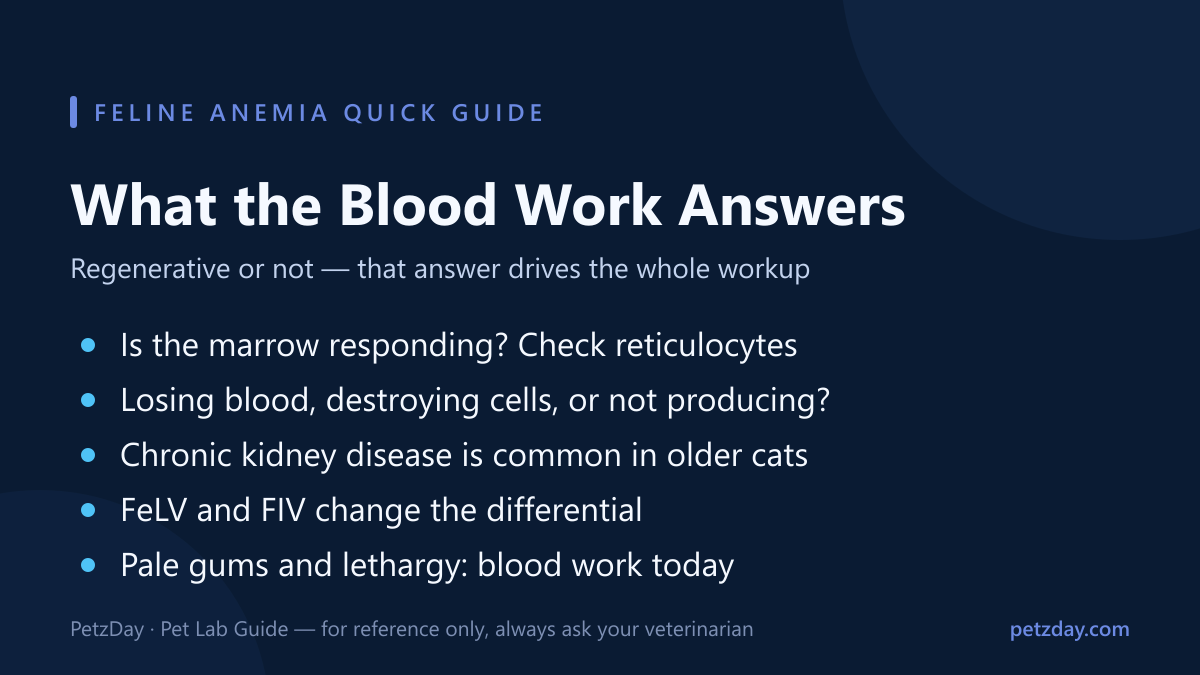
Anemia in cats quick reference
- What it is: HCT/PCV, HGB, or RBC below the lab's reference range (Merck, 2026).
- Typical feline PCV: 25%–45%; below 25% is generally anemic (Cornell; VCA, 2023).
- Regenerative cutoff: above about 50,000 aggregate reticulocytes/µL in cats (Merck, 2026); dogs use a different cutoff.
- Common cause in older cats: chronic kidney disease — 30%–65% of affected cats develop anemia (Cornell, 2021).
- Emergency signs: open-mouth breathing, collapse, or jaundice with weakness (Cornell).
FAQ
What is a normal hematocrit for a cat?
Many laboratories use roughly 25%–45%, and a PCV below 25% is generally called anemic (Cornell Feline Health Center; VCA, 2023). Some labs print a narrower range — PetzDay's tool lists 30%–45% — so the range on your cat's report decides whether the value is flagged.
Can anemia in cats be cured?
Sometimes. Anemia from parasites or acute blood loss often resolves once the cause is treated, while IMHA usually needs immunosuppression and CKD anemia is managed rather than cured (Cornell Feline Health Center; VCA, 2023). Prognosis depends on the cause and how early it is found.
What do low red blood cells in cats look like at home?
Often little. Cats may sleep more, play less, or seem weak, and pale gums are easy to miss at home (VCA, 2023). Jaundice, black stool, or fast breathing are later signs and should prompt a call to your vet (Cornell).
Should I give my anemic cat iron supplements?
Not without a diagnosis. Iron deficiency is rare in cats and develops only with severe chronic blood loss or a very unbalanced diet (VCA, 2023), so iron is unlikely to be the answer. Ask your vet first.
Keep every CBC in one place
Create a free PetzDay account to keep every lab report, PCV trend, and note in one timeline, or browse our full library of plain-English lab guides. For the kidney side, see early signs of kidney disease in cats.
References
- Cornell Feline Health Center — Anemia — last updated 2021
- VCA Animal Hospitals — Anemia in Cats — updated October 2023
- VCA Animal Hospitals — Pica in Cats — anemia listed among causes of pica
- Merck Veterinary Manual — Overview of Anemia in Animals — updated March 2026
- eClinPath (Cornell University) — Assessment of Regeneration — aggregate versus punctate reticulocytes in cats
- eClinPath (Cornell University) — Hematocrit/packed cell volume — HCT versus PCV, dehydration effects
Last reviewed: November 27, 2026. This article is for general education and does not replace an examination by your veterinarian.