IMHA in Dogs (Immune-Mediated Hemolytic Anemia): Signs, Diagnosis & Treatment
IMHA in dogs is an emergency: the immune system destroys red blood cells faster than the bone marrow can replace them, so pale or yellow gums, weakness, and dark urine mean a same-day exam. Most dogs need glucocorticoids, many need a transfusion and a second immunosuppressant, and relapse is common — here is how vets confirm the diagnosis, what treatment looks like, and what owners monitor during months of tapering.
IMHA in dogs — immune-mediated hemolytic anemia — is an immune attack on the dog's own red blood cells, and it is one of the few abnormal blood-test findings that counts as an emergency. Antibody-coated red cells are pulled out of circulation by the spleen and liver, or burst inside blood vessels, faster than the bone marrow can replace them (eClinPath; VCA, 2023). Most affected dogs are severely anemic on arrival, many need a transfusion within hours, and pale or yellow gums plus weakness should send you to a veterinarian the same day — not into a wait-and-see week.
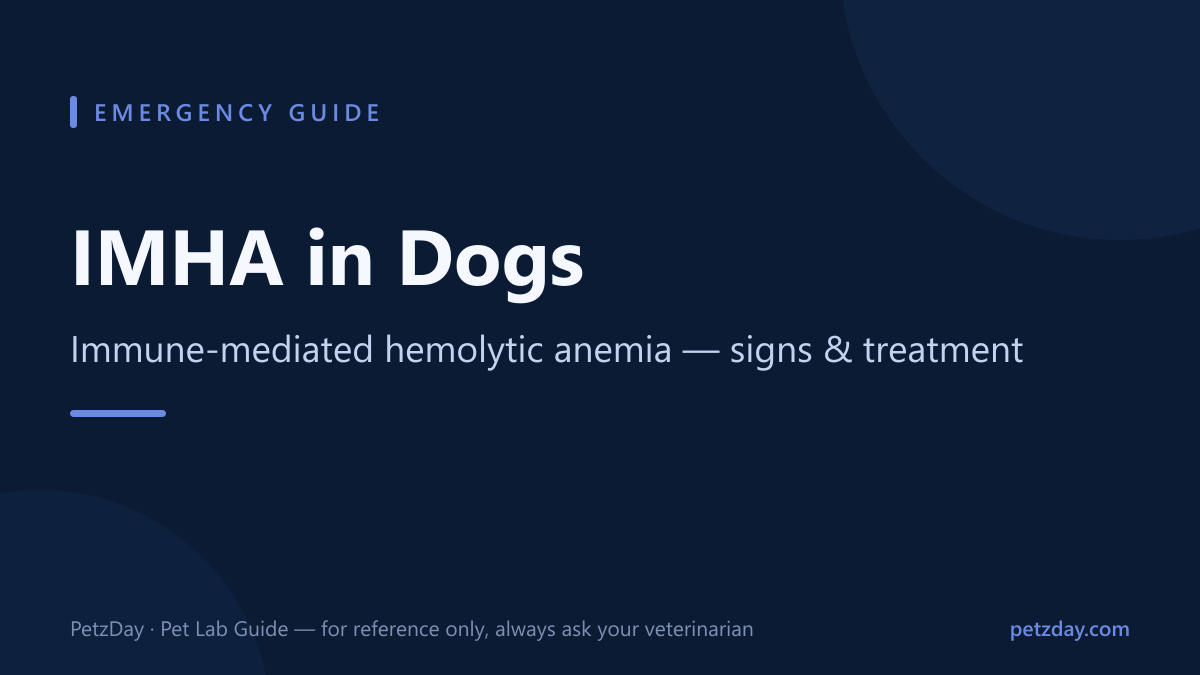
Pale or yellow gums with sudden weakness is an emergency — call ahead before you drive.
What IMHA in dogs is (immune-mediated hemolytic anemia)
IMHA is an autoimmune disease in which the immune system stops recognizing red blood cells as "self" and makes antibodies against them (Merck, 2026). Most destruction happens outside the bloodstream, where coated red cells are removed early by macrophages in the spleen, liver, and bone marrow; some dogs also lyse red cells inside vessels when complement fixes on the membrane (eClinPath). Hemoglobin is then released faster than the liver can process it, which is why jaundice and dark urine accompany the anemia.
- Primary (idiopathic) — roughly three-quarters of canine cases, with no trigger identified (VCA, 2023).
- Secondary — cancer is the most commonly identified secondary cause in dogs; infections (Ehrlichiosis, Leptospirosis, Babesiosis, Mycoplasma), drug reactions, snakebite, toxins, and bee stings are also listed, and Merck adds vaccinations (VCA, 2023; eClinPath; Merck, 2026).
- Breed clustering — Cocker Spaniels and Old English Sheepdogs appear at higher risk (eClinPath).
- Severity — in a 456-dog anemia study, IMHA was 13% of cases but overrepresented among the most severe anemias, under 20% hematocrit (eClinPath).
Symptoms & when to worry
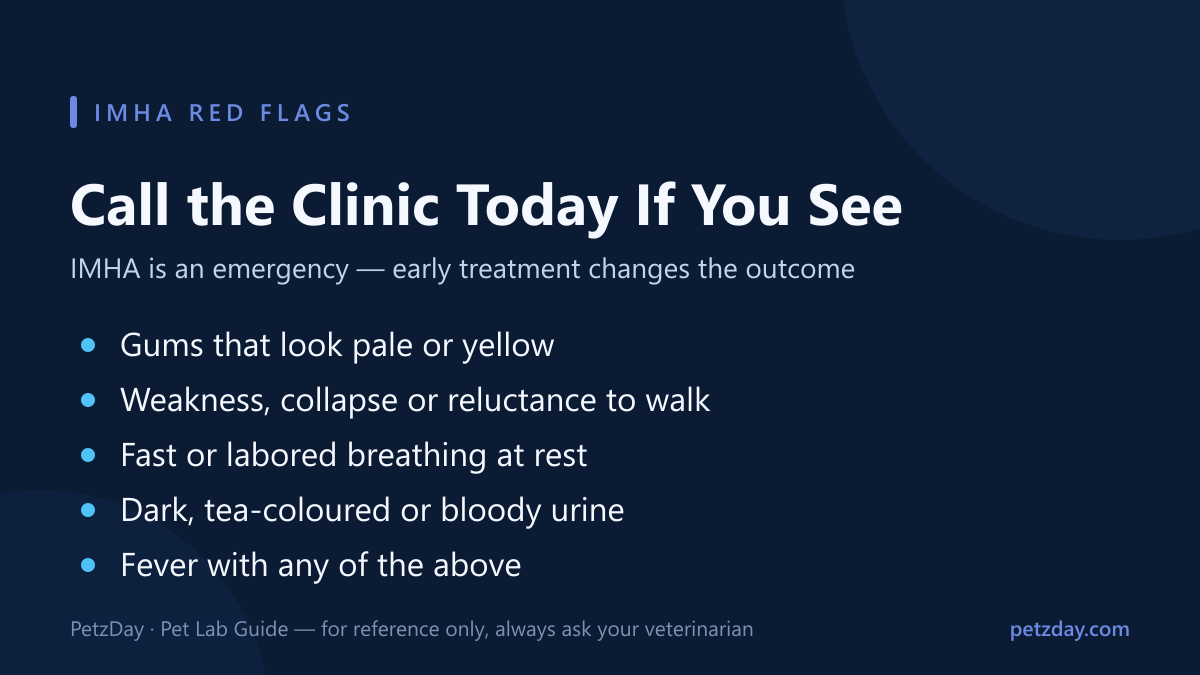
Pale gums are usually the first sign owners notice, and jaundice together with weakness is a same-day emergency (VCA, 2023; Merck, 2026).
- Pale gums — pink fading toward pale pink or white; the classic sign of severe anemia (VCA, 2023)
- Yellow gums, skin, or eyes (icterus) — bilirubin buildup; icterus is usual in IMHA (Merck, 2026)
- Dark, orange, or tea-colored urine — bilirubin spilling into urine (VCA, 2023)
- Weakness, listlessness, fainting, or disorientation — from low oxygen delivery (VCA, 2023)
- Fast breathing or a racing heart — compensation for the anemia (VCA, 2023)
- Fever, an enlarged spleen, vomiting, or poor appetite — common, and easy to write off as "just off" (Merck, 2026; VCA, 2023)
Go to an emergency hospital now if your dog has yellow gums or eyes with weakness, collapses, breathes with effort at rest, or has white gums. Call ahead so the team can prepare blood products. Some dogs are caught on routine bloodwork before they look sick; that still needs a prompt workup, on your vet's timeline.
How IMHA is diagnosed
No single test confirms IMHA. Vets combine anemia, evidence that the immune system is attacking red cells, and evidence of hemolysis, while ruling out infections and cancer that can mimic it (Merck, 2026; eClinPath).
- Complete blood count. Hematocrit, hemoglobin, and red-cell count are usually low, often severely; our CBC guide walks through each line.
- Reticulocyte count. A regenerative response supports hemolysis or blood loss, but the marrow needs about 3–5 days, so the first sample can look non-regenerative (Merck, 2026; eClinPath); our reticulocyte guide explains the timing.
- Blood smear. Moderate to many spherocytes support IMHA in dogs, but small numbers appear in other conditions, including after transfusion (eClinPath).
- Saline agglutination test. Diluting blood in saline at roughly 1:4 to 1:10 disperses rouleaux while true agglutination persists (eClinPath).
- Direct Coombs (antiglobulin) test. It detects antibody or complement on red cells; results are supportive, with false positives and negatives documented (eClinPath; Merck, 2026).
- Infectious disease testing. The ACVIM consensus statement recommends a workup that includes testing for infectious agents (Merck, 2026); Babesia, Ehrlichia, Mycoplasma, Leptospira, and heartworm are the usual targets (VCA, 2023).
- Chemistry, urinalysis, and imaging. High bilirubin, liver enzyme changes, bilirubin in urine, and imaging for hidden cancer complete the picture (VCA, 2023; eClinPath).
Merck's clinical definition is a useful yardstick: at least two signs of immune-mediated destruction (spherocytes, autoagglutination, or a positive Coombs test) plus at least one sign of hemolysis (high bilirubin, or hemoglobin in plasma or urine) (Merck, 2026). Thrombocytopenia is common alongside IMHA, so platelet and clotting tests often run in parallel.
Treatment
Glucocorticoids are first-line treatment for IMHA, and many dogs also need a transfusion plus a second immunosuppressive drug — all of it chosen and adjusted by your vet, not at home, with any secondary cause treated alongside (Merck, 2026; VCA, 2023).
- Transfusion. Packed red cells are usually required, with crossmatching first (Merck, 2026; VCA, 2023).
- Prednisone or prednisolone. The standard first-line immunosuppressive treatment in dogs (Merck, 2026).
- Second-line drugs. Mycophenolate, cyclosporine, or azathioprine are added for life-threatening disease, transfusion dependence, or expected severe steroid effects (Merck, 2026).
- Clot prevention. Dogs with IMHA are prone to pulmonary thromboembolism; the ACVIM consensus statement favors clopidogrel over aspirin when an antiplatelet drug is used (Merck, 2026; VCA, 2023).
Do not start, stop, or change the dose of any of these drugs on your own. Steroids are tapered on a schedule, and stopping abruptly can trigger a relapse or a crisis. Never give human pain relievers such as ibuprofen or acetaminophen. Heavy thirst, frequent urination, a ravenous appetite, and panting are expected; vomiting, black stool, weakness, or difficulty breathing are not, and should be reported the same day.
Prognosis and what owners monitor
Many dogs improve with treatment, but relapses are common, so monitoring continues through months of tapering (VCA, 2023); your vet rechecks the CBC before each dose reduction.
What to track at home:
- Gum color — daily, in daylight, at the same spot along the gum line
- Breathing rate at rest — a rising rate can signal worsening anemia or a clot
- Urine color — dark or orange urine suggests ongoing hemolysis
- Energy, appetite, and water intake — appetite often climbs on steroids; note the new baseline
- Bruising, nosebleeds, or blood in stool — possible clotting problems, worth a call
Keep every CBC in one timeline so the trend is visible, not just isolated numbers. PetzDay stores results, dates, medications, and notes in one place your vet can read at rechecks — create a free account. Our emergency card generator puts the diagnosis, drugs, and clinic number on one card for sitters and family.
IMHA in dogs: quick reference
- What it is — immune-mediated destruction of red blood cells; an emergency, not a watch-at-home problem
- Classic signs — pale or yellow gums, weakness, fast breathing, dark urine, sometimes fever
- Emergency trigger — jaundice plus weakness: go now
- Diagnosis — no single test; CBC, smear findings, Coombs, and infection testing together
- Treatment — steroids first, often a transfusion and a second drug; tapering takes months
FAQ
Can IMHA come back in dogs?
Yes — relapses are common, and risk is highest while doses are being reduced or after treatment stops (VCA, 2023). That is why vets taper slowly and recheck bloodwork before each step down, and why a dog who seems recovered should still be watched for pale gums, weakness, or dark urine.
Can vaccines or medications trigger IMHA in dogs?
Vaccinations and drugs are both listed among possible secondary triggers, and drug reactions are documented in animals (Merck, 2026; eClinPath). A reported association is not proof of cause, and most canine cases are primary (VCA, 2023). Do not skip core vaccines on your own; ask your vet how to weigh timing against your dog's history.
How long does IMHA treatment last?
Typically several months: most dogs start on immunosuppressive doses and are tapered gradually once the hematocrit is stable, with rechecks along the way (VCA, 2023). Some need longer courses, and a relapse restarts the clock — your vet sets the schedule.
Can a dog survive IMHA?
Many dogs can be managed with appropriate treatment, and the outlook depends on the diagnosis, severity at presentation, and complications such as clots (VCA, 2023; Merck, 2026). Because deterioration can be fast, early treatment matters more than any single lab value — your vet will give you a realistic picture for your dog.
What are the first signs of IMHA in dogs?
Pale gums and unusual tiredness usually come first, followed by yellow gums or eyes, dark urine, faster breathing, and sometimes fever or vomiting (VCA, 2023; Merck, 2026). Some dogs are caught on routine bloodwork with no obvious signs — ask your vet what the hematocrit trend means.
References
- eClinPath (Cornell University) — Causes of Anemia — IMHA mechanism, spherocytes, agglutination, Coombs testing, breed risk, concurrent thrombocytopenia
- eClinPath (Cornell University) — Assessment of Regeneration — reticulocyte response and the 3–5 day window
- eClinPath (Cornell University) — Red Blood Cell Patterns — rouleaux versus true agglutination on the smear
- Merck Veterinary Manual — Regenerative Anemias in Animals — ACVIM-based diagnostic criteria, first-line and adjunctive treatment, thromboembolism risk
- Merck Veterinary Manual — Overview of Anemia in Animals — regenerative versus non-regenerative framework and marrow response timing
- VCA Animal Hospitals — Autoimmune Hemolytic Anemia in Dogs — signs, primary versus secondary causes, transfusion, tapering, relapse (updated September 2023)
- VCA Animal Hospitals — Anemia in Dogs — clinical signs of anemia and what a CBC shows
All web sources accessed October 27, 2026.
Last reviewed: November 13, 2026. This article is for general education and does not replace an examination by your veterinarian. IMHA is an emergency condition; follow your vet's guidance for all testing, medication, and monitoring decisions.