How to Organize Pet Records When You See Multiple Vets
Pet records are the running story of your pet's health — and when a dog or cat sees more than one vet, those records often sit in separate files that don't talk to each other. Here's a simple master-record system: what to track, what to request from each clinic, and how to close the gaps so every vet sees the same history.
Pet records are the running story of your pet's health — and when a dog or cat sees more than one vet, those records often live in two or three separate files that don't talk to each other. Organizing them comes down to two habits: keep one master list of the essentials (vaccinations, medications, lab results, diagnoses, and who did what when), and request a copy of the official record from every clinic along the way. You don't need to be the one interpreting the medicine — you just need to close the gaps so every vet sees the same history.
One master file closes the gap between clinics — but always request the official records too.
Why pet records get scattered across multiple vets
The most common gap isn't a missing document — it's a document that exists but was never shared between clinics. A pet might see a primary vet, a specialist, and an emergency hospital in the same year, and each keeps its own record.
- Specialists and emergency visits create parallel files. A dermatologist's notes or a 2 a.m. emergency visit often don't reach your regular vet automatically.
- Requests stall without a follow-up. Clinics are busy, and a faxed or portal request can sit unanswered without a reminder.
- Moves, boarding, and new providers split the history. Relocating, changing clinics, or using a groomer or boarding facility can scatter copies across several places.
- Human memory fades. Vaccine dates, a past reaction to a drug, or the year a chronic condition started are easy to misremember years later.
None of this means anyone did anything wrong — it's how paper-and-portal record keeping works when care is spread across more than one practice.
What belongs in a master pet health record
A master pet health record only needs the items every clinician asks for first. You can keep it on a single page.
- Identification — name, species, breed, sex, age or date of birth, and microchip number.
- Vaccination history — which vaccine, the date it was given, and which veterinarian or clinic gave it (AVMA).
- Current medications and supplements — name, dose, how often, and when the dose last changed.
- Chronic conditions and allergies — diagnosed conditions, plus any known food, drug, or environmental reactions.
- Lab and imaging reports — keep the whole report, not just the number, because reference ranges are set by each laboratory (eClinPath, Cornell University).
- Procedures and surgeries — spay/neuter, dentals, and any anesthesia notes if the clinic provides them.
- Contacts — your primary vet, specialists, and the nearest emergency hospital.
How to organize pet records when you see multiple vets
A simple routine keeps pet records organized without turning your kitchen into an archive. Do it once, then update it after every visit.
- Request a copy at every visit — or right after. Ask for the visit summary, lab results, and any updated vaccination certificate before you leave.
- Keep one master folder, paper or digital. Use the seven-item checklist above and update it the same day as the appointment.
- Log every medication change with the date. Dose increases, new prescriptions, and stopped medications all matter when a new vet reviews the history.
- Store lab reports with their reference ranges. Each lab prints its own normal ranges; keeping the report lets the next vet compare like with like (eClinPath).
- Bring a summary to every new vet. A one-page list beats a shopping bag of paper — and you can offer the official records to be sent separately.
For lab-heavy histories, our guide to dog blood test results explains what those reports actually mean, and a senior dog blood panel shows the tests that become routine as dogs age.
What to request from each clinic
Start with a written or portal request for a copy of the medical record — including visit notes, lab reports, imaging reports, and vaccination certificates. Every clinic that has seen your pet is a separate source: primary vet, specialists, urgent care, and emergency hospitals each keep their own file.
Rules for copies — how quickly they must be provided and whether a fee applies — are set at the state level, so the exact process varies. The practical move is to ask each clinic what it needs (a signed request, a portal form, or a direct transfer to the next vet) and to follow up if nothing arrives within a week or two. Some clinics release a summary quickly and the full record more slowly; both are worth having. If tests have to be repeated because results didn't transfer, prices are set by the hospital, so ask for an itemized estimate.
Dog medical records and cat records: the species differences
The organizing system is the same for dogs and cats; the contents differ. Dogs lean on vaccine schedules, heartworm testing, and breed-specific screening; cats lean on vaccine and FeLV/FIV status early in life, and kidney values become central as they age.
- Never compare across species. Reference ranges are species-specific — a normal value for a dog can be abnormal for a cat, so always read the lab's own range for the species tested (eClinPath).
- Cats hide illness, so a running record of weight, appetite, and water intake matters more than it does for many dogs. Our cat kidney disease guide covers the early signs to log at home.
- Vaccine names differ by species. A dog's DHPP or bordetella and a cat's FVRCP or FeLV records are not interchangeable — keep them labeled (AVMA).
Pet records quick reference
Here is the five-line version to keep inside the folder or on your phone:
- Identification + microchip number — name, species, breed, sex, date of birth.
- Vaccines — name, date, and who gave them (AVMA).
- Medications and supplements — with dose and frequency.
- Diagnoses, allergies, and procedures — with dates where known.
- Lab reports — keep the full report with the lab's reference range (eClinPath).
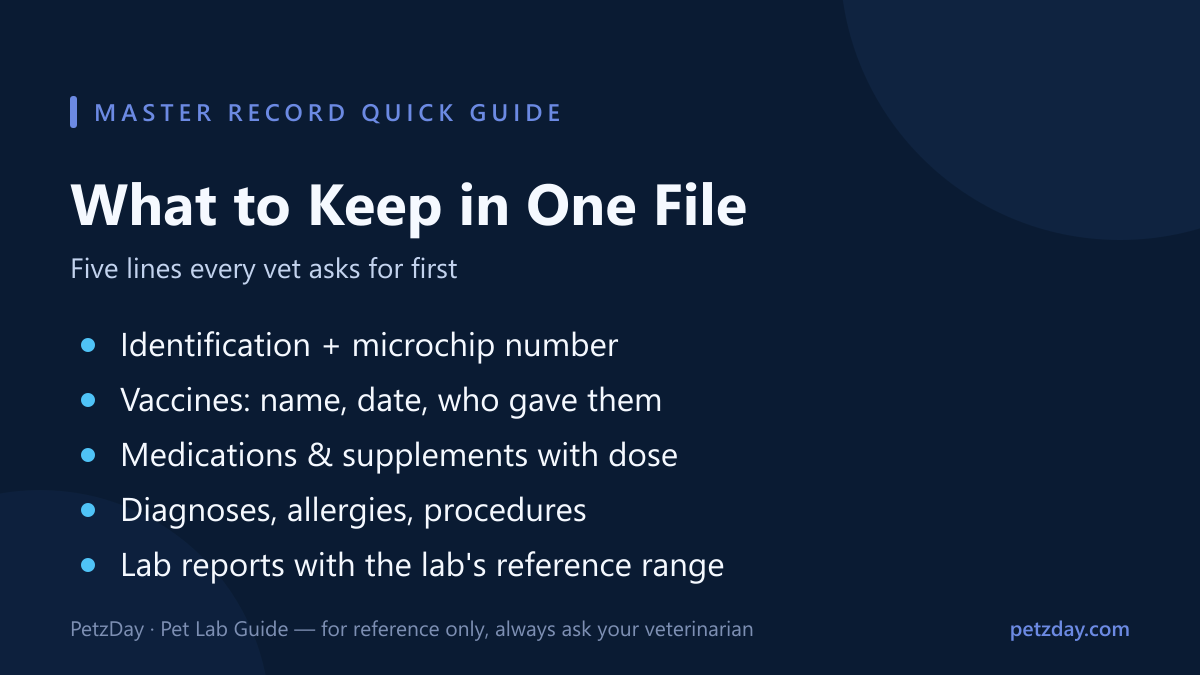
Pet records, on one card — identification, vaccines, medications, diagnoses, and labs.
A paper folder works. A digital master record helps when the vet is closed and you're standing in an emergency lobby at midnight. PetzDay is a free way to keep this master list on your phone, with results, dates, and notes in one shareable timeline — but it's your side of the story, not a replacement for the official records each clinic keeps, so request those too. Create a free PetzDay account or browse the full article library.
FAQ
How do I get my pet's records from a previous vet?
Call or message the previous clinic and ask what their release process is — many use an online portal, while others need a signed request or will transfer directly to your new vet. Request the full record (visit notes, labs, imaging, vaccines), not just the summary, and follow up if nothing arrives within a week or two.
Who owns my pet's medical records?
In the U.S., the physical record generally belongs to the veterinary practice, but owners are typically entitled to copies of the records for their pet. Timelines and fees vary by state, so ask the clinic — or your state's veterinary board — what applies where you live.
What if two vets give different advice?
Give each veterinarian the same complete picture — current medications, diagnoses, and recent labs — and ask one to coordinate care or explain how their recommendations fit together. Don't stop or change a medication on your own; any change should come from the veterinarian managing the pet.
How long should I keep pet records?
Keep them for your pet's life, plus a few years after. Old values are useful baselines — a "new" abnormal result often turns out to be a trend that started years earlier. There's no universal legal requirement for owners to retain them, but the records have real clinical value.
Is an app a safe place to store pet records?
An app is a convenient summary, not a replacement for the official records kept by each clinic. Check the app's privacy and export options, keep official copies as well, and treat the app as your portable master list rather than the source of truth.
References
- AVMA — Vaccinating your pet — vaccination records and sharing with your veterinary team
- AVMA — Pet owners — owner resources
- eClinPath (Cornell University) — Chemistry — reference intervals and lab reporting
- VCA Animal Hospitals — Know Your Pet — pet health education library
- Merck Veterinary Manual — Dog Owners — routine care for dogs
All web sources accessed October 2026.
Last reviewed: October 14, 2026. This article is for general education and does not replace an examination by your veterinarian. Follow your vet's guidance for all testing, medication, and treatment decisions.