Flying with a Dog in 2026: Airline Pet Fees Compared & In-Cabin Rules
What Delta, United, Alaska, American, JetBlue and Southwest charge to fly a dog in the cabin in 2026, the carrier size that actually fits under the seat, cargo options for larger dogs, and the rules that get pets denied at the gate.
Flying with a dog is not one decision. It is three: whether your dog is small enough to fly in the cabin, whether the airline has space left for a pet on your flight, and whether you are willing to pay a fee that is often charged each way, per carrier.
The fee is the easy part to look up. The part that ruins trips is the carrier that does not fit under the seat, the reservation that was never made for the pet, or the dog that is too old, too young or too flat-faced for the cargo hold. This guide compares the major U.S. airlines, then walks through the rules in the order they actually get checked.
This post contains affiliate links. If you buy through them, PetzDay may earn a commission at no extra cost to you. We do not list invented prices or fabricated reviews; fees below are the airlines' published in-cabin charges and should be confirmed before booking.
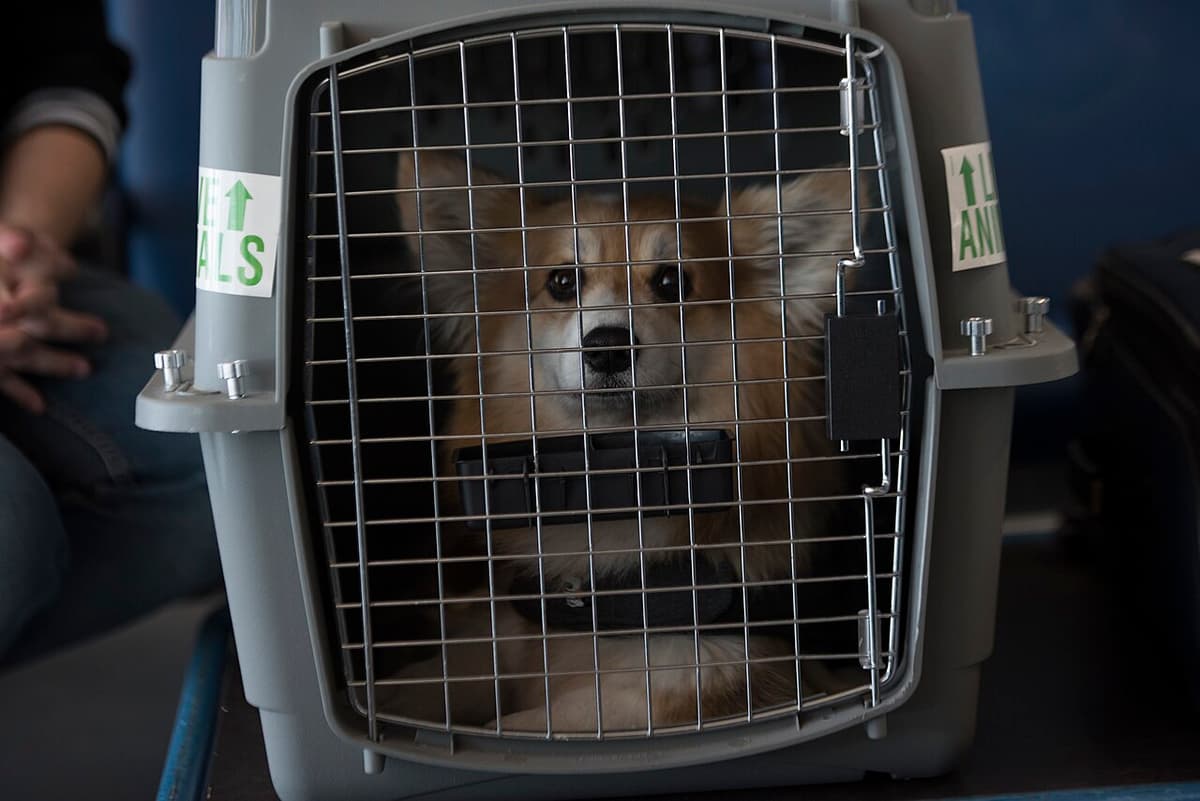
A dog in a travel carrier. Photo: U.S. Air Force photo by Airman 1st Class Taylor Slater / Wikimedia Commons (public domain).
In-cabin pet fees, compared
These are the published in-cabin fees for one pet in one carrier, each way, as of November 2026. A round trip is double. Fees are set by the airline's contract of carriage and can change without much notice.
- Alaska Airlines: $100 each way; $35 for travel wholly within Hawaii. Pets in the baggage compartment are $200 each way.
- American Airlines: $150 each way for a carry-on pet within the U.S., Canada, Mexico, Central America and the Caribbean.
- Delta Air Lines: $150 each way within the U.S., Canada, Puerto Rico and the U.S. Virgin Islands; $200 international.
- JetBlue: $150 each way.
- Southwest Airlines: $125 each way.
- United Airlines: $150 each way.
Two structural details matter more than the exact number:
- The fee is per direction, not per trip. A $150 fee is $300 for a round trip with one dog.
- A second pet usually needs a second seat and a second fee. United and JetBlue both require an adjacent seat if you bring two pets, and the pet must be in its own carrier.
United no longer sells PetSafe for the general public; pets fly in the cabin or, for active-duty military and State Department employees on orders, in cargo. American accepts checked pets only for those same groups and routes everyone else to American PetEmbark cargo. Alaska is the outlier: it still sells space in the baggage compartment to ordinary passengers, at $200 each way.
What the fee does — and does not — include
- It includes the pet, not a seat. The carrier counts as your personal item or carry-on, depending on the airline. You do not get extra legroom, and you cannot buy the pet a seat just for comfort.
- It does not guarantee space. Airlines cap the number of pets per flight. JetBlue allows six per flight; American allows up to 20 carriers across cabins on many aircraft; Delta handles cabin pets first-come, first-served within its limit.
- It does not cover the carrier, the vet visit or the health certificate. For international travel, the certificate alone can cost more than the pet fee.
- It does not cover a connection on a different ticket. If you bought two separate tickets, expect two pet fees.
In-cabin carrier limits by airline
The height limit is the one that catches people. A carrier marketed as "airline approved" can still be too tall for the seat in front of you.
- Alaska: soft-sided only, up to 17 × 11 × 9.5 inches. Hard-sided kennels are not allowed in the cabin.
- American: soft-sided 18 × 11 × 11 inches; hard-sided 19 × 13 × 9 inches on mainline flights, 16 × 12 × 8 inches on American Eagle.
- Delta: under-seat space varies by aircraft. Delta recommends a soft-sided carrier no larger than 18 × 11 × 11 inches.
- JetBlue: 17 × 12.5 × 8.5 inches. This is the tightest height limit of the group.
- Southwest and United: both publish their own limits and both vary by aircraft. Check the pet page for your specific flight rather than trusting the carrier's label.
The functional test is not the tape measure alone: your dog must be able to stand up, turn around and lie down inside the closed carrier without touching the sides. A dog who fits the bag but cannot turn around is not a dog who fits the rule.

A soft-sided carrier is the type most airlines require in the cabin. Photo: ELTORO.VET / Wikimedia Commons (CC0).
The rules that get dogs turned away
Age
Most airlines require puppies to be at least eight weeks old and fully weaned for domestic travel. There is a separate, stricter rule for entering the United States: CDC requires dogs to be at least six months old, and that applies to returning U.S. dogs too.
One pet per carrier
One pet per carrier is the default. Some airlines allow two puppies of the same breed and size under six months in one carrier; almost none allow two adult dogs. If you have two dogs, budget for two carriers and often two seats.
Seat restrictions
You cannot sit in an exit row, a bulkhead seat, or a seat without under-seat stowage. On Delta, pets are not allowed in Delta One or flat-bed seats. On American, some premium cabins have no under-seat space at all, and the airline uses dedicated animal compartments on certain aircraft.
Advance reservation
This is the rule people miss. A ticket is not a pet reservation. Call or use the airline's chat before the day of travel, confirm the pet is on the manifest, and get the confirmation in writing. Alaska requires you to contact the airline after booking; Delta recommends calling as soon as you have a reservation.
Carrier construction
Carriers must be leak-proof, well ventilated (three sides for domestic, four for international on Delta) and secure enough that a determined dog cannot unzip it. Zip clips or small cable ties on the zippers are cheap insurance; there is no such thing as a "TSA-certified" pet carrier, and a TSA luggage lock is not a substitute for a carrier that closes properly.
Sedation
American does not accept pets that have been sedated or tranquilized, citing AVMA guidance that sedated pets are at higher risk of respiratory and cardiovascular problems at altitude. Alaska advises against sedation and says the decision belongs to your vet. If your dog cannot fly calm without medication, that is a conversation for your veterinarian weeks before the trip, not a pill in the parking lot.
Brachycephalic breeds
Flat-faced dogs — French and English bulldogs, pugs, Boston terriers, boxers and similar — have a higher risk of breathing problems in cargo. Many airlines restrict or ban them from the baggage compartment, and Alaska applies seasonal embargoes. In the cabin, the risk is lower but not zero; discuss it with your vet.
Hawaii and international destinations
Delta and United do not allow pets in the cabin to or from Hawaii. Alaska does, subject to Hawaii's agricultural rules. International routes add a health certificate, destination requirements and, on the way back into the U.S., the CDC Dog Import Form. The health and paperwork guide covers that process in detail.
Service animals
Trained service dogs fly in the cabin at no charge and are not pets. Under DOT rules, only dogs trained to perform a task for a person with a disability qualify; emotional support animals are generally treated as pets and pay the pet fee.
Flying with a dog in the cabin: step by step
- Book your ticket, then immediately reserve the pet. Do not wait for a confirmation email to mention the pet; confirm it by phone or chat.
- Measure the carrier against the airline's limit for your aircraft. If you are close on height, size down.
- Check in at the ticket counter or a special service counter. A Delta agent will inspect the carrier and collect the fee; expect extra time.
- Go through security with the dog out of the carrier. The carrier goes through the X-ray; the dog walks through with you on a leash. Put a slip leash in your pocket for this moment.
- Find the pet relief area after security. Most large U.S. airports have one; ask at the gate rather than guessing.

Dog Water Bottle Portable with Food Container & Filter for Travel
Compare bottles on AmazonAs an Amazon Associate we earn from qualifying purchases.
- Board when your zone is called. Keep the dog in the carrier, under the seat, for taxi, takeoff and landing. Do not open the carrier in flight unless the airline's policy allows it.

Washable Pee Pads for Dogs, 2 Pack Waterproof Reusable Puppy Pads
Compare pads on AmazonAs an Amazon Associate we earn from qualifying purchases.
Cargo: what is left for larger dogs
For a medium or large dog, the realistic options have narrowed:
- Alaska: baggage compartment for ordinary passengers, $200 each way, with a 150-pound combined pet-and-kennel limit, a health certificate and breed restrictions. Seasonal embargoes apply in hot months.
- American: checked pets only for active-duty military and State Department personnel on official orders; everyone else uses American PetEmbark cargo.
- United: no PetSafe for the general public; cargo only for military and State Department orders.
- Delta: in-cabin for small pets; larger pets move through Delta Cargo rather than as checked baggage.
Cargo is not a casual choice. It means a hard-sided kennel that meets IATA-style requirements, a health certificate, a temperature-sensitive route, and a dog who is comfortable in a crate for hours. If your dog has never been crate-trained, cargo is not the trip to start.
Choosing a pet carrier that will actually be accepted
- Match the airline, not the marketing. Write down the limit for your specific flight and measure the carrier's exterior, including wheels and pockets.
- Choose soft-sided for the cabin. Soft-sided carriers compress into uneven under-seat spaces; hard-sided carriers must meet stricter dimensions.
- Check ventilation on three sides. Mesh on the front and both sides is the practical minimum.
- Look for a leak-proof bottom and a removable pad. This is the difference between a washable carrier and a ruined trip.
- Introduce it early. Feed the dog in the carrier for a week before travel; leave it out with a blanket.

Top-Side Expandable Pet Carrier, Treat Window,18x11x11 Airline Approved
Compare carriers on AmazonAs an Amazon Associate we earn from qualifying purchases.
If flying is not the right answer
If the dog is too large for the cabin, the route is under a day's drive, or the cargo options do not fit, driving is usually the better trip. The complete guide to traveling with dogs compares car, plane and train, and the road trip checklist covers restraint, motion sickness and rest stops.
Whatever you choose, keep the pet reservation, the carrier dimensions and the dog's vaccine dates in one place. PetzDay is free for the records side: start a pet profile before you book, and browse the rest of the article library for destination guides.
FAQ
Can my dog fly in the cabin?
Only if the dog can stand, turn and lie down inside a carrier that fits under the seat in front of you. In practice that means most dogs under about 15–20 pounds, and some smaller dogs still fail the "turn around" test.
Which airline is cheapest for a dog?
Alaska is the cheapest of the major carriers at $100 each way, followed by Southwest at $125. The gap narrows once you factor in route availability: the cheapest pet fee is irrelevant if the airline does not fly your route.
Do I pay the pet fee for each leg?
Fees are charged per direction. A connection on the same ticket is normally covered by one fee, but a stopover or a separate ticket can trigger another charge. Confirm when you reserve the pet.
Is it safe to sedate a dog for a flight?
American will not carry a sedated pet, and most veterinarians avoid sedation at altitude because of breathing and blood-pressure risks. If your dog is anxious, ask your vet about a trial of medication well before travel rather than dosing on the day.
What if my dog is too big for the cabin?
You are choosing between a cargo service (Alaska baggage compartment, American PetEmbark, Delta Cargo) and driving. For many dogs, driving is the lower-risk option, especially in summer.
Do I need a health certificate for a domestic flight?
In-cabin pets generally do not need one, but airlines can ask, and checked pets do. International travel always involves documentation; start with APHIS and the destination country.
References
- Delta Air Lines — Pet travel overview, fees and kennel rules
- United Airlines — Traveling with pets
- Alaska Airlines — Pets in cabin
- American Airlines — Traveling with pets, carrier dimensions and fees
- JetBlue — Traveling with pets
- Southwest Airlines — Pet policy
- CDC — Bringing a dog into the U.S.
- APHIS — Travel with a pet
- VCA Hospitals — Motion sickness in dogs
All web sources accessed November 2026. Airline pet fees and carrier limits change frequently; confirm with the airline before booking.
Last reviewed: November 10, 2026. This article is for general information and does not replace veterinary advice for your dog.