The Ultimate Guide to Traveling with Dogs in 2026: Everything You Need to Know
A complete planning guide to traveling with dogs in 2026: the pre-trip vet checklist, how to choose between car, plane and train, what pet fees really cost, national park rules, and the gear that earns its space in the bag.
Most dog trips go wrong before the car is packed. They go wrong at the point where someone assumes a hotel takes pets, a flight has cabin space, or a national park trail allows leashes — and finds out otherwise at the counter, at the gate, or at the trailhead.
This guide is the planning layer. It covers the four decisions that determine whether a trip with your dog is easy or expensive: what your vet needs to sign off on, how you will get there, where you will sleep, and what you will actually do once you arrive. Each section links to a deeper guide on that specific problem.
This post contains affiliate links. If you buy through them, PetzDay may earn a commission at no extra cost to you. We only recommend categories of gear we would pack ourselves, and we do not publish invented prices or fake reviews.
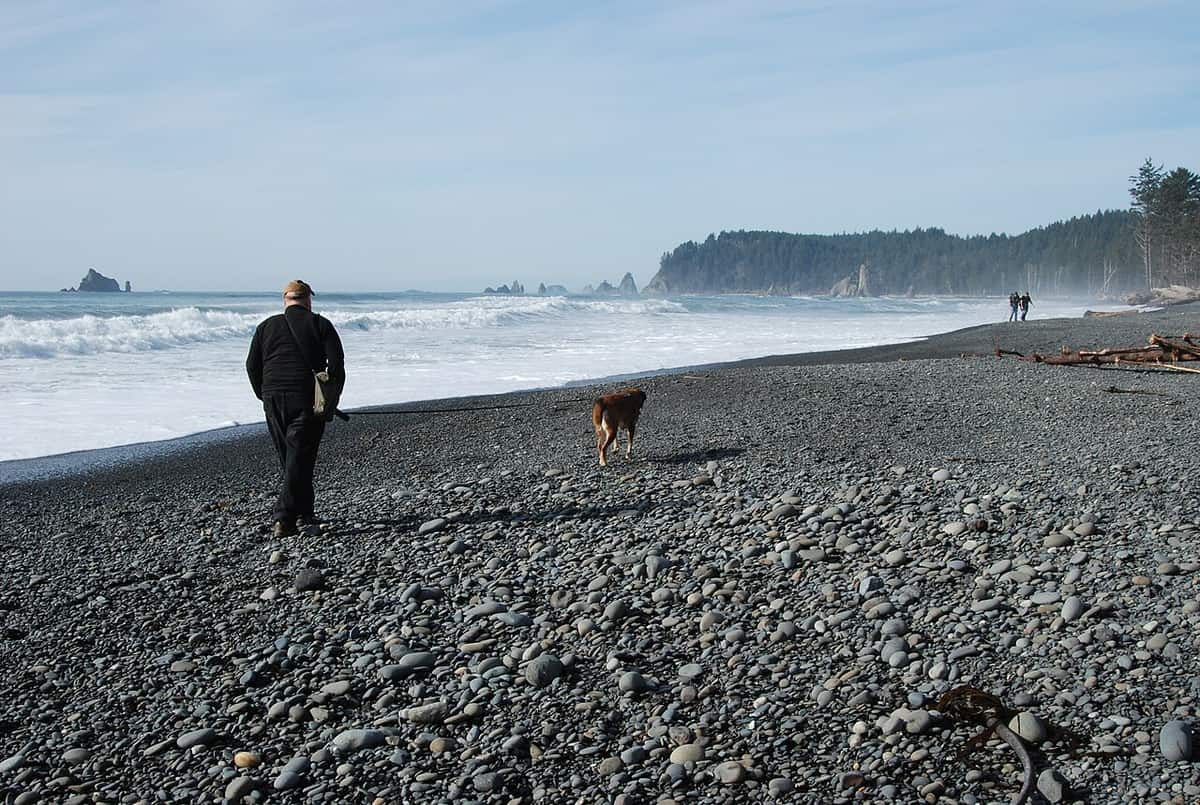
A dog on Rialto Beach, Olympic National Park. Photo: National Park Service / Wikimedia Commons (public domain).
Start with the pre-trip checklist
The timeline matters more than the packing list. Vaccines take time to take effect, health certificates expire, and cabin space for pets is sold per flight. Work backward from your departure date instead of forward from today.
Four to six weeks before you leave
- Book a vet visit and say the word "travel." Ask for a general health check, a rabies certificate with the vaccine lot and expiry date, and a written summary of chronic conditions and medications. If you are crossing a border, ask whether the clinic has a USDA-accredited veterinarian on staff.
- Confirm the microchip is readable and registered. A chip that is not registered, or is registered to an old phone number, does not help anyone. Ask the clinic to scan it and check that the number matches your paperwork (VCA Hospitals explains why registration is the part that matters).
- Check parasite prevention for the destination. Heartworm, fleas and ticks are regional. A dog who is fine at home may need a different product for a month in another climate.
- Start motion-sickness training now, not on departure day. Short, boring car rides with a reward at the end work better than one long trip. VCA's guide to motion sickness in dogs recommends building up to 20–30 minutes over several days or weeks.
- Reserve pet space. Airlines cap the number of pets per flight, and pet-friendly rooms sell out around holidays. This is the step people skip and then pay for.
One to two weeks before
- Get the health certificate if your destination or airline requires one. Airlines commonly ask for a certificate issued within 10 days of travel for checked pets; requirements vary by route and carrier, so confirm the exact window in writing.
- Renew the rabies certificate in your travel folder. For domestic trips it is the document you are most likely to be asked for, at a campground, a groomer, a boarding facility or a border.
- Test the carrier or crate at home. Leave it open with a bed and a treat for a few days. A carrier that only appears on travel day is a carrier your dog has a reason to distrust.
- Update the ID tag. Put your mobile number on it, not your home number, and add a second tag with a reachable travel contact if you are swapping SIM cards.
The night before
- Pack food in a sealed container with a measuring scoop. Changing food on the road is a reliable way to cause diarrhea in a hotel room.
- Charge the tracker, the phone mount and the backup battery. A dead tracker is a collar.
- Photograph the dog from four angles, plus one photo of you together. Recent photos are the single most useful thing you can hand a shelter or post in a local group if the dog bolts.
- Put the records in one place you can open offline. A folder on your phone works; so does an app. PetzDay is free for this — keep the vaccine record, medications and vet contacts in one profile before you leave.
Choose how you will get there
There is no universally best transport for dogs. There is a best transport for your distance, your dog's size and your tolerance for paperwork.
Driving: the most flexible option
Driving is usually the cheapest way to move a dog, and the only one where you control the temperature, the rest stops and the schedule. It is also the option with the most hidden risk: an unrestrained dog becomes a projectile in a crash, and a dog left in a parked car can overheat in minutes.
If you are driving, read the full road trip guide with the 15 essentials that actually matter. The short version: back seat, not the front; a crate or crash-tested harness, not a lap; a rest stop every two to three hours; and water offered at every stop.
Flying: fastest, but only for small dogs in most cases
In-cabin travel is limited to pets that can stand, turn and lie down inside a carrier that fits under the seat. That excludes most medium and large dogs. Cargo options have shrunk: several major airlines now accept checked pets only for active-duty military and State Department personnel on orders, and route the rest through cargo services with their own rules.
Fees are charged each way, per carrier, and they are not small. Our airline-by-airline comparison of pet fees and in-cabin rules has the current numbers, carrier dimensions and the rules that get people turned away at the gate.
Train: the middle ground people forget
Amtrak carries small dogs and cats in the cabin on many routes, with a combined pet-and-carrier limit of 20 pounds and a maximum carrier size of 19 × 14 × 10.5 inches. Pets are limited to trips of up to seven hours on most routes, one pet per customer, and the fee varies by route. Pets are not allowed on Auto Train, and there are exclusions on some Canadian segments.
For a four-hour regional trip, the train can be less stressful than either alternative: no security bin, no car seat, and a dog who stays with you the whole way.
A simple decision rule
- Under 300 miles, or more than one dog: drive.
- Over 800 miles and the dog fits under a seat: compare a direct flight against two days of driving, including the hotel night and the pet fee.
- 300–800 miles with a small dog and a station on both ends: check the train first.
- A large dog and a long distance: driving is usually the only realistic option; plan the route around two-night stops rather than one brutal day.
Book lodging before anything else
Pet policies are where budgets quietly break. A "pet-friendly" hotel can mean no fee at all, a $25 nightly charge, or a $150 non-refundable cleaning fee per stay. The difference over five nights is larger than the flight.
Ask five questions before you book:
- Is the fee per night, per stay, or per pet?
- Is it refundable, or is it a cleaning fee charged either way?
- Is there a weight or breed limit?
- Which rooms are set aside for pets, and do they have easy outdoor access?
- Where is the nearest relief area, and is it lit at night?
The full playbook — including how to read listings, which fee structures favor long stays, and the legal difference between a pet and a service animal — is in how to find pet-friendly hotels and avoid hidden pet fees.
One legal point worth knowing before you call: under the ADA, hotels must accept trained service dogs and cannot charge a pet fee for them. Emotional support animals are not service animals under the ADA and are covered by the hotel's pet policy instead. The Department of Justice's service animal guidance is the source to quote if a front desk disagrees.
Plan the days around the dog
National parks have the strictest rules
The National Park Service welcomes pets in developed areas, but "developed" is doing a lot of work in that sentence. Rules are set park by park, and the popular parks are the strictest.
- Yosemite: pets are allowed on fully paved roads, sidewalks and bicycle paths, and in most campgrounds — not on trails, not on shuttle buses, not in lodging areas, not in meadows or on beaches. Leashes must be six feet or shorter, and pets cannot be left unattended.
- Yellowstone: pets must stay within 100 feet of roads, parking areas and campgrounds; they are not allowed on boardwalks, hiking trails, in the backcountry or in thermal areas. Carried pets do not get an exception.
- Service animals are allowed wherever visitors go. Emotional support animals are treated as pets.
The NPS B.A.R.K. Ranger program is a useful shorthand for the rules that apply almost everywhere: Bag your pet's waste, Always leash, Respect wildlife, Know where you can go. If a park's signature hike is the reason you are going, check the pet page before you book — and consider a local sitter or daycare for the hike day instead of leaving the dog in a hot car.
Restaurants, patios and cafés
Dog-friendly patios are common but not universal, and the rules come from state and local health codes rather than a national standard. Call ahead, ask whether dogs are allowed on the patio (not just outside the door), and keep the leash short and under your chair. A dog who barks at every passing plate is not ready for a crowded brunch, and that is fine — a picnic is usually better for everyone.
Heat, pavement and water
Pavement in direct summer sun gets much hotter than the air. A common rule of thumb is the seven-second test: hold the back of your hand on the pavement for seven seconds; if it is too hot for you, it is too hot for paws. Walk early, carry water, and keep a collapsible bowl in the bag rather than assuming a café will provide one.
Do not leave the dog alone in the room all day
A strange room plus a closed door plus hallway noise is how separation anxiety starts and how hotel complaints happen. If you are spending a day somewhere dogs cannot go, book daycare or a sitter, or choose a trip where the dog can come along. If you must leave the dog, crate it, leave water, tell the front desk, and keep the absence short.
The paperwork nobody remembers until the airport
Domestic travel inside the U.S. is governed by the destination state, not by a single federal rule. APHIS does not regulate interstate pet movement by owners, but states can require health certificates, vaccination proof or testing. Check the destination state's animal health office before a long move, and carry the rabies certificate on every trip.
International travel is a different process:
- Leaving the U.S.: the destination country sets the rules. Many require a USDA-endorsed health certificate prepared by a USDA-accredited veterinarian, plus a rabies vaccination and sometimes a titer test. Start at least a month out, longer for countries with quarantine.
- Returning to the U.S.: CDC requires every dog to be at least six months old, appear healthy, have a microchip readable by a universal scanner, and arrive with a receipt for the free CDC Dog Import Form. Dogs that have been in a high-risk country for dog rabies in the previous six months face additional vaccination and documentation requirements, and the form must be handled before the dog leaves the U.S.
The guide to health certificates, vaccines and lost-pet prevention walks through the timeline, what each document is for, and what to do in the first hour if your dog gets away in an unfamiliar place.
The gear that actually earns its space
Most "dog travel" gear solves a problem you will not have. These categories solve the problems that recur.
- Restraint for the car: a crate that can be secured, or a harness that has been crash-tested. Not a clip that attaches a walking harness to a seat belt.
- A carrier that matches your airline's dimensions: measure the under-seat space, not the carrier's marketing copy.
- Water you can serve anywhere: a bottle with a built-in trough, or a collapsible bowl and a spare bottle.
- Something that smells like home: a blanket from the dog's bed does more for settling than a new toy.
- Records you can open without a signal: vaccine dates, rabies certificate, medications, vet phone numbers.
- Identification that works at a distance: a tag with a mobile number, plus a microchip that is actually registered.
{{buy | title=Crash-tested dog car harness | url=https://www.amazon.com/s?k=crash+tested+dog+car+harness&tag=petzday-20 | meta=Look for a harness tested to a published crash standard, sized by weight and chest girth | cta=Compare harnesses on Amazon}}
{{buy | title=Soft-sided airline pet carrier | url=https://www.amazon.com/s?k=soft+sided+airline+approved+pet+carrier&tag=petzday-20 | meta=Check the carrier against your airline's under-seat limit before buying | cta=Compare carriers on Amazon}}
{{buy | title=Portable dog water bottle with trough | url=https://www.amazon.com/s?k=portable+dog+water+bottle+with+bowl&tag=petzday-20 | meta=One-handed operation matters at a rest stop with a leash in the other hand | cta=Compare bottles on Amazon}}
{{buy | title=Dog back seat cover or hammock | url=https://www.amazon.com/s?k=dog+back+seat+cover+hammock&tag=petzday-20 | meta=Look for a grippy backing and seat-belt anchors, not just a waterproof top | cta=Compare seat covers on Amazon}}
What a dog-friendly trip actually costs
Three costs surprise people more than the rest:
- Airline pet fees are charged each way. A $150 fee is $300 round trip for one dog, before the carrier, the health certificate or an extra seat for a second pet.
- Hotel pet fees are often per stay, not per night. A $150 cleaning fee is painful for one night and reasonable for seven. Ask which structure applies before you compare two hotels.
- The health certificate is a vet visit, not a form. For international travel, expect an exam fee plus the certificate, and sometimes a USDA endorsement fee.
A realistic domestic road trip with one dog usually costs less in fees than flying, but more in time and hotel nights. The break-even point is different for every route; the useful exercise is to price both versions with the pet fees included, not to compare a flight's base fare against a tank of gas.
Keeping the trip's records together
Travel generates exactly the paperwork you do not want to reconstruct later: vaccine dates, the health certificate, the name of the vet who saw the dog in another state, the medication that ran out mid-trip. Keep one timeline instead of a folder of photos.
PetzDay is free and built for that: one profile per pet, with vaccine records, medications, lab results and vet contacts you can open at a front desk or an emergency clinic. Start at petzday.com/register, and browse the rest of the article library for destination-specific guidance.
FAQ
Is it cheaper to fly or drive with a dog?
For one small dog and a long route, flying is often cheaper once you count hotel nights and meals on a two-day drive — but only if the pet fee is $100–$150 each way and you already need to fly. For two dogs, a large dog, or a route under 500 miles, driving usually wins.
Do dogs need a health certificate for domestic travel?
Not always. APHIS does not regulate interstate pet travel by owners, but destination states can require documentation, and airlines may require a health certificate for checked pets. Carry the rabies certificate regardless.
Can I take my dog to a national park?
Usually yes, in developed areas, on a six-foot leash. Most parks prohibit pets on trails, boardwalks, shuttle buses and in the backcountry. Check the individual park's pet page before planning a hike around the dog.
What if my dog hates the car?
Start with stationary sessions, then a driveway, then a block, and build slowly. Withholding food for a few hours before travel can reduce nausea, and a vet can prescribe medication for genuine motion sickness. Do not give human anti-nausea drugs.
Do I need a pet passport?
U.S. travelers do not need a U.S. pet passport. The EU issues an EU pet passport to pets registered in an EU country; U.S. dogs traveling to the EU generally travel on a USDA-endorsed health certificate instead.
How do I keep track of vaccine records on a trip?
Keep a photo of the rabies certificate and a written list of vaccine dates on your phone, and store the same records in one app profile. If you use PetzDay, the record is available without carrying the paper folder.
References
- CDC — Bringing a Dog into the U.S.
- CDC — CDC Dog Import Form and instructions
- APHIS — Travel With a Pet
- APHIS — Interstate movement of pets
- National Park Service — Pets in parks
- Yosemite National Park — Pet regulations
- Yellowstone National Park — Pet regulations
- Amtrak — Pets on trains
- VCA Hospitals — Motion sickness in dogs
- U.S. Department of Justice — Service animals under the ADA
All web sources accessed November 2026. Airline, hotel and park rules change; confirm details with the operator before you book.
Last reviewed: November 10, 2026. This article is for general information and does not replace veterinary advice for your dog.