Electrolytes in Pets: Sodium, Potassium, Calcium, and What Their Balance Means
Electrolytes are the quiet machinery behind every heartbeat and nerve signal. Learn what sodium, potassium, chloride, calcium, and magnesium tell your vet.
Sodium, potassium, chloride, calcium, and magnesium are the quiet machinery behind every heartbeat and nerve signal — shifts of a fraction of a millimole can change how a pet feels, and a few are immediately life-threatening.
Electrolytes rarely make headlines, but they run the show. Every nerve impulse, muscle contraction, and heartbeat depends on precise concentrations of charged minerals on both sides of cell membranes. Small shifts — sometimes fractions of a millimole — can change how a patient feels, and a few can be immediately life-threatening.
A chemistry panel reports these values automatically, which is why almost every sick pet gets an electrolyte picture whether or not anyone ordered "electrolytes." Learning to read sodium, potassium, chloride, calcium, and magnesium turns a wall of abbreviations into a window on hydration, kidney function, hormones, and gastrointestinal health. For a deeper dive, eClinPath chemistry pages cover each analyte in technical detail.

Reported ranges vary by laboratory; the pattern across several electrolytes is what guides treatment.
Sodium: the volume regulator
Sodium is the main cation outside cells and the primary determinant of the body's water balance. When sodium is low, the most common scenario in veterinary medicine is not salt deficiency but excess free water — diluted blood from heart disease, liver disease, inappropriate ADH, or diuretics. Conversely, high sodium usually reflects water loss: vomiting, diarrhea, fever, or restricted access to water.
Changes in sodium should always be corrected slowly, because the brain adapts to its surroundings. This principle — careful, measured correction — protects patients from neurologic complications, and it is a large part of why hospitalized pets receive fluids by precise calculation rather than by estimate.
Potassium: the cardiac critic
Potassium lives mainly inside cells, with a narrow window outside. Because it governs the electrical resting state of heart muscle, both extremes carry urgency. Vomiting pets lose potassium and can become weak with muscle pain; cats with urinary blockage or kidney failure can rise dangerously, slowing the heart rate in a way that can be heard and seen on an ECG well before disaster strikes.
Low potassium is a frequent, quiet companion to chronic disease — picked up incidentally and corrected with fluids and supplementation. High potassium is the one that interrupts dinner. When a blocked cat presents with a low heart rate and high potassium, that number becomes the emergency, and treatment decisions follow it directly.
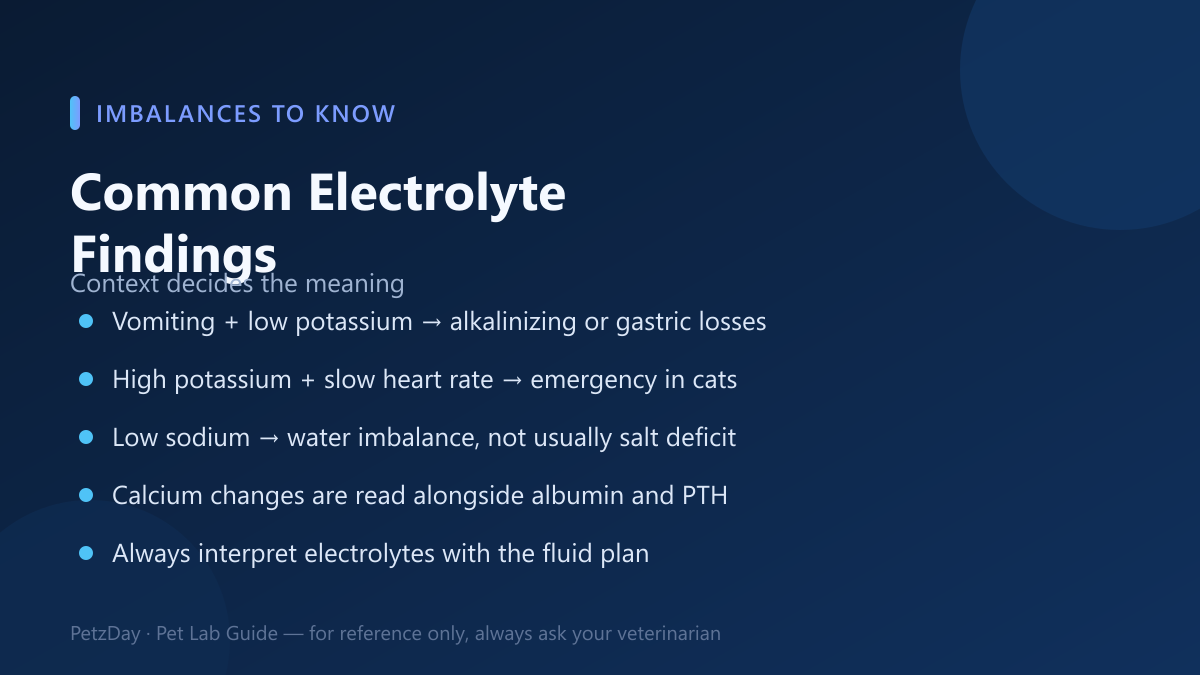
Every value is read with its clinical context: vomiting, kidney function, and hydration change the meaning.
Chloride: the quiet partner
Chloride shadows sodium and helps interpret acid-base status. A chloride that rises while sodium stays normal hints at dehydration or certain acid-base problems; both values moving together suggests a broader osmolality shift. It is rarely a headline finding, but it tightens the interpretation of everything around it.
Calcium and magnesium: from bones to bellies
Calcium is part of bone, but in blood it is also a messenger between parathyroid hormone, vitamin D, and the kidneys. Low calcium can cause tremors, muscle twitching, and seizures; high calcium — often flagged first in a routine panel — can suggest cancer, parathyroid disease, or kidney damage, and should never be ignored because a pet "looks fine." Total calcium must be read alongside albumin, the protein that ferries it through blood.
Magnesium quietly modulates nerve and muscle excitability. Deficiencies assemble silently during long courses of poor intake, diarrhea, or certain medications, and can make potassium stubbornly difficult to correct. It is not on every routine panel — another reason a good history matters when labs look "almost normal" in a patient who does not.
Fluids and follow-through
Most electrolyte corrections are achieved with careful fluid therapy plus treatment of the underlying cause: stop the vomiting, fix the diet, unblock the urethra, address the kidney. Rechecking values hours after treatment begins is normal critical care, not over-testing. The rhythm of electrolyte medicine is measure, adjust, measure again — and celebrate small wins.
The heart beats on electricity. Electrolytes are the current — handle them with care.
Questions to ask your veterinarian
- Which electrolyte is abnormal — one, or several together?
- What does the pattern say about hydration and organ function?
- Could a medication or diet be responsible?
- How fast should this be corrected, and by what route?
- When will we recheck, and what result would worry you?
Spotting dehydration at home — and when to call
You cannot measure electrolytes at home, but you can learn the general hydration signals every anxious pet parent eventually needs: gums that feel damp rather than tacky, skin that springs back when gently tented over the shoulders, eyes sitting comfortably in their sockets. None of these is a lab test; together they offer a rough sense of whether a day of vomiting or a hot walk has crossed a line.
Certain situations raise the stakes. Very small pets — puppies, kittens, toy breeds — can dehydrate within hours of an episode of vomiting or diarrhea, and their electrolyte swings are proportionally larger. Pets with known kidney or heart disease live on narrower margins. After a day of GI upset, a tense check-in call with your clinic is almost never a waste of anyone's time; the stakes of waiting are asymmetric.
One caution for the Googling pet owner: do not chase human sports-drink products or salt tablets as home remedies. Electrolyte medicine is about tailoring corrections — sometimes withholding sodium, sometimes replacing potassium, sometimes slowing the change — and the wrong guess can do real harm. Water, rest, and a plan from a professional cover most home situations.
Write down what you observe and when it started. A brief log — appetite, water intake, urine output, energy — converts home observations into data your veterinarian can use, and often shortens the diagnostic path from days of guessing to a single targeted visit.
Keep Every Result in One Place
Results only become a story when you can compare them. PetzDay keeps every lab panel in one timeline you own — so trends stand out, and any clinic can see the full history in a single link.
- New to blood work? Start with the complete guide to dog blood test results.
- Browse more lab value guides, or create a free PetzDay account to keep your own results in one place.
References and further reading
- Cornell eClinPath — Electrolytes
- Merck Veterinary Manual — Fluid and Electrolyte Disorders
- VCA Animal Hospitals — Fluid Therapy Basics
- AVMA — Pet Owner Resources