Liver Enzymes Explained: What ALT, AST, ALP, and GGT Mean in Dogs and Cats
Liver values are among the most misunderstood numbers on a blood panel. Learn which enzyme signals which problem — and why one high value is rarely a diagnosis.
Liver values are among the most misunderstood numbers on a pet's blood panel: a mildly high ALT is often a recheck in two to four weeks, while a tenfold increase demands attention — and each enzyme (ALT, AST, ALP, GGT) signals something different.
"The liver numbers are up." Few sentences cause more worry — and more confusion — for pet owners. The liver panel contains several different enzymes and proteins, each leaking or accumulating for different reasons. Understanding what each one reflects transforms a scary phone call into an informed conversation.
This guide covers the four values you will meet most often: ALT, AST, ALP, and GGT, plus bilirubin. For deeper reading on the biochemistry, eClinPath chemistry resources remain the standard reference for veterinarians in training.
Ranges differ by lab and by species; in puppies, growing bone adds its own ALP signal.
ALT: the leak detector
Alanine aminotransferase (ALT) lives inside liver cells. When hepatocytes are damaged or inflamed, ALT leaks into the bloodstream, making it the most liver-specific enzyme in dogs. A mild bump might follow a minor insult; a tenfold increase demands attention. Cats are less predictable because their ALT also lives in muscle, so a laboratory cannot always tell liver from muscle injury without additional tests.
Crucially, ALT tells you about cell damage, not liver function. A liver can have sky-high ALT and still do its jobs perfectly well. Conversely, a scarred liver in the late stages of disease may show falling ALT as fewer cells remain to leak. This is why ALT is read as one axis of a two-dimensional picture: damage versus function.
AST: useful, but not specific
Aspartate aminotransferase (AST) is found in liver, muscle, and red blood cells. On its own it is a poor liver marker; paired with ALT it adds context. When ALT and AST rise together, liver concern grows. When AST rises alone, a muscle disease or even a rough blood draw becomes a more likely explanation.
ALP and GGT: the bile ducts and beyond
Alkaline phosphatase (ALP) lines the bile ducts and also rises with certain hormones and with bone growth. That combination makes ALP the most frequently "abnormal" liver value in dogs — a young dog with rapidly growing bones, a dog receiving steroid medication, or a dog with Cushing's disease can all post high numbers without any liver disease at all. In cats, ALP is rarely just "noise," and a high value there carries more weight.
Gamma-glutamyl transferase (GGT) tracks more closely with cholestasis — obstruction or impaired flow of bile. When ALP and GGT rise together, veterinarians investigate the biliary tree; when ALP rises alone, they consider steroids, growth, and endocrine disease first. Corticosteroid treatment and naturally occurring Cushing's can produce the same pattern, which is why "rule out steroids" appears in so many internal medicine notes.
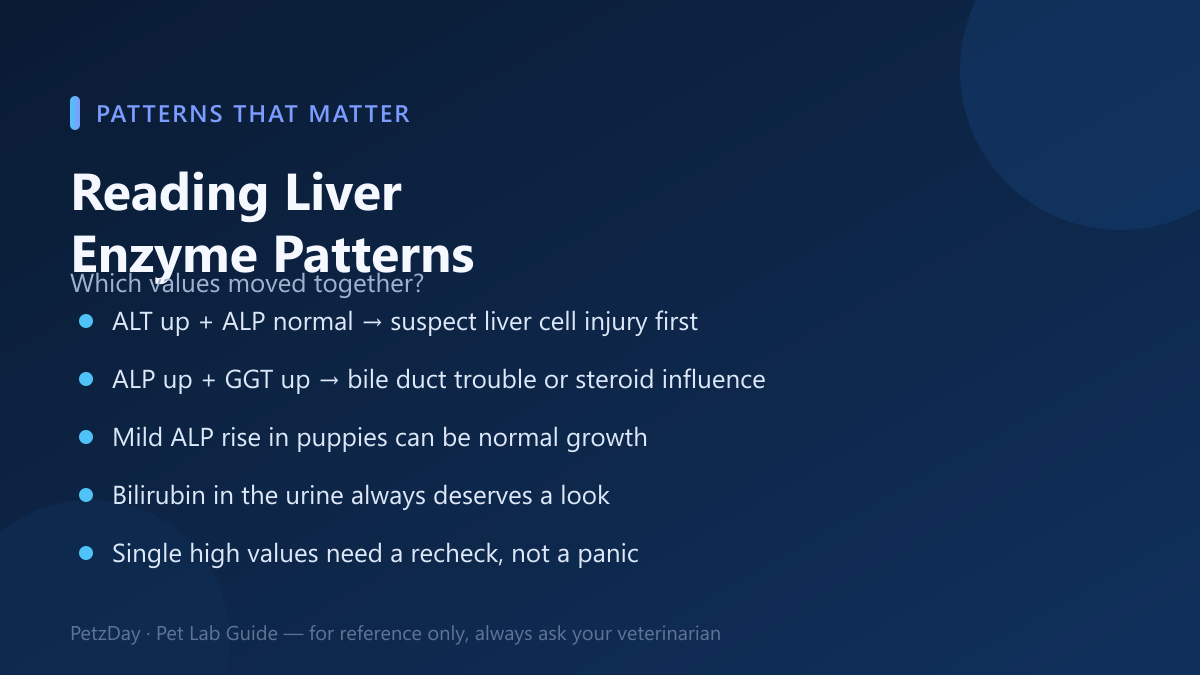
Patterns are clues that direct the next test — ultrasound, bile acids, or a biopsy — not a diagnosis by themselves.
Bilirubin: yellow flags
Bilirubin is a breakdown product that the liver processes and excretes. When it accumulates, gums, the whites of the eyes, and sometimes the skin turn yellow — jaundice. Bilirubin rises for three reasons: too much production (hemolysis), too little processing, or an outlet problem in the bile ducts. Distinguishing these three is a textbook exercise in reading the rest of the panel together: a very low HCT with high bilirubin points one way; a normal blood count with high ALP points another.
From numbers to next steps
Because liver biochemistry is so pattern-driven, mildly elevated values in a perfectly healthy dog are often managed with the least invasive tool of all: monitoring. Repeat testing after a few weeks reveals whether the finding is stable, improving, or worsening — and trends are the one thing a snapshot can never show you.
When several values or a clinical sign point to real disease, the next steps are usually imaging (an ultrasound of the abdomen), bile acid testing to assess liver function, and in some cases a fine-needle sample or biopsy. Each step has a specific question to answer, which keeps the workup logical instead of expensive for its own sake.
Treat the patient, not the number — but respect the number enough to repeat it.
Questions to ask your veterinarian
- Which enzyme is up, and does the pattern point to liver or something else?
- Could breed, age, medications, or Cushing's explain these values?
- Do we need bile acids to assess function, or is monitoring enough?
- Would an abdominal ultrasound add useful information now?
- When should we recheck, and what change would prompt action?
Diet, supplements, and the liver conversation
Because the liver processes everything that enters the bloodstream, food and supplements are part of liver medicine. When copper storage disease is suspected — a recognized problem in some breeds, including Bedlington and West Highland white terriers — diet and copper-binding therapy become central, guided by a liver biopsy rather than guesswork. For most other liver patients, digestibility matters more than any single nutrient.
Supplement shelves promise liver miracles. The honest state of the evidence is modest: some supplements such as SAMe and milk thistle derivatives show plausible mechanisms and are commonly used, but no bottle replaces diagnosing what the liver is actually fighting. Worse, unregulated products can themselves stress the liver. Anything labeled "liver support" deserves a conversation before it earns shelf space in your kitchen.
Monitoring completes the loop. Depending on the pattern, veterinarians recheck enzymes every four to twelve weeks, restart with a fasting sample where possible, and pair blood work with the clinical signs that matter — appetite, energy, coat quality, and weight. Numbers and a patient's daily life disagreeing is common; good medicine leans on both.
Keep Every Result in One Place
Results only become a story when you can compare them. PetzDay keeps every lab panel in one timeline you own — so trends stand out, and any clinic can see the full history in a single link.
- New to blood work? Start with the complete guide to dog blood test results.
- Browse more lab value guides, or create a free PetzDay account to keep your own results in one place.
References and further reading
- Cornell eClinPath — Chemistry (Liver)
- Merck Veterinary Manual — Liver and Biliary Diseases
- VCA Animal Hospitals — Liver Disease in Pets
- Cornell University College of Veterinary Medicine