Dog Blood Types & Blood Typing Tests: What Owners Should Know
Blood typing in dogs maps out the DEA antigens on your dog's red blood cells — and DEA 1 is the antigen vets check first, with roughly 33–65% of dogs testing DEA 1-positive depending on region (Merck, 2026). Here's how a dog blood type test works, when vets order one, what it costs, and what typing still can't tell you.
Dogs have their own blood-type system — the DEA (dog erythrocyte antigen) system — and it doesn't map onto human blood types like A, B, or O. The antigen vets watch most closely is DEA 1: depending on region, roughly 33–65% of dogs are DEA 1-positive, and DEA 1-negative dogs can develop antibodies after receiving positive blood (Merck Veterinary Manual, March 2026). A blood typing test tells your vet which DEA antigens your dog's red cells carry — whether to test, and how to use the result, is always your veterinarian's decision.
Dog blood types use the DEA system — a blood typing test maps what's on the red cells.
Blood typing in dogs: what dog blood types actually are
Dog blood types describe the antigens — marker proteins — on the surface of a dog's red blood cells. The canine system is DEA (dog erythrocyte antigen), and DEA 1 is the antigen vets watch most (Merck, 2026; eClinPath). Recognized groups include DEA 1, 3, 4, 5, 6, 7, and 8, plus newer non-DEA groups — Dal (first found in Dalmatians), D1D2, and Kai 1 and Kai 2.
Why DEA 1 leads. It's the most immunogenic antigen in dogs — "the major (most immunogenic) antigen," per eClinPath, and the most clinically relevant, per Merck. A DEA 1-negative dog given DEA 1-positive blood can develop anti-DEA 1 antibodies that set up severe reactions on a later transfusion; production typically takes about 7–10 days (eClinPath; Merck).
A naming note. Older charts split DEA 1 into 1.1, 1.2, and 1.3; current references describe one DEA 1 antigen at different expression levels — negative, weak positive, or 2+ to 4+ positive — and a "DEA 1.1" result refers to this same antigen (Merck, 2026; eClinPath).
Frequency varies. Depending on region, about 33–65% of dogs are DEA 1-positive (Merck, 2026) — both results are common. Natural antibodies against DEA 3, 5, and 7 exist in some dogs but rarely cause severe reactions; acute reactions trace to DEA 1 and, after sensitization, DEA 4 (eClinPath).
Dogs also differ from cats: cats commonly carry natural antibodies against other blood types — risky from the first transfusion — while dogs usually don't (Merck; eClinPath). New to lab reports? Our guide to dog blood test results covers the rest of the page.
When canine blood typing matters
For most dogs, typing isn't routine bloodwork — vets order it mainly before a transfusion, for donor screening, and occasionally around breeding.
- Before a transfusion. Merck says DEA 1 typing is "strongly recommended" before transfusing a dog. A DEA 1-negative recipient should get DEA 1-negative blood so it isn't sensitized; a DEA 1-positive dog can safely receive negative cells too, but banks often reserve negative units for negative recipients. Weak positive results get special handling: a weak-positive donor is treated as positive, and a weak-positive recipient should still receive DEA 1-negative blood (Merck, 2026).
- First vs. later transfusions. Dogs generally lack ready-made antibodies that destroy red cells, so a crossmatch isn't required before a first transfusion — typing is still recommended. After a previous transfusion, crossmatching is strongly recommended once about four days have passed, since a sensitized dog may now have antibodies waiting (Merck; eClinPath).
- Blood donors. eClinPath says donors "should be preferably blood typed," and describes the ideal canine donor as negative for DEA 1.1, 1.2, and 7. Banks also screen donors for infectious diseases, including vector-borne ones (Merck). Thinking of volunteering your dog? Ask the program what it tests and requires.
- Breeding, rarely. Neonatal isoerythrolysis — a newborn's red cells destroyed by antibodies in the mother's first milk — has been reported in dogs when a DEA 1-negative dam previously sensitized to DEA 1-positive blood is bred to a DEA 1-positive male (eClinPath). Not a routine reason to type a family dog; ask your vet if you breed.
Dog blood type test: how testing works
A dog blood type test answers one narrow question — which DEA antigens are on your dog's red blood cells — from a small blood sample, either in-clinic or via a lab.
- In-clinic quick tests. Card-based tests use antibody wells to check dogs for DEA 1, 4, and 5, plus the Dal antigen; strip-format kits detect DEA 1, including weak expression. Point-of-care options show good agreement with lab methods (Merck).
- Reference labs. Labs can type additional antigens with commercial antibodies, and specialty centers offer broader panels. No method covers everything — Dal, for example, has limited commercial testing — which is one reason crossmatching still matters (Merck; eClinPath).
Typing is not a crossmatch. Blood typing asks what antigens this dog has on its red cells; a crossmatch asks whether this specific unit will work in this specific dog. A major crossmatch mixes the recipient's plasma with donor red cells to find antibodies that would destroy them; a minor crossmatch checks the reverse direction (Merck).
Crossmatching catches incompatibilities that typing misses, since typing covers only the major antigens (eClinPath). Which tests to run is your vet's call. Sample-wise: typing needs a small blood draw; crossmatching uses donor red cells in an anticoagulant (EDTA or citrate) plus recipient serum from a plain tube (eClinPath).
Related but different tests. Typing isn't a CBC; our guide to reading a CBC covers HCT, HGB, RBC, WBC, and platelets. And for bruising or bleeding rather than blood matching, vets use platelet and clotting tests such as PT and APTT — see our platelets and clotting guide.
What a dog blood type test costs
Blood typing has no national price list — hospitals set their own fees, and typing is usually one line inside a larger transfusion workup, not a standalone product.
- What drives the fee: in-clinic card vs. lab send-out, whether a crossmatch is bundled in, and whether the visit is routine or an emergency.
- Ask for the full estimate. For a transfusion, typing is one component alongside the exam, crossmatch, blood product, and hospitalization. For a donor-program dog, ask the standalone charge and what the program covers.
- No verified public range. As of October 2026, we couldn't verify a generalizable public price for canine blood typing — treat any number you see online with caution; your clinic's itemized estimate is what counts.
Dog blood types: quick reference
Five things worth remembering:
- DEA 1 leads. The antigen vets check first — about 33–65% of dogs are DEA 1-positive depending on region (Merck, 2026).
- Typed for a reason. Transfusions, donor screening, and some breeding situations — not routine wellness testing (Merck; eClinPath).
- Typing vs. crossmatch. Typing lists antigens; crossmatching tests one donor–recipient pairing (Merck; eClinPath).
- Positive or negative isn't health. DEA labels are matching markers — they say nothing about whether your dog is sick.
- Ask your vet: what was tested, what it means for your dog, and what comes next.
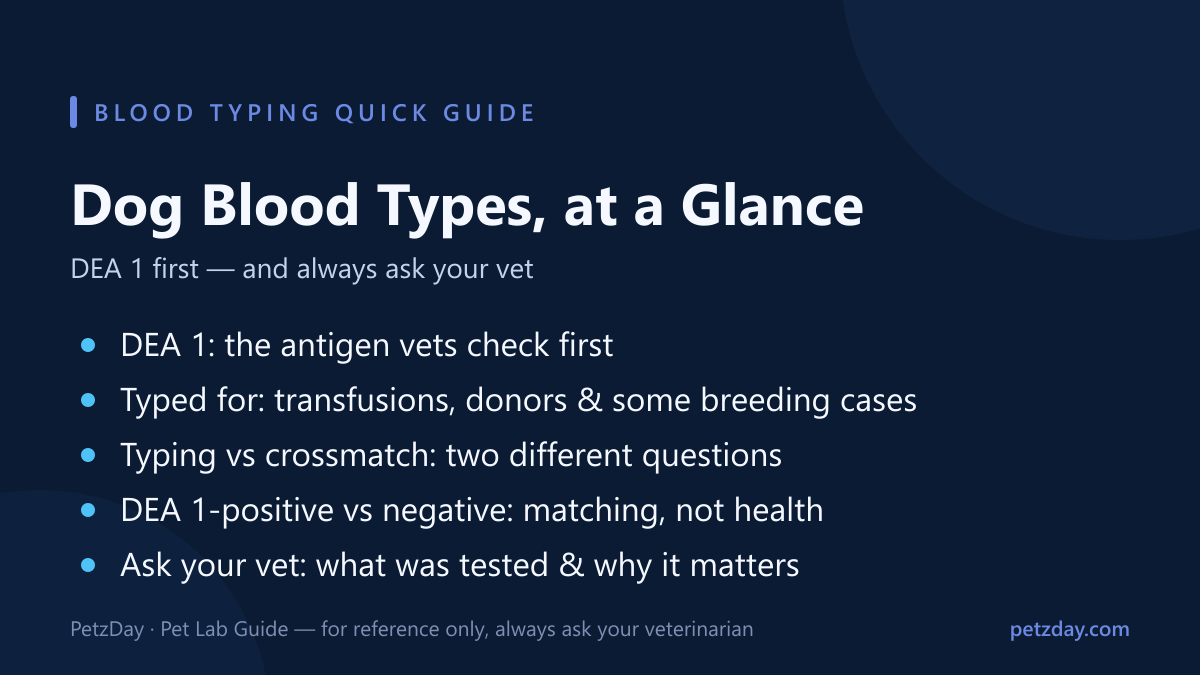
The core of dog blood typing on one card — confirm the details with your vet.
If your dog is ever typed — before surgery, for a donor program, or at a specialist — keep the result where you can find it. PetzDay keeps lab results, dates, and notes in one timeline to share with your vet — your side of the story, not a replacement for clinic records. Create a free PetzDay account or browse the full library.
FAQ
Do dogs have the same blood types as humans?
No. People use the ABO and Rh systems; dogs have their own dog erythrocyte antigens — DEA 1, 3, 4, 5, 6, 7, and 8 are recognized (Merck, 2026). Labels don't carry over between species, and canine transfusions use blood from screened dog donors — not human blood.
What is the most common dog blood type?
Dogs don't have one common type the way people think of O-positive. The antigen vets track most is DEA 1: about 33–65% of dogs are DEA 1-positive depending on region (Merck, 2026), so both results are commonly seen. Only a blood typing test tells you your dog's status — breed and appearance won't.
Can I test my dog's blood type at home?
As of October 2026, we found no at-home dog blood typing product validated for real clinical decisions. Typing is done by a veterinarian — an in-clinic card, or a lab sample your vet sends. Transfusion decisions also require a crossmatch and veterinary judgment, so ask your vet about adding typing to a visit.
References
- Merck Veterinary Manual — Blood Groups in Dogs and Cats — DEA 1 focus; 33–65% prevalence (March 2026)
- Merck Veterinary Manual — Blood Typing in Dogs and Cats
- Merck Veterinary Manual — Crossmatching in Dogs and Cats
- Merck Veterinary Manual — Blood Transfusions in Dogs and Cats
- Merck Veterinary Manual — Screening of Blood Donors and Blood Banking
- eClinPath (Cornell University) — Transfusion Medicine: Blood Types
- eClinPath (Cornell University) — Blood Type Incompatibility Testing
- eClinPath (Cornell University) — Blood Collection for Transfusion
All web sources accessed October 2026.
Last reviewed: October 10, 2026. This article is for general education and does not replace an examination by your veterinarian. Follow your vet's guidance for all testing and treatment decisions.