White Blood Cell Differential in Pets: What Neutrophils, Lymphocytes, and Eosinophils Mean
The WBC total tells you something is happening. The differential tells you what kind of something — here is how veterinarians read each cell type.
When a report says "WBC: 21.4 K/µL (H)", pet owners reasonably ask: is that bad? The honest answer is the same one veterinarians give each other — it depends entirely on the differential. The total white blood cell count is a headline; the five-part differential underneath it is the article. Reading them together is how a doctor decides whether they are looking at an infection, an allergy, a stress response, or something that needs a specialist.
This guide covers what each white cell does, the classic patterns veterinarians memorize, and the traps that make automated counts misleading. For authoritative technical depth, the eClinPath leukocyte section from Cornell University is the reference many clinicians use daily.

Percentages shift with age, stress, and species — the same value can mean different things in a young cat and a senior dog.
Meet the five cell types
Neutrophils are the first responders. They rush to bacteria and debris, and they make up the majority of white cells in most dogs and cats. Lymphocytes handle long-term immunity and produce antibodies; they are the second most common type. Monocytes are the cleanup crew. Eosinophils specialize in parasites and allergic reactions, and basophils — rare in health — still puzzle researchers in many contexts.
Because each cell type has a job, each type rises or falls predictably in specific situations. A differential is essentially a staffing report: who showed up to the emergency, and in what numbers? When one department is overstaffed and another is empty, the pattern itself is the diagnosis clue.
The patterns vets look for
Neutrophilia — a high neutrophil count — is the most common finding on any sick patient's report. When it comes with a left shift (immature "band" neutrophils released early from the bone marrow), bacterial infection and serious inflammation top the list. Without a left shift, stress, corticosteroids, and chronic inflammation become more likely. Doctors often describe inflammation as "suppurative" or "non-suppurative" based on exactly this distinction.
Lymphocytosis — a high lymphocyte count — is a chameleon. In a young cat with a mild illness it may be entirely normal physiology. In an excited puppy at the clinic it is a stress artifact called "physiologic lymphocytosis." But a very high count, especially in an older patient, raises the question of lymphoproliferative disease and may prompt a deeper workup such as flow cytometry.
Eosinophilia tends to send veterinarians hunting for three things: intestinal parasites, flea allergy or other hypersensitivity conditions, and eosinophilic diseases of the skin or gastrointestinal tract. Monocytosis is less specific — it accompanies chronic inflammation, stress, and some infectious diseases. Basophils are so rare that even small increases attract attention.
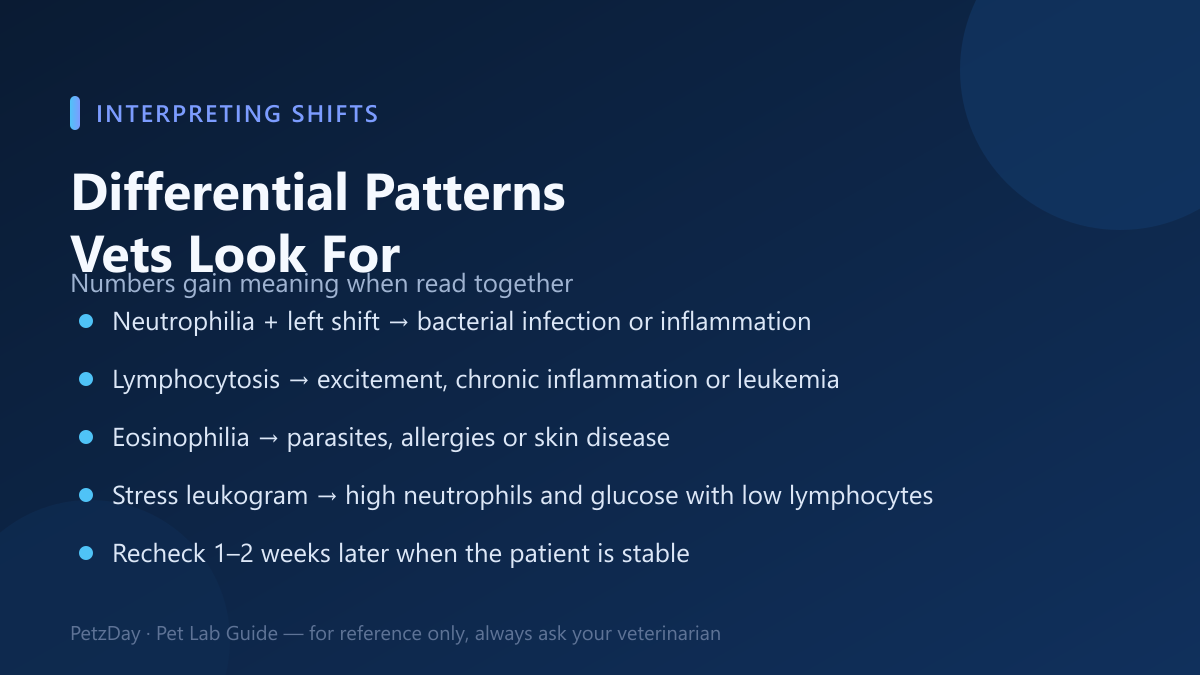
Interpretation always combines the differential, the blood smear, and the patient in front of you.
A stress leukogram, explained
One of the most common findings in sick pets is not infection at all. The stress leukogram — high neutrophils, low lymphocytes, high monocytes, and sometimes high blood sugar — appears in dogs under physiologic stress, from fear at the clinic to pain, fever, or chronic disease. Recognizing it prevents over-treatment: the cells look "off" because the body is flooded with cortisol, not because bacteria are winning.
Cats play by slightly different rules. Because their lymphocytes recirculate differently, stress in cats often raises neutrophils while leaving lymphocytes roughly normal, and profound lymphopenia in a cat deserves attention for other reasons. This is one reason automated interpretation tools struggle with feline blood: species matters at every step.
When automation is not enough
Modern analyzers produce a differential in seconds, but the machine is counting shapes, not understanding them. Two problems recur: misclassification of cells that look similar under automated optics, and failure to detect cells that should not be there at all, such as reactive lymphocytes, mast cells, or blast cells. When the clinical picture and the numbers disagree, veterinarians examine a stained blood smear under the microscope — the original "differential."
Machines count cells. Pathologists recognize them. When the two disagree, trust the microscope.
Questions to ask about your pet's differential
- Is the change in one cell line, or several?
- Is there a left shift, and how severe is it?
- Does the pattern fit stress, infection, or allergy best?
- Would a manual blood smear review add confidence?
- Should we recheck after treatment to confirm the trend?
Why veterinarians repeat the CBC
A single differential is a snapshot of one moment in a moving system. The white cell picture can shift faster than almost any other blood value: hours decide some changes, days others. When a dog treated for infection still looks tired after a course of antibiotics, repeating the CBC is not bureaucratic box-ticking — it is the only way to see whether the neutrophils are calming down or recalibrating to a new problem.
Recheck timing follows the biology. After starting an antibiotic, many clinics recheck at one to two weeks, or sooner if the patient does not improve. For chronic inflammation, the interval stretches to weeks or months, following a trend line rather than a single flag. When everything looks better but a value lingers, the interesting question changes from "what is wrong" to "what is keeping this number up" — and the answer is often a low-grade, structural explanation such as gingivitis or a healing wound.
A few findings in the white series deserve a quieter, faster escalation: marked decreases in all cell lines, immature cells (blasts) on the smear, or persistently unexplained cytopenias. These are signals to move from pattern-watching to deeper evaluation — possibly bone marrow sampling or referral — because a well-organized early workup spares the patient a late, harder one.
Keep Every Result in One Place
Results only become a story when you can compare them. PetzDay keeps every lab panel in one timeline you own — so trends stand out, and any clinic can see the full history in a single link.
- New to blood work? Start with the complete guide to dog blood test results.
- Browse more lab value guides, or create a free PetzDay account to keep your own results in one place.
References and further reading
- Cornell eClinPath — Leukocytes and leukograms
- Merck Veterinary Manual — White Blood Cell Disorders
- VCA Animal Hospitals — Blood Work for Pets
- American College of Veterinary Internal Medicine