Purina Pro Plan vs Blue Buffalo: What the Labels Actually Say
Purina Pro Plan vs Blue Buffalo, label first: we compare the two specific adult recipes — Complete Essentials Shredded Blend Chicken & Rice and Life Protection Formula Chicken & Brown Rice — on dry-matter protein and fat, cost per 1,000 kcal, AAFCO wording, formulation claims and recall history. Public sources only; snapshot October 2026.
Purina Pro Plan vs Blue Buffalo comes down to labels, not marketing. On the two adult recipes we compared, Pro Plan Complete Essentials Shredded Blend (35-lb, $74.99) costs ≈$1.25 per 1,000 kcal; Blue Buffalo Life Protection Formula (30-lb, $67.98 on sale) runs $1.37–$1.53. Dry-matter math flips the marketing: ≈29.5% protein vs ≈26.7%. Both are complete adult foods — which fits your dog is a vet question.
How we put this together. Public info only: PetSmart listing label data and pricing (checked October 10, 2026), plus AAFCO, WSAVA, FDA and Tufts guidance. We did not conduct hands-on testing. Snapshot: October 2026; verify before buying.
This post contains affiliate links. If you buy through them, we may earn a commission at no extra cost to you.
Public specs, prices and label data; October 2026 snapshot.
How to read a dog food label (and what actually matters)
Weighing Purina Pro Plan vs Blue Buffalo — or any two foods — starts at the adequacy statement on the bag, not the ingredient list.
- Find the AAFCO statement (AAFCO) — wording shows the method: "Formulated to meet the nutritional levels established by the AAFCO Dog Food Nutrient Profiles for ___" (checked by calculation) or "Animal feeding tests using AAFCO procedures substantiate..." (feeding trial; a rare "family product" format exists too).
- Ask WSAVA's brand questions: who employs a qualified nutritionist, who formulates, quality control, published research, who makes the food, and a "typical" nutrient analysis on request.
- Discount unregulated words like "holistic" and "premium" — "little practical value for nutritional assessment" (WSAVA).
The two options at a glance
Both are complete adult foods; key differences: protein/fat guarantees, fiber, calorie density, cost per calorie (PetSmart prices, Oct 10, 2026).
Purina Pro Plan Complete Essentials Shredded Blend Chicken & Rice (adult)
- Price: $74.99 per 35-lb bag — ≈$1.25 per 1,000 kcal
- Guaranteed analysis: protein 26% min, fat 16% min, fiber 3% max, moisture 12% max → DM ≈29.5 / 18.2 / 3.4%
- Calories: 3,790 kcal/kg; 369 kcal/cup
- AAFCO statement: listing cites "100% complete and balanced nutrition for adult dogs"
Blue Buffalo Life Protection Formula Chicken & Brown Rice (adult)
- Price: $67.98 sale / $75.49 regular per 30-lb bag — ≈$1.37 / ≈$1.53 per 1,000 kcal
- Guaranteed analysis: protein 24% min, fat 14% min, fiber 5% max, moisture 10% max → DM ≈26.7 / 15.6 / 5.6%
- Calories: 3,633 kcal/kg; 379 kcal/cup
- AAFCO statement: listing cites "formulated to meet AAFCO dog food nutrient profiles"
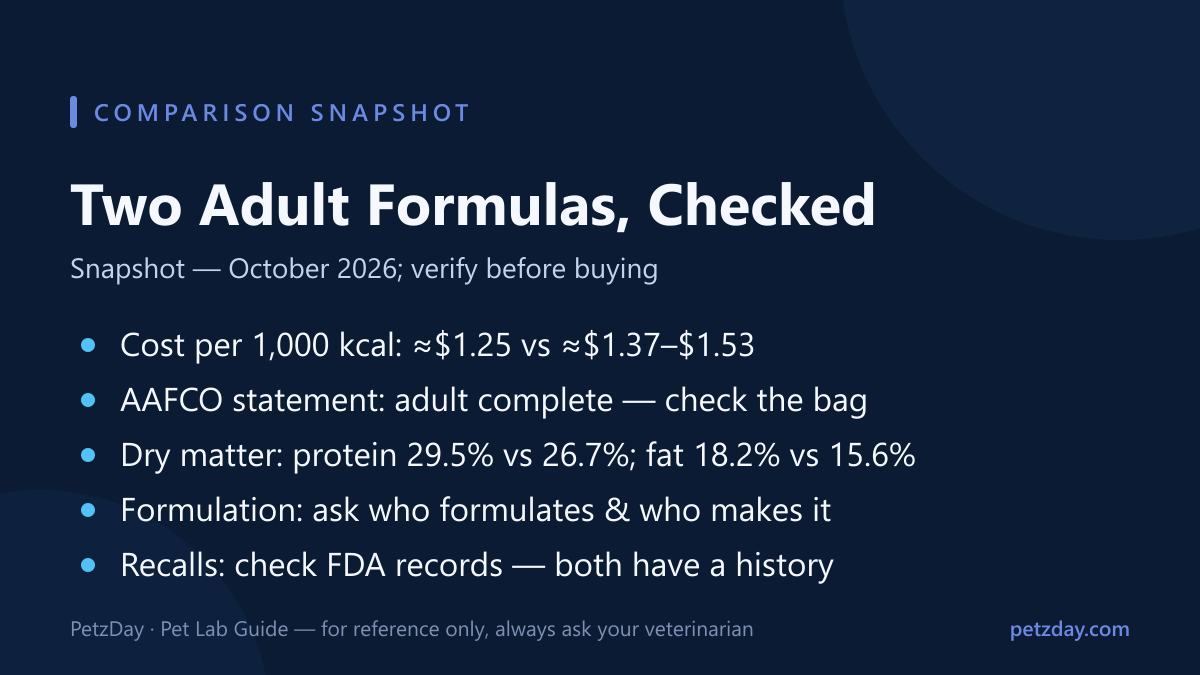
Label quick-check: cost per 1,000 kcal, AAFCO statement, dry-matter math, formulation and recalls.
Guaranteed analysis, normalized
As-fed percentages can't be compared across foods with different moisture; dry-matter math levels the field (dry matter = 100% − moisture; here 88% and 90%):
- Pro Plan: protein 26 ÷ 0.88 = ≈29.5% DM; fat 16 ÷ 0.88 = ≈18.2% DM; fiber 3 ÷ 0.88 = ≈3.4% DM
- Blue: protein 24 ÷ 0.90 = ≈26.7% DM; fat 14 ÷ 0.90 = ≈15.6% DM; fiber 5 ÷ 0.90 = ≈5.6% DM
Caveats: guarantees are minimums or maximums, not lab results; moisture is a max, so values shift. Calories are within 3% (369 vs 379 kcal/cup) — differences come from the feeding chart, not density. Think in calories, not cups.
Ingredients, line by line
The list is weight-ordered before processing — Tufts' nutrition team calls it "one of the worst ways to select your pet's food," partly because it's also marketing.
- By-products. Pro Plan lists poultry by-product meal; Blue markets "NO poultry by-product meals." Per AAFCO, byproducts (often organ meats) are secondary products of primary processing, and that "doesn't mean byproducts are unsafe or lack nutrition." Tufts adds they can be more nutrient-dense than muscle meat. The claim is marketing, not proof of a better diet.
- Grain-free. Neither food here is grain-free — grains aren't an established problem for dogs. FDA's DCM investigation (2018–) centers on diets high in peas and pulses — grain-free and grain-inclusive alike — with no cause established; its last update (Dec 23, 2022) awaits meaningful new science (Tufts, June 2026). Diet-and-heart questions belong with your vet.
Formulation and expertise
Public claims differ, and neither listing says who manufactures the food.
- Blue Buffalo says formulas "are developed by a dedicated team of veterinarians and animal nutritionists" and are "formulated to meet AAFCO dog food nutrient profiles," without names or credentials.
- Purina says "100% complete and balanced nutrition for adult dogs" on the listing we verified, with no formulator details.
- Feeding trials: neither listing shows a feeding-trial statement; check the bag's AAFCO statement if that matters to you.
- Manufacturing: labels distinguish "Made by" from "Made for." We couldn't verify either brand's production arrangements, so we're not guessing — WSAVA's advice is to ask the company directly.
Recall history
Both brands have public recall records; we verified the entries below in FDA postings at our snapshot, and none covers the exact recipes above.
- Blue Buffalo — October 8, 2010: several dry foods recalled over possible excess vitamin D (FDA-posted notice).
- Blue Buffalo — March 17, 2017: one lot of BLUE Wilderness Rocky Mountain Recipe Red Meat Dinner (wet) over elevated beef thyroid hormones; recall completed, FDA terminated it.
- Purina — November 30, 2022: Pro Plan Veterinary Diets EN Low Fat wet food, mislabeled as a different complete recipe.
- Purina — February 8 and March 10, 2023: Pro Plan Veterinary Diets EL Elemental prescription dry food, recalled then expanded over elevated vitamin D (supplier error).
Scope: both Purina items are prescription diets; the 2017 Blue item is a wet-food lot. No current FDA notice covers either exact recipe — check FDA.
Price math
At our snapshot, a moderately active 44-lb dog costs ≈$1.25/day on Pro Plan vs $1.37–$1.53 on Blue — roughly $4–$8 more a month. Rerun:
- Total kcal per bag = kg × kcal/kg: Pro Plan ≈ 60,170; Blue ≈ 49,440.
- Cost per 1,000 kcal = price ÷ kcal × 1,000: ≈$1.25 vs ≈$1.37 / ≈$1.53.
- Daily cost = cost per 1,000 kcal × daily calories — near 1,000 kcal/day for a 44-lb dog per both charts (≈2.5–3.5 cups); ×30 for a month.
Example math, not a promise: needs vary with age, activity and health — ask your vet for your dog's target.
Who should pick which
Blue Buffalo vs Purina Pro Plan: no universal winner — decide by your dog, budget, and (for anything medical) your vet.
- Pro Plan fits better if lower cost per calorie and more guaranteed protein/fat matter to you (by-product meal and wheat are fine).
- Blue fits better if the no-by-product, no-corn/wheat/soy positioning and higher guaranteed fiber matter, and the ≈$4–$8/month premium is acceptable.
- Neither fits if your dog needs a prescription diet (kidney values example), a growth or all-life-stages food (these are adult maintenance), or condition-specific diets like pancreatitis or allergies — ask your vet.
- Recording, not deciding: PetzDay logs meals, weight and notes to share with your vet; it doesn't tell you what to feed. Free account · Article library.
Limitations & what to check before buying
This is a public-information comparison, not lab testing or advice about your dog.
- Prices are one retailer, one day: PetSmart, Oct 10, 2026.
- Guarantees aren't lab measurements; read the bag for AAFCO and the date code.
- Check FDA recalls before buying.
- Don't switch foods for label reasons alone — transition gradually (7–10 days for Pro Plan; up to 14 for Blue).
FAQ
Is Purina Pro Plan better than Blue Buffalo?
Neither is universally better. At our Oct 2026 snapshot, Pro Plan guaranteed more protein/fat (dry-matter) and cost less per 1,000 kcal; Blue guaranteed more fiber and avoids by-product meals. Match the profile to your dog — ask your vet.
Is grain-free food better for dogs?
No — most dogs have no established need to avoid grains; "grain-free" says nothing about quality by itself. FDA's DCM investigation centers on diets high in peas and pulses, grain-free and grain-inclusive alike, with no cause identified (Tufts, June 2026). Ask your vet first.
Are by-products bad for dogs?
No. By-products (often organ meats) are secondary parts of processing; AAFCO says that "doesn't mean byproducts are unsafe or lack nutrition," and Tufts notes they can be richer in nutrients than muscle meat. "No by-products" is marketing, not a requirement.
References
- AAFCO — Reading Labels — statement formats; feeding trials
- AAFCO — Byproducts — definitions
- WSAVA — Global Nutrition Guidelines + Selecting Pet Foods, PDF (2021)
- Tufts Petfoodology — By-products (2016)
- Tufts Petfoodology — Ingredient lists (2019)
- Tufts Petfoodology — DCM update (June 2026)
- FDA — DCM investigation
- FDA — Blue Buffalo Wilderness recall (March 17, 2017)
- FDA — Purina PPVD EL Elemental recall (2023)
- FDA — Purina PPVD EN Low Fat recall (2022)
- Dog Food Advisor — Blue Buffalo recall archive (2010)
- PetSmart — Pro Plan listing, Blue Buffalo listing — prices/label data, Oct 10, 2026
Last reviewed: October 10, 2026. For general education only; not a replacement for an examination by your veterinarian. Follow your vet's protocol for all feeding, testing, dosing, and treatment decisions.