Pet Medication Tracker: App vs Spreadsheet vs Paper
A pet medication tracker is a dated log of every dose, refill, and reaction. Here's how app, spreadsheet, and paper compare — and which one fits your household.
A pet medication tracker is a dated log of every medication, supplement, and preventive you give your pet, with the dose and time written down exactly as prescribed. The three common forms are an app, a spreadsheet, and paper — and the right choice depends more on how many pets and medications you are juggling than on the tool itself. For a one-pet household finishing a short antibiotic course, paper is usually enough; for multiple daily medications, reminders, and handoffs to a sitter, an app earns its keep.
Three ways to track the same thing: a dated log of every dose, written down as prescribed.
What a pet medication tracker is — and what it tracks
A pet medication tracker is a single running record of what was given, when, and at what dose, so you and anyone caring for your pet can see the full medication picture at a glance. It tracks the facts you already have — drug name, strength, dose, frequency, date and time given, and the vet who prescribed it — not medical judgments.
The record exists to catch the two mistakes that matter most: a missed dose and an accidental double dose. The American Veterinary Medical Association's pet care guidance points owners to keep medication instructions clear and to follow the label. A tracker also helps with handoffs: whoever feeds or walks your pet can see what was already given today.
Pet medication log vs tracker: the terms are interchangeable
Pet medication log and pet medication tracker mean the same thing in everyday use, with one small difference in emphasis. A log is the written record of what was given; a tracker adds the scheduling and reminder layer around it — which dose is due next and whether today's dose is done.
You do not need both — pick one word for the same habit: write down every dose the day it happens, copy the dose from the label, and keep the history where you can find it. This page uses "tracker" throughout.
App vs spreadsheet vs paper: how the three actually compare
Paper wins on simplicity and zero cost, a spreadsheet wins on detail and backups, and an app wins on reminders and handoffs — none of the three is objectively best. This is a form-level comparison of the three ways to track, not a benchmark of specific products. PetzDay appears below as one app option; no company paid for placement, and we have not run a head-to-head product test.
- Paper — simplest, and honestly fine for short courses. A sheet on the fridge costs nothing, needs no battery, and anyone in the house can read it. The limits are real: no reminders, no automatic history, and it is easy to lose or spill on. Paper fits one pet on a short or stable routine.
- Spreadsheet — the detail option. A spreadsheet is free or low-cost, sortable, printable, and backed up in the cloud if you use an online version. It handles multiple pets, long medication lists, and past doses well. The tradeoff is manual entry: every dose still depends on you remembering to type it, and a mistyped number is a mistake waiting to happen. Spreadsheets fit detail-oriented owners who are already comfortable with them.
- App — reminders and handoffs. An app can send a reminder, timestamp each dose when you mark it done, keep a photo of the prescription label, and show a sitter or vet the recent history without a phone call. The tradeoffs are real too: apps depend on your phone, often have a free tier with limits, and notification fatigue can make you tune out. No app should tell you to change a dose — that decision stays with your vet.
What to record for every medication
Every entry needs the same six facts, copied from the prescription label or your vet's written instructions — never from memory.
- Drug name and strength, exactly as printed.
- Dose and frequency as prescribed — do not round or guess.
- Date and time given, so nobody double-doses by accident.
- Start date and end date, especially for short courses like antibiotics or steroids.
- Prescribing vet and clinic, in case a refill or a question comes up.
- Refill and pharmacy info, plus any reaction note if one was observed and reported.
These fields are record-keeping, not dosing guidance. Any change to the dose, the timing, or what to do about a missed dose is a question for your veterinarian.
Pet medication tracker quick reference
If you only remember five lines, these cover the decision and the daily habit.
- Paper fits one pet and short courses
- Spreadsheet fits multi-med detail and backups
- App fits reminders and sitter handoffs
- Log six facts: drug, dose as prescribed, time, date, vet
- Never change a dose — that is your vet's call
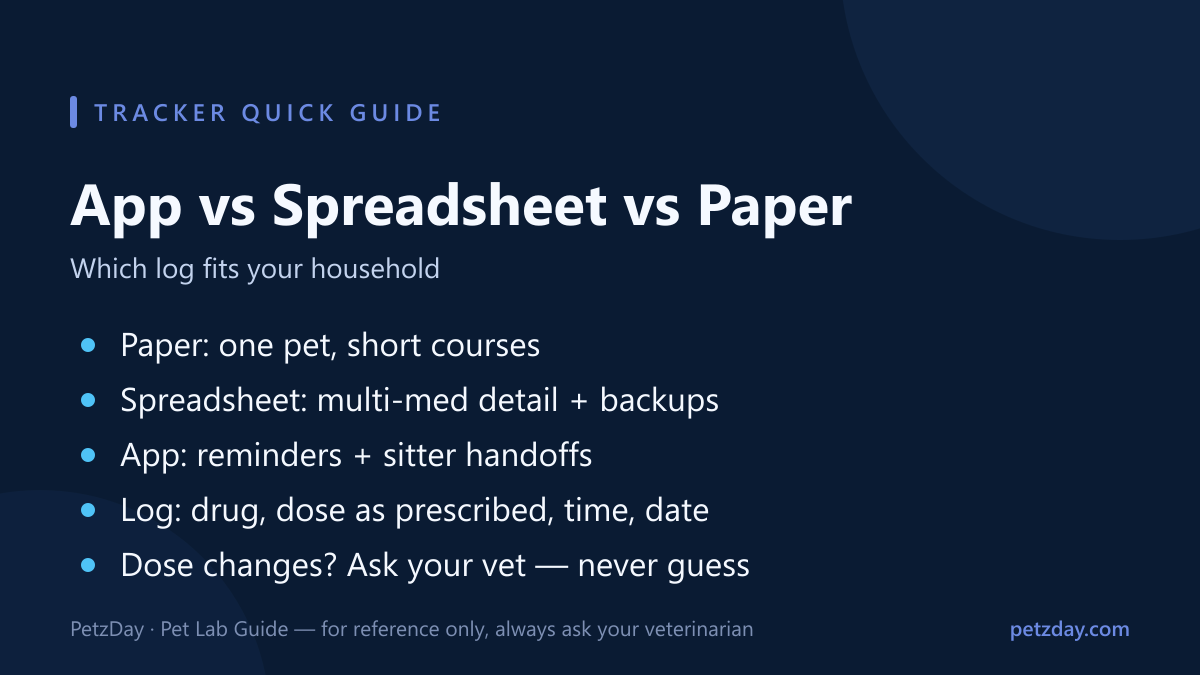
Five lines cover the choice of tool and the daily logging habit.
When an app is worth it — and when it isn't
An app is worth it when you manage several daily medications, when more than one person cares for the pet, or when you need a reminder you will actually follow — and it is not worth it when paper is already working for you. PetzDay is a pet health records and timeline app; its medication area is a log of what was prescribed and given. It is not a pharmacy, it does not send refill requests, it does not diagnose, and it never tells you to change a dose.
PetzDay is the wrong fit if you prefer paper and your routine is stable, if you do not keep a smartphone nearby, or if you are looking for an app to decide dosing — that is exactly the job no responsible tool should do. For a single short antibiotic course, a sticky note is genuinely enough. We would rather you keep a system you actually use than adopt ours out of guilt.
What a tracker can't do
A tracker is a record, not a decision tool — it cannot tell you whether a dose is right, and it cannot treat a reaction.
- Missed dose: do not double up on your own; call your vet and ask what to do for that specific medication.
- Possible reaction: vomiting, diarrhea, swelling, or unusual sleepiness after a new medication warrants a call to your vet.
- Dose questions: the label and your vet's written instructions are the authority, not the tracker.
Keep the tracker in its lane: it documents care so the right person can make the call.
How to keep the log where you'll actually use it
Put the log where the medication lives — paper taped inside the cabinet, a spreadsheet saved to your phone's home screen, or an app you open at the same time every day. Update it the moment you give the dose, not hours later. When you hand your pet to a sitter, pair the tracker with a pet sitter instructions template so the medication line matches the sheet they take home, and keep the log next to your organized pet records so a new vet sees the whole history at once. Create a free PetzDay account to build the timeline, or browse all articles.
FAQ
Is there a free pet medication tracker?
Yes. Paper is free, a spreadsheet is free with an account on most online tools, and many apps offer a free tier. Free tiers often limit reminders, multiple pets, or history, so check what the free version actually includes before you commit.
What should a pet medication log include?
Drug name and strength, dose and frequency as prescribed, date and time given, start and end dates, the prescribing vet, and refill information. Copy every field from the label or written instructions rather than memory.
Can I use a spreadsheet to track my pet's medication?
Yes. A spreadsheet fits multiple pets or long medication lists, and an online sheet is backed up automatically. The limitation is manual entry — no built-in reminders, and the record is only as accurate as what you type.
What is the best way to remember my pet's medicine every day?
Pair the dose with a fixed daily routine — a meal, a walk, or your own medication — and add a phone reminder or an app alert as a backup. A reminder only works if it is tied to something you already do every day.
References
- VCA Hospitals — Know Your Pet
- AVMA — Pet care resources for owners
- Merck Veterinary Manual — Dog Owners
- Merck Veterinary Manual — Cat Owners
Last reviewed: November 3, 2026. This article is for general education and does not replace an examination by your veterinarian.