How to Get Your Pet's Vet Records (and Keep Them in One Place)
Most vet records are one phone call, portal request, or signed form away — including vaccine certificates and lab reports from chains like Banfield and Vetco. Here's how to get copies of your pet vet records online, what to ask for, and how to keep every page in one place.
Getting your pet's vet records usually takes one of three routes: a call or portal request to each clinic, a written records-release form, or asking your new veterinarian to request them for you. Once you have the copies, keep them together — vaccine certificates, visit notes, and lab reports — so you are not rebuilding the whole history during a midnight emergency visit. This guide covers each request path, how chains like Banfield and Vetco handle records, and a five-item list to save first.

Request your pet's vet records once, then keep every page in one place you can find fast.
How to get your pet vet records online
The fastest way to get your pet vet records online is usually the clinic's client portal, followed by a quick call or email asking for a copy — many practices can send a summary or vaccination certificate within a few business days.
Try the request paths in this order:
- Client portal or app. If your clinic uses an online portal, log in and look for "records," "documents," or "visit history." What you can download varies, so a follow-up call is often still needed.
- Call or email the clinic. Ask specifically for "a copy of the full medical record, including visit notes, lab results, and vaccination certificates." Saying "full record" instead of "just the shots" matters, because the shot list is only part of the file.
- Signed release form. Some practices require a written request — especially to send records directly to another veterinarian — and may ask for proof that you are the owner.
- Let the new vet request it. A new clinic's front desk can request the records for you — practices do this routinely, removing you from the middle of the fax or portal exchange.
In the United States, the physical medical record generally belongs to the veterinary practice, but owners are entitled to ask for a copy of their pet's records (AVMA). Timelines and any copying fee are set at the state level, so if nothing arrives within a week or two, call back and ask what the clinic needs to complete the release.
What your vet records actually include
A complete record is more than a vaccine list — ask for the whole file, then organize the parts you will actually use.
- Vaccination and shot certificates. Names, dates, and who gave each vaccine. The rabies certificate in particular is often treated as a legal document for licensing, travel, and boarding (AVMA).
- Visit notes (SOAP notes). The veterinarian's notes from each exam — symptoms, findings, recommendations, and the plan. This is the context that a new vet needs most.
- Lab reports with reference ranges. Each laboratory sets its own normal ranges, so keep the full report rather than just the number (eClinPath, Cornell University).
- Imaging and procedure reports. X-ray or ultrasound interpretations, dental charts, and anesthesia notes if the clinic provides them.
- Prescription and microchip information. Current medications with doses, plus the microchip number and the registry it is enrolled in.
If all you need right now is proof of shots — for a kennel, a groomer, or a license — ask for the vaccination certificate or a shot summary first; it is the piece clinics can usually send fastest.
Getting records from chain clinics: Banfield, Petco Vetco, and more
Chain clinics keep records in their own systems, so the request path depends on where your pet was actually seen. The rule is the same everywhere: contact that location and ask for a complete copy — not just a reminder card.
- Banfield pet records. Banfield hospitals provide records through their client portal (the MyBanfield app or website) and by request from the hospital where your pet was seen. You can ask for the full medical record, and the practice publishes its records-request information in its pet healthcare resources (Banfield). If you moved, any Banfield location can help you reach the right team.
- Petco Vetco / Vetco pet records. Vetco clinics operate inside many Petco stores and focus heavily on vaccinations, so shot records are the most common request. The certificate or visit summary from the appointment usually has the clinic's contact information and your pet's ID — keep it, because that information makes a follow-up request much faster. For a full copy, contact the Vetco location directly.
- Any other chain. Find the location's phone or portal, ask what they need, and follow up if nothing arrives within a week or two.
We are not affiliated with Banfield, Petco, or Vetco; the steps above are what these chains describe publicly, and they change — confirm on their site or by phone.
Vet records quick reference: request these five first
When you request records, five items cover almost every situation — a new vet, a move, boarding, or an emergency.
- Vaccination and shot certificates — with dates and product names (AVMA).
- Visit notes (SOAP notes) — from each clinic that has seen your pet.
- Lab reports — the full report with the lab's reference range (eClinPath).
- Imaging reports and anesthesia or dental notes — if any procedures were done.
- Microchip number and current prescription list — including doses and start dates.
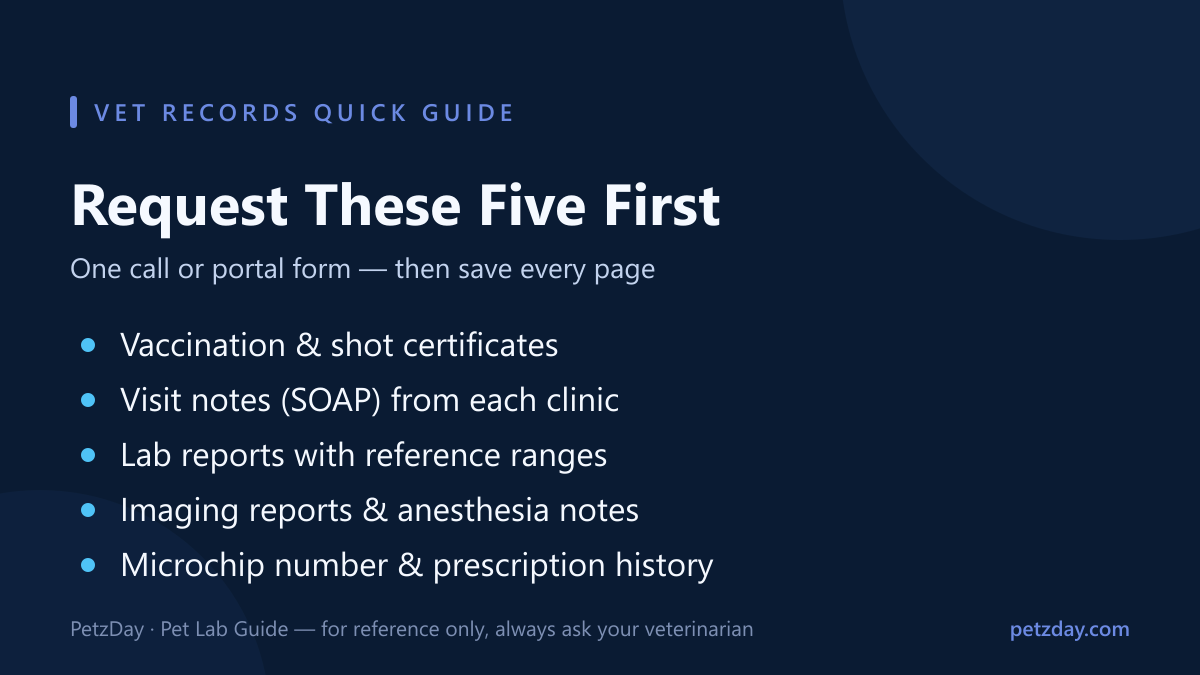
Five records cover most vet visits, moves, and emergencies.
How to keep them in one place
Copies only help if you can find them. Keep one portable master file — paper or digital — and update it after every visit.
- Scan or photograph every page the day it arrives, and label files by date and type (for example, "2026-10-14-rabies-certificate").
- Keep lab reports whole. Do not cut them down to one number; the lab's reference range travels with the report (eClinPath).
- Store a one-page summary with vaccines, medications, diagnoses, allergies, and microchip details, so you can hand a new vet the essentials in seconds.
- Keep official copies too. Your own file is a convenience; the clinic's official record remains the source of truth. Request copies from each clinic and keep both.
- Update after every visit. New vaccine, new dose, new result — add it the same day while the details are fresh.
A folder works. A digital master record helps when the clinic is closed and you are standing in an emergency lobby at midnight. PetzDay is a free way to keep results, dates, and notes in one shareable timeline on your phone — but it is your side of the story, not a replacement for the official records each clinic keeps. For the system behind a multi-vet history, read how to organize pet records when you see multiple vets, and if the pages are full of lab values, our guide to dog blood test results helps you read them. Create a free PetzDay account or browse all articles.
FAQ
How do I get my dog's shot records online?
"Dog shot records online" usually means the vaccination certificate a clinic emails you or a portal where you can view the history. Ask the clinic to email the vaccination record; if your dog was seen at a chain, check its portal. Confirm the rabies certificate is included — many states, kennels, and airlines require it (AVMA).
Can I get my pet's vet records online for free?
Many clinics provide a vaccination certificate or visit summary at no charge, while some states allow a reasonable copying fee for a full record. Ask about any fee up front so there are no surprises, and request the summary first if you are in a hurry.
Who owns my pet's vet records?
In the United States, the physical medical record generally belongs to the veterinary practice, but owners are entitled to request copies for their pet. Timelines and fees vary by state, so ask the clinic or your state's veterinary board what applies where you live (AVMA).
How long do vets keep pet records?
Retention rules vary by state and by practice, so there is no single number. On your side, keep copies for your pet's life — old values and dates are useful baselines when a new vet reviews the history years later.
What if I do not remember which vet gave a vaccine?
Start with the microchip registry and any boarding, grooming, or travel records you still have, then call the clinics you think were involved and ask for the vaccination history. The rabies certificate, if you kept it, lists the administering veterinarian.
References
- AVMA — Pet owners: pet care resources
- AVMA — Vaccinating your pet
- eClinPath (Cornell University) — Hematology
- VCA Animal Hospitals — Know Your Pet
- Merck Veterinary Manual — Dog Owners
- Banfield Pet Hospital — Pet healthcare resources
All web sources accessed October 2026.
Last reviewed: October 14, 2026. This article is for general education and does not replace an examination by your veterinarian. Follow your vet's guidance for all vaccination, testing, medication, and treatment decisions.