Glucose Meters for Diabetic Cats: AlphaTRAK 3 vs PetTest vs a Human Meter
A blood glucose meter for cats isn't a one-size pick — AlphaTRAK 3 and PetTest are calibrated for pets, while human meters like CONTOUR NEXT are not. Here's how the three compare on price, sample size, accuracy research, and daily use (snapshot: October 2026).
For most diabetic cats the choice is pet-calibrated versus human: feline studies and veterinary protocols center on cat-calibrated meters like AlphaTRAK 3 ($77 starter kit, $59.72 per 50 strips, October 2026) and PetTest ($59.95 kit, $49.95 per 50 strips); human meters like CONTOUR NEXT are widely available but not calibrated or labeled for cats. Schedules and insulin decisions stay with your vet; this guide compares hardware only.
How we put this together. Public information only: manufacturer specifications, public retail pricing, published validation studies, and public review summaries where available. We did not conduct hands-on testing. Snapshot: October 2026; specs and prices change — verify before buying.
This post contains affiliate links. If you buy through them, we may earn a commission at no extra cost to you.
Public specs, prices, and research; October 2026 snapshot.
Why meter choice matters for cats
Meter choice affects the numbers your vet reads, and those numbers feed decisions only your vet should make. At-home testing exists to build curves: readings through the day showing how your cat responds to their current plan. Different meters can read the same drop of blood differently, so a curve only means something when built on one consistent device. New to curves? Our glucose curve and fructosamine guide explains how vets read them.
The three options at a glance
Three options dominate home testing for cats: two pet-calibrated meters, AlphaTrak 3 (Zoetis) and PetTest, plus human OTC meters like the CONTOUR NEXT line (Ascensia). Prices verified October 10, 2026.
AlphaTrak 3 (Zoetis)
- Price: $77.23 starter kit; 50 strips $59.72 (≈$1.19 per test), VetRxDirect, October 2026
- Specs and data: 0.3 µL; 5 seconds or less; calibrated for dogs, cats, and horses (manufacturer); in-app capture for your vet
PetTest
- Price: $59.95 Classic kit with 25 strips; 50 strips $49.95 (≈$1.00 per test); 35 strips $29.95 (≈$0.86), official store, October 2026
- Specs and data: 0.3 µL; 5 seconds; dog/cat switch; foil-wrapped strips; 400-reading memory, 7/14/28-day averages, downloads for your vet
CONTOUR NEXT (human OTC example)
- Price: pharmacies and mass retailers (prices vary — check current listings)
- Specs and data: small sample drop; results "in seconds"; not calibrated/labeled for pets; CONTOUR app; Second-Chance sampling avoids wasted strips
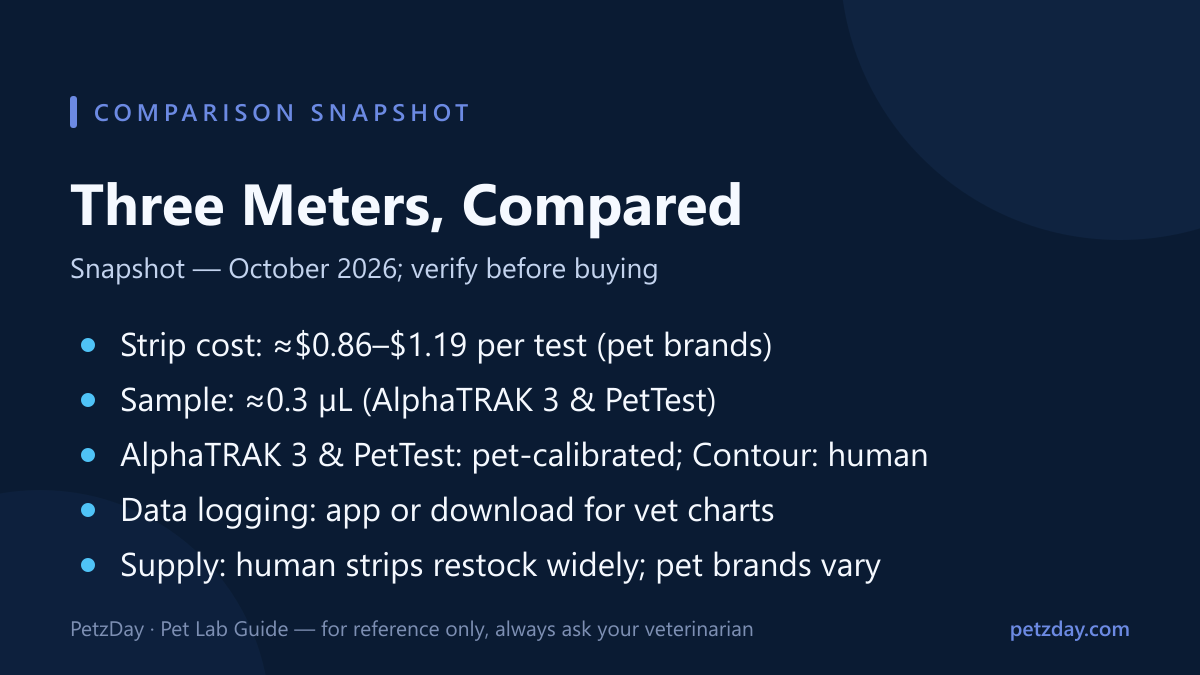
Strip cost, sample size, calibration, data, and supply at a glance.
Accuracy: what published studies show
Veterinary-calibrated meters have performed consistently well in cats in published studies; human meters spread wider by device, from clinically acceptable to clearly biased.
- Five portable meters, 200 cats (Wess & Reusch, 2000): biggest differences at high glucose, small in low and normal ranges; 4 of 5 meters placed 100% of readings (one, 98.7%) in the clinically acceptable error-grid zone; samples under 3 µL caused errors in three meters; low hematocrit made all five overestimate.
- Veterinary-calibrated meter, 64 cats (Cammarano et al., 2024): met human accuracy standards (ISO 15197:2013) for 95% of feline samples; 97% of readings clinically accurate with no expected treatment changes.
- Veterinary meter with hematocrit correction, 31 cats (Mori et al., 2017): average difference from the lab reference about 1.3 mg/dL; hematocrit did not skew results.
Takeaway: human-meter readings in dogs and cats commonly run lower than lab values, and human-meter performance in cats varies by device (see the FAQ), so performance in people doesn't predict performance in cats. Strongest footing: feline validation, or a meter your vet trusts. (Zoetis's "more accurate" claim is marketing, not an independent trial.)
Ongoing cost: do the math
Strips, not the meter, are the recurring cost; for the two pet meters we priced, a test runs about $0.86–$1.19.
- Per-test strip cost: AlphaTrak 3: $59.72 ÷ 50 = $1.19. PetTest: $49.95 ÷ 50 = $1.00; $29.95 ÷ 35 = $0.86.
- Tests per month: 2–4 checks a day, about 60–120 tests.
- Monthly strip cost: AlphaTrak 3 ≈ $71–$143; PetTest ≈ $52–$120.
Example math, not a promise: many owners test less on most days and frequency is your vet's call. Strips expire, so bulk boxes only pay off in time; some pharmacies require vet authorization for the meter (VetRxDirect notes this). For a human meter, run your pharmacy's prices through the same math, after your vet OKs it.
Day-to-day use
All three do the core job (small drop, fast number) but differ in handling.
- Speed and sample: the pet meters read in 5 seconds or less and need about 0.3 µL, a help on a reluctant ear; human-meter sample volumes vary by model.
- Data: AlphaTrak 3 captures readings in-app; PetTest exports 400-reading histories with 7/14/28-day averages; CONTOUR NEXT pairs with its app and allows Second-Chance re-fills.
- Context: readings mean more with dates, insulin times, appetite, and water intake attached. PetzDay logs that in one timeline (create a free account); plainly, it stores what you enter, doesn't connect to your meter, and isn't a replacement for your vet's records. Browse our library.
Availability and long-term supply
A meter you can't feed with strips stops being useful: human meters restock anywhere (pharmacies, mass retail), while pet-brand strips run through veterinary clinics and online pet retailers (Chewy, Amazon, veterinary pharmacies), with real stock variation.
- AlphaTrak 3: veterinary clinics and online veterinary retailers; some listings require vet authorization, and we saw items out of stock at VetRxDirect in October 2026.
- PetTest: mainly its official online store and online retailers, in 35- and 50-count boxes.
- CONTOUR NEXT: widest availability, but only useful for cats with your vet's approval.
Keep one unopened spare box if you test daily; follow storage instructions; don't stockpile past expiry.
Who should pick which
No single meter fits every household; start from your vet's protocol, then match trade-offs.
- Accuracy-first: unstable readings or detailed curves point to a pet-calibrated meter; AlphaTrak 3 is the most embedded in veterinary channels, and matching your clinic keeps numbers comparable.
- Budget-first: PetTest cuts per-test cost to $0.86–$1.00 with pet calibration and a fast 0.3 µL workflow; trade-offs: smaller brand ecosystem, less clinic presence. Tell your vet you're using it.
- Data-logging-first: choose by where numbers land (AlphaTrak app, PetTest downloads, CONTOUR app), or consolidate labs, meds, and other conditions like kidney disease tracking in one timeline.
When none of these is right: don't switch meters or strip brands mid-protocol without asking your vet; curves assume a consistent device. If cost blocks you, ask your clinic about assistance before unfamiliar online deals; if your vet has a device in mind, that overrides this guide; and "a human meter is the same thing" is false until your vet signs off.
Limitations & what to check before buying
This guide compares public information; it is not lab testing, and not advice about your cat. We did not conduct hands-on testing, and we left user-review scores out entirely: no stable source existed at snapshot, and invented review data is worse than none.
- Studies are device- and year-specific: direction, not a guarantee.
- Real-world accuracy also depends on technique: warm ear, adequate drop, labeled storage, within expiry.
- Before buying, check: price; strip expiry and storage; kit contents; whether your vet wants a specific model; mg/dL display.
FAQ
Can I use a human glucose meter for my cat?
Sometimes, with your vet's sign-off. Human meters are labeled for people, and studies in cats show mixed results: acceptable treatment decisions in some trials, but systematic bias, with agreement from poor to substantial by device (Domori et al., 2014; Wess & Reusch, 2000). Ask your vet before making one your cat's main device.
How often should I test?
Your vet sets the schedule; it depends on your cat's insulin plan, how stable their glucose has been, and whether you're doing a spot check or a full-day curve. Ask your vet to put the frequency in your protocol, including when to test extra and when to call with readings.
Do test strips expire?
Yes, and expired strips can give wrong readings. AlphaTrak's guidance says expired strips cannot guarantee accurate results and should be discarded; Ascensia's instructions say strips are usable until the printed date on the packet, bottle, or carton. PetTest's foil-wrapped strips avoid the opened-vial expiry clock but still carry printed dates. Check before buying a large box.
References
- Zoetis — AlphaTrak 3 — specs, strip expiry (Oct 2026)
- VetRxDirect — AlphaTrak3 (OTC) — $77.23 kit; $59.72 per 50 strips
- PetTest — Classic Meter Kit — $59.95 (Oct 2026)
- PetTest — 50 ct Test Strips — $49.95 (Oct 2026)
- Ascensia — CONTOUR NEXT Test Strips — human OTC labeling, app, Second-Chance sampling
- Ascensia — CONTOUR NEXT insert, PDF — "intended for self-testing by persons with diabetes"; storage and expiry
- Wess & Reusch, Am J Vet Res, 2000 — five portable meters in cats
- Cammarano et al., Am J Vet Res, 2024 — veterinary-calibrated glucometer
- Mori et al., J Vet Med Sci, 2017 — meter with hematocrit correction
- Domori et al., Vet Clin Pathol, 2014 — two human meters (PubMed)
Last reviewed: October 10, 2026. For general education only; not a replacement for an examination by your veterinarian. Follow your vet's protocol for all testing, dosing, and treatment decisions.