Canine Titer Test for Dogs and Cats: Rabies, Cost and Travel Rules
A canine titer test for rabies is a blood test run at an approved laboratory: the federal endorsement of the paperwork costs $101 or $160, results take about 10 days to a month, and the vaccine-to-sample gap decides your departure date.
A rabies titer test — the canine titer test most owners find when a destination asks for "rabies serology" — is a blood test that measures rabies-neutralizing antibody in serum, reported in IU/mL, with 0.50 IU/mL as the usual travel pass mark. Results take 10 days to a month, and the only published federal price is APHIS's $101 or $160 endorsement of the health certificate that carries them.
Certificate logistics are in our health certificate guide; this covers the test itself.
A titer is only as good as the draw, the tube label and the lab the destination accepts.
Canine titer test: what the lab actually measures
A titer measures one thing — how much rabies-neutralizing antibody is in the blood on the day of the draw — and the destination decides what number passes.
The travel test is the FAVN test (fluorescent antibody virus neutralization). Kansas State University's rabies laboratory, a CDC-approved lab, says it measures "the response of an animal's immune system to the rabies vaccine" and that "a titer of greater or equal to 0.50 IU/mL is required for pet travel to rabies-free areas." The EU sets the same bar: neutralising antibody of at least 0.5 IU/ml. Clinic paperwork may call it a blood titer test for dogs; the sample and the threshold are unchanged, and blood titers for dogs and cats run the same way.
Antibody titer test for dogs: what the number means
- 0.50 IU/mL or higher meets the usual threshold — if the lab is on the destination's list and the official report, not an email, carries the result.
- Below 0.50 IU/mL fails the requirement; in the US, revaccinate and draw again 30 days after the booster.
- Not a diagnosis — the number says nothing about whether the dog is unwell.
Canine vaccine titer testing: what it does not prove
A titer is an extra condition on top of vaccination, never a substitute: US re-entry and EU rules both require a valid rabies vaccination, then the serology. A high titer cannot replace a vaccine requirement or extend vaccine validity, so the vaccination records guide matters as much as the report.
Rabies titer test for dogs: the decision table
Most US dog travel does not need a titer; the situations that do are narrow.
| Trip | Titer needed? | Who sets the rule |
|---|---|---|
| Between US states (not Hawaii) | No federal requirement; the receiving state decides | USDA APHIS |
| Hawaii | Yes — passing FAVN plus two rabies vaccinations, with 30-day waits | Hawaiʻi Dept. of Agriculture |
| Returning to the US from a high-risk country, vaccinated abroad | Yes — CDC-approved lab, or a 28-day quarantine | CDC |
| Returning to the US with a US-issued rabies vaccination | No — use the Certification of U.S.-Issued Rabies Vaccination | CDC |
| Entering the EU from outside, unless exempt | Yes — ≥0.5 IU/mL, sample ≥30 days post-vaccination, ≥90 days before the certificate | European Commission |
| "The titer is high, so I'll skip the vaccine" | No — a titer never replaces vaccination | CDC and EU |
APHIS leaves state-to-state rules to the receiving state, which is why Hawaii behaves like a border. The EU exempts certain listed non-EU countries, so check that list first.
Rabies titer test for cats
Cats take the same test at the same threshold, but not every US rule applies to them. The titer test cats need for travel is the same FAVN assay used for dogs. Hawaii requires "two rabies vaccinations within the required timeframe and a passing FAVN test" for "all dogs and cats entering the State of Hawaiʻi," and the EU rule covers dogs, cats and ferrets. CDC's serology requirement is written for dogs, so cat owners should read the CDC import pages rather than assume the dog checklist transfers.
How long a titer test takes
Plan on 10 days to a month for the lab, and start roughly 60 days out — the vaccine-to-sample gap, not the lab bench, breaks schedules.
- Day 0 — rabies vaccination, after the microchip. EU vaccine validity starts 21 days after the primary protocol is completed.
- Day 30 or later — blood draw, per CDC and the EU; sooner after a booster if coverage never lapsed. Missouri VMDL calls roughly 21–30 days after the most recent vaccination the optimal window for measuring response, but for a first vaccination the CDC and EU rules still set a 30-day floor.
- Lab time. Kansas State quotes 10–14 calendar days with no expedited service; Missouri quotes 7–10 business days; Auburn quotes 3–4 weeks; Hawaii warns labs can run 1–2 months behind.
- US re-entry. Sample at least 28 days before arrival; CDC suggests starting 60 days before travel.
- EU entry. The result must be 90-plus days old when the health certificate is issued.
- Hawaii. A 30-day wait after the test and after the latest rabies vaccination.
The binding date is usually the EU's 90-day rule or Hawaii's waits, not lab turnaround.
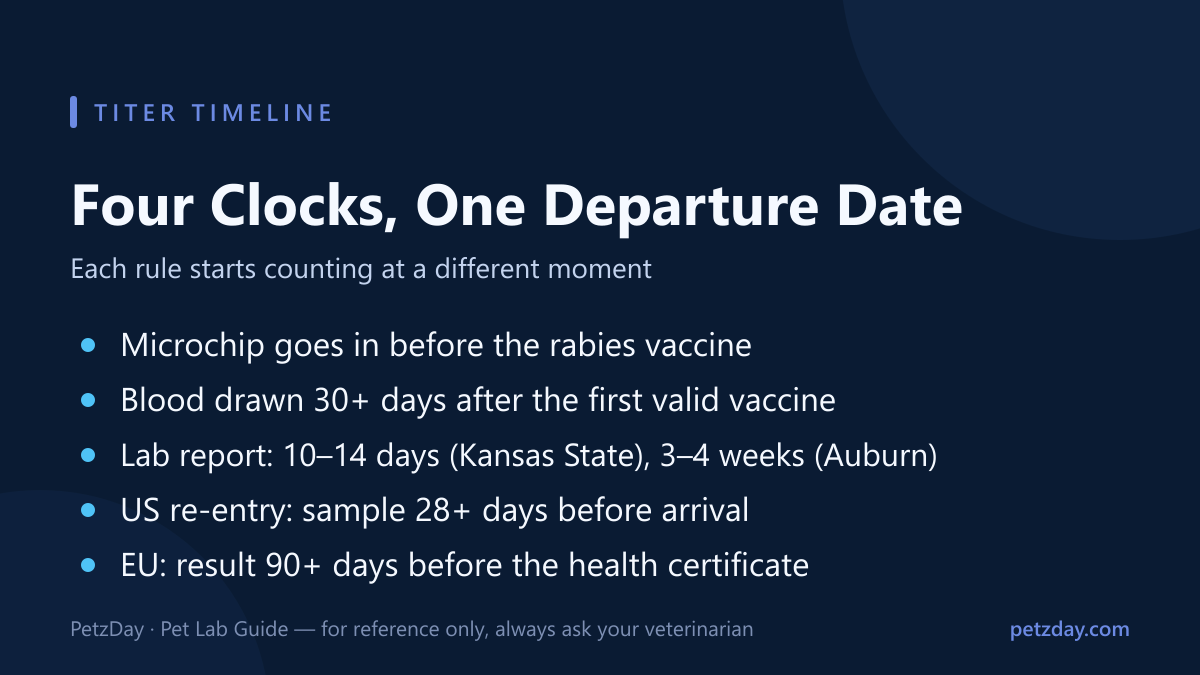
The four clocks that decide a departure date: vaccine, blood draw, lab report, destination waiting period.
How to book it without losing a month
The order matters more than the test.
- Check the microchip date against the vaccine date. CDC requires the microchip first, or the vaccination is invalid.
- Choose the lab before booking. CDC lists approved labs for US entry, the EU lists designated ones, and Hawaii names Kansas State, the DOD lab, Auburn and Missouri.
- Brief the clinic on shipping. Kansas State requires a serum separator tube, 1–2 mL of serum, the tube labeled with the microchip number — "unlabeled tubes are cancelled" — and no lipemic or hemolyzed sample.
What a rabies titer test costs
The cost of a titer test for dogs breaks into four lines, and only the federal one has a published price.
| Line item | Who sets it | US snapshot, November 2026 |
|---|---|---|
| Exam and blood draw | Your clinic | Ask for a written estimate; APHIS fees exclude vet services |
| Lab test (FAVN or RFFIT) | The lab's fee schedule | Ask the lab or clinic |
| Shipping the serum | Courier | Varies with service and distance |
| APHIS endorsement of the health certificate | USDA APHIS | $101; $160 when 1–2 tests or vaccinations must be verified (first animal, +$10 each additional) |
| Hawaii airport release (Honolulu) | Hawaiʻi Dept. of Agriculture | $185; $244 if documents arrive under 10 days before arrival |
| Service dogs | USDA APHIS | No endorsement fee |
The lab fee is the one owners ask about and the one least often published: Kansas State, Missouri and Auburn route pricing through submission forms, so the honest answer is a quote.
Affordable titer testing for dogs: where the money goes
- A sample drawn too soon can show a high number and still fail the rule — you pay twice.
- A redraw after a lapse resets a 30-day clock plus lab time.
- Expedited service is pointless when the destination's wait is longer, and Kansas State offers none.
Reading the result — and the five ways it goes wrong
A passing report gets the dog past a paperwork check; it is not a health certificate and not proof the dog cannot be infected. The failures are administrative and visible weeks ahead: a sample drawn too soon; a microchip implanted after the vaccine, which invalidates it; a lab the destination rejects, which for US entry can mean a 28-day quarantine; an unlabeled or hemolyzed sample; and coverage lapsing before travel.
FAQ
How much does a dog rabies titer test cost?
There is no published national price. APHIS charges $101 to endorse a pet health certificate, or $160 when one or two tests or vaccinations must be verified. Your clinic's exam fee, the lab fee and courier costs are quoted separately — ask for an itemized estimate.
Is there an at-home titer test for dogs?
Not for travel. CDC requires a veterinarian to draw the sample and a CDC-approved lab to test it; the EU requires an authorised veterinarian and a designated laboratory. A mail-in kit may hint at antibody levels, but no border officer accepts it as documentation.
Do cats need a rabies titer test too?
Yes, for the same destinations. Hawaii requires two rabies vaccinations and a passing FAVN for dogs and cats, and the EU rule covers dogs, cats and ferrets. The test, the 0.50 IU/mL threshold and the 30-day gap are identical; only the US re-entry requirement is dog-specific.
Where can I get a titer test for my dog near me?
Start with a vet who handles travel paperwork and can confirm which lab your destination accepts — in the US, a clinic used to sending serum to a CDC-approved laboratory. Ask which lab they use, how they ship, and whether they can issue the health certificate. The same questions apply to a titer test for cats near me.
How long is a rabies titer good for?
For US re-entry, a passing result lasts the life of the dog as long as rabies coverage never lapses and the lab stays approved. Under EU rules it need not be repeated if the dog is revaccinated within the previous vaccination's validity. A lapse resets both.
What happens if the titer comes back below 0.50 IU/mL?
The dog is revaccinated and blood is drawn again at least 30 days after the booster, per CDC. That resets your timeline, so a low result close to departure is the expensive outcome: another lab fee, another wait, possibly changed flights.
Keep the report with the rest of the records
Store the stickered lab report, the vaccination certificate, the microchip number and the destination's current page together.
PetzDay keeps vaccination dates, microchip numbers and lab results in one place you can open at the clinic or at check-in — create a free account and add your dog's rabies records before you book. More guides are in the article library, and wider planning is in our 2026 travel guide.
References
- CDC — Entry requirements for foreign-vaccinated dogs from high-risk countries
- CDC — Approved rabies serology laboratories
- CDC — Entry requirements for U.S.-vaccinated dogs from high-risk countries
- European Commission — Bringing a pet into the EU from a non-EU country
- Hawaiʻi Department of Agriculture — Animal quarantine information
- USDA APHIS — Interstate movement of pets
- USDA APHIS — Cost to endorse your pet's health certificate
- USDA APHIS — Veterinary Services import/export user fees
- Kansas State University Rabies Laboratory — FAVN test
- Kansas State University Rabies Laboratory — Sample collection and shipping
- Auburn University — Rabies serology (FAVN/RFFIT)
- University of Missouri VMDL — Rabies antibody by FAVN
- University of Missouri VMDL — FAVN for export
- Merck Veterinary Manual — Rabies in animals
All web sources accessed November 2026. Rabies entry rules change; confirm the current requirements with the destination authority before booking.
Last reviewed: November 28, 2026. This article is for general information and does not replace veterinary advice for your dog.